Weed Control
Pre-Emergent vs Post-Emergent Herbicide: What Is the Difference?
Quick answer
Pre-emergent herbicide stops weed seeds from establishing and must go down before they sprout, when soil holds about 55 F for several days; it does nothing to weeds already growing. Post-emergent herbicide kills weeds you can see. Most lawns need both: a pre-emergent like Scotts Halts for crabgrass, and a post-emergent for what gets through.

Scotts Halts Crabgrass and Grassy Weed Preventer, 20.12 lb
$49.02A granular crabgrass preventer for 10,000 sq ft with no fertilizer mixed in.
Best for: spring crabgrass prevention with a spreader
Check price on Amazon
BASF Drive XLR8 Crabgrass Killer Concentrate, 64 oz
$55.45A quinclorac concentrate labeled for crabgrass that has already come up.
Best for: killing crabgrass that already came up
Check price on AmazonA pre-emergent herbicide forms a treated zone in the top of the soil that controls weed seedlings as they germinate. It works only on weeds that grow from seed each year, such as crabgrass, foxtail, goosegrass and spurge, and only if it is in place and activated before germination. A post-emergent herbicide is absorbed by weeds that are already growing. Selective post-emergents kill certain weeds without killing listed turf grasses; non-selective ones such as glyphosate kill everything green.
They are not substitutes. Pre-emergent is prevention for annual grassy weeds; post-emergent is the cure for perennial broadleaf weeds like dandelions and for any annual weed that escaped. The practical program for most lawns is a granular preventer such as Scotts Halts ($49.02) at the right soil temperature, then spot treatment with a post-emergent such as Drive XLR8 ($55.45) for crabgrass or Ortho WeedClear for broadleaf weeds. Timing detail is in when to apply pre-emergent.
On this page
- How does pre-emergent compare with post-emergent?
- Which do you need, pre-emergent or post-emergent?
- When should you apply pre-emergent for crabgrass?
- Which post-emergent works on which weed?
- Is weed and feed a pre-emergent or post-emergent?
- Why did my pre-emergent fail?
- Pre-emergent and post-emergent products to consider
How does pre-emergent compare with post-emergent?
| Factor | Pre-emergent | Post-emergent |
|---|---|---|
| When to apply | Before weed seeds germinate | After weeds are up and actively growing |
| Timing cue | Soil at about 55 F for several days (crabgrass) | Young, actively growing weeds; not during drought stress |
| What it controls | Annual weeds from seed: crabgrass, foxtail, goosegrass, spurge | Visible weeds, including perennials like dandelion and clover |
| Effect on existing weeds | None, with a few exceptions noted on labels | Kills them |
| How it works | Treated layer in the top of the soil | Absorbed by leaves, and roots for some products |
| Water | Most need rain or irrigation to activate; follow the label | Needs time on dry leaves; Drive XLR8 is rainfast in under an hour, Spectracide Weed Stop in 6 hours |
| New grass seed | Most also stop grass seed for the label interval | Many allow reseeding after a label interval |
| How long it lasts | Weeks to months; Lesco Stonewall lists up to 4 months | Kills what is present; Drive XLR8 lists up to 30 days residual |
| Granular example | Scotts Halts; Lesco 0-0-7 Stonewall | Scotts Weed and Feed5 (broadleaf) |
| Liquid example | Quali-Pro Prodiamine 65 WDG | Drive XLR8; Ortho WeedClear |
Details from product listings. Labels vary by active ingredient and turf type; the label on your product governs.
Which do you need, pre-emergent or post-emergent?
Use a pre-emergent if:
- Crabgrass, foxtail or spurge filled your lawn last summer, so seed is in the soil.
- You are not planning to seed the lawn in the coming weeks.
- You can apply it on time, before soil reaches germination temperature.
- You have a warm-season lawn with winter annual weeds such as poa annua, henbit and chickweed, which call for a fall pre-emergent.
Use a post-emergent if:
- Weeds are already visible.
- Your problem is perennial broadleaf weeds such as dandelion, clover or plantain, which pre-emergents do not stop.
- You have nutsedge, which spreads from tubers and needs a sedge product.
- Crabgrass escaped your pre-emergent and needs to be knocked out while young.
When should you apply pre-emergent for crabgrass?
When soil at a 2 in depth holds about 55 F for several days, which in much of the country lines up with early spring as forsythia finishes blooming. Crabgrass germination rises as soil warms past that point, so the product must already be down and watered in. A soil thermometer or a state extension soil temperature map beats the calendar, because the date shifts by weeks between a warm year and a cold one and between a sunny south slope and a shaded north lawn.
Many labels allow a split application, half the rate at the normal time and the rest several weeks later, which extends control through summer; prodiamine products such as Quali-Pro Prodiamine are commonly used this way and tank-mix with fertilizer. In warm-season lawns, a late summer to early fall application targets poa annua and other winter annuals. See crabgrass for identification and the best crabgrass preventers.
Which post-emergent works on which weed?
Match the product to the weed and to your grass type, because selective herbicides are labeled for specific turf species and some injure others, such as St. Augustine. The table covers the common lawn weeds; pages for dandelion and yellow nutsedge go deeper.
| Weed | Type | Product type | Catalog example |
|---|---|---|---|
| Crabgrass, foxtail | Annual grass | Quinclorac | BASF Drive XLR8 |
| Crabgrass, nutsedge, some broadleaves | Mixed | Mesotrione (pre and post activity) | Syngenta Tenacity |
| Dandelion, clover, plantain | Perennial broadleaf | Selective broadleaf mix | Ortho WeedClear, Spectracide Weed Stop |
| Yellow and purple nutsedge | Sedge | Sedge herbicide | Sedgehammer Plus, Ortho Nutsedge Killer |
| Everything, for lawn renovation | Non-selective | Glyphosate (kills turf too) | Roundup Weed and Grass Killer4 |
Always confirm your grass type is listed on the label before applying.
Is weed and feed a pre-emergent or post-emergent?
It depends on the bag. Scotts Weed and Feed5 is fertilizer plus a post-emergent broadleaf control, applied to a wet lawn so granules stick to growing weeds. Other combination bags pair fertilizer with a crabgrass pre-emergent. The honest problem with combination products is timing: the best moment to feed grass and the best moment to kill or prevent weeds do not always line up, so one of the two jobs is often mistimed, and you spread herbicide over the whole lawn when a few weeds needed spot treatment. Separate products applied at the right time generally work better.
Why did my pre-emergent fail?
The usual causes: it went down after crabgrass had already germinated; it was never watered in; gaps between spreader passes left untreated strips; aeration or dethatching after application broke the treated layer; the rate was cut to stretch a bag; or the weed was a perennial like dandelion or nutsedge that pre-emergents do not control. Fix the timing and coverage next season, and use a post-emergent on young escapes now.
Pre-emergent and post-emergent products to consider
More in the best crabgrass preventers and best weed killers for lawns.
Scotts Halts Crabgrass and Grassy Weed Preventer, 20.12 lb
$49.02A granular preventer for crabgrass, foxtail and spurge applied to a dry lawn, with 10,000 sq ft of coverage and no fertilizer mixed in, so timing is not tied to a feeding.
Best for: spring crabgrass prevention with a spreader
Check price on Amazon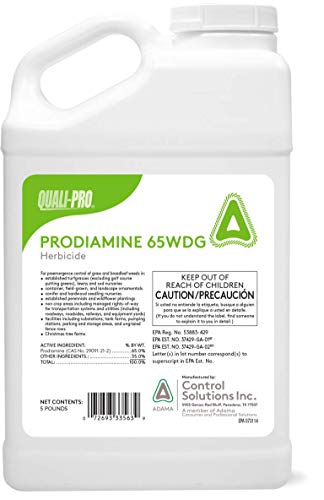
Quali-Pro Prodiamine 65 WDG Pre-Emergent Herbicide, 5 lb
$77.00A sprayable 65 percent prodiamine for spring and fall use against crabgrass, poa annua, henbit, chickweed and spurge that tank-mixes with fertilizer and iron.
Best for: sprayer owners with large lawns
Check price on Amazon BASF Drive XLR8 Crabgrass Killer Concentrate, 64 oz
$55.45A water-based quinclorac labeled for crabgrass, foxtail and key broadleaves on warm and cool-season turf, rainfast in under an hour.
Best for: crabgrass that already came up
Check price on Amazon
Ortho WeedClear Weed Killer for Lawns Concentrate, 1 gal
$36.29A concentrate labeled for over 250 broadleaf weeds including dandelion and clover on most turf types, treating up to 64,000 sq ft; not for Floratam St. Augustine.
Best for: dandelions and clover
Check price on AmazonHow we chose
We did not test these products in person. Picks are researched from manufacturer specifications and owner manuals, engine and safety certifications where they apply, warranty terms, public recall records, and the recurring themes in verified owner reviews. We favor established brands with large review counts and parts support, match each pick to a real yard size or task, and place it in the tier where its price and capability actually belong.
Frequently asked questions
Can I apply pre-emergent and post-emergent at the same time?
Often yes, if both labels allow it. Many lawn programs apply a pre-emergent for crabgrass while spot-spraying broadleaf weeds with a post-emergent. Tank-mix only products whose labels permit the combination, and follow the most restrictive label for rates, grass types and re-entry. Some products, such as Tenacity, carry both pre and post-emergent activity in a single active ingredient.
Will pre-emergent kill existing crabgrass?
Generally no. Pre-emergents act on germinating seedlings, so crabgrass that is already up keeps growing. A few active ingredients, such as dithiopyr, have some early post-emergent activity on very young crabgrass, and labels say so when that applies. For established crabgrass, use a post-emergent labeled for it, like Drive XLR8 with quinclorac, while plants are still small.
Can I seed grass after applying pre-emergent?
Usually not for a while. Most pre-emergents also stop grass seed from establishing, and labels list a waiting period before seeding that can run from weeks to months. Plan ahead: if you intend to overseed in fall, skip a fall pre-emergent on those areas. Check your product label for its seeding interval, and see how to overseed a lawn.
What soil temperature should I apply pre-emergent?
Apply crabgrass pre-emergent before soil at a 2 in depth holds about 55 F for several days, since germination increases as soil warms past that. Use a soil thermometer or your state extension soil temperature map instead of a fixed date, and water it in as the label directs. Many labels allow a second, split application weeks later to extend control through summer.
Is Tenacity a pre-emergent or post-emergent?
Both. Syngenta Tenacity contains mesotrione, which has pre-emergent and post-emergent activity; its listed targets include crabgrass, clover, dandelion and yellow nutsedge. Treated weeds often turn white before dying. It is labeled for specific turf species and not others, so confirm your grass type on the label and follow its rates, surfactant instructions and intervals exactly.
Researched, not professional advice. This page is compiled from published specifications, manuals, labels and owner-review consensus, not hands-on testing. Follow the manufacturer's instructions and product label, and consult a qualified professional where safety, chemicals, fuel or structures are involved. As an Amazon Associate we earn from qualifying purchases.