Lighting and Exterior
Solar vs Low-Voltage Landscape Lights: Which Is Worth It?
Quick answer
Choose low-voltage lighting if you want reliable, bright, all-night light every night: a 12 V system like the Malibu 150W kit runs from a plug-in transformer with a timer. Choose solar for dim accent and path marking where running wire is impractical: the Mancra 8-pack installs in minutes, but output depends on daily sun.

Mancra Solar Pathway Lights (8-Pack)
$39.99Push-in stakes, no wiring, no running cost.
Best for: lighting a path where running wire is impractical
Check price on Amazon
Malibu 10-Light Low Voltage Landscape Kit with 150W Transformer
$259.99Transformer, wire, path lights and spotlights in one box.
Best for: a first wired landscape lighting install
Check price on AmazonSolar landscape lights each carry a small panel and battery that charge by day and switch on at dusk. Low-voltage landscape lights, often called hardwired, run from a transformer that plugs into an outdoor outlet and steps 120 V household power down to about 12 V, sent through direct-burial cable to each fixture. Low voltage is safe for homeowner installation in most cases; true 120 V line-voltage fixtures are electrician work.
The Mancra Solar Pathway Lights (8-Pack) is $39.99 for eight lights; the Malibu 10-Light Low Voltage Landscape Kit with 150W Transformer is $259.99 for ten fixtures, transformer and 75 ft of wire. Size any wired system with the landscape lighting transformer calculator.
On this page
- How do solar and low-voltage landscape lights compare?
- Which should you choose, solar or low-voltage?
- Are solar landscape lights bright enough?
- How do low-voltage landscape lights work, and what transformer do I need?
- What does low-voltage landscape lighting cost to run?
- Do low-voltage landscape lights need an electrician?
- Which solar and low-voltage lights are worth buying?
How do solar and low-voltage landscape lights compare?
| Factor | Solar | Low-voltage (12 V) |
|---|---|---|
| Example | Mancra solar path lights, 8-pack, $39.99 | Malibu 10-light kit with 150W transformer, $259.99 |
| Power source | Panel on each light, 800 mAh battery | 120 V outlet to transformer, 12 V to fixtures |
| Install | Push stakes into the ground | Lay cable, connect fixtures, plug transformer into a GFCI outlet |
| Light output | Warm 3000K filament-style LED; lumens not published | 6 path lights at 10 W and 4 spotlights at 20 W, halogen |
| Nightly reliability | Varies with sun; shorter after cloudy days and in winter | Same every night; photocell or timer controlled |
| Placement | Panel needs direct sun | Anywhere the cable reaches |
| Light types | Path and small accent | Path, spotlights, uplighting trees and walls |
| Running cost | None | Kit uses 140 W: about $52 a year at 6 hours a night |
| LED version cost | Not applicable | 8 Lumina 3 W LED path lights: about $9 a year |
| Wear item | Battery capacity fades over time | Replaceable bulbs; transformer lasts longer |
| Materials | ABS shell, glass shade, stainless pole | Metal fixtures |
Running cost uses electricity at $0.17 per kWh and 6 hours per night, 365 nights. Use your own rate.
Which should you choose, solar or low-voltage?
Choose solar landscape lights if
- You want to mark a path or garden edge this afternoon with no wiring.
- The spot is far from an outlet, or cable would have to cross a driveway.
- The lights get several hours of direct sun.
- You rent, or want lights you can rearrange every season.
Choose low-voltage landscape lights if
- You want steps, walkways and entries lit brightly and consistently for safety.
- You want to uplight trees or the front of the house.
- Your yard is shaded, or you are in a northern climate with short winter days.
- You want a system that lasts for years with replaceable parts, like Lumina Lighting 3W LED Low Voltage Path Lights (8-Pack) fixtures.
Are solar landscape lights bright enough?
For marking where a path is, usually yes. For lighting steps well enough to see your footing or washing a tree with light, usually not. A solar stake has a small panel and a battery like the 800 mAh cell in the Mancra lights, so the energy available each night is limited, and output falls after cloudy days, under trees and in winter when days are short and the sun is low. Owners commonly report solar path lights dimming or shutting off before dawn by late fall, and fading overall after a season or two as batteries age. Solar spotlights such as the NYMPHY Solar Spotlights (4-Pack, Warm White) work for shrubs in full sun. For anything safety-related, like stairs and entry walks, wire it.
How do low-voltage landscape lights work, and what transformer do I need?
The transformer converts 120 V household power to about 12 V and switches the lights on at dusk with a photocell or timer. Fixtures clip onto a direct-burial cable anywhere along its run. Size the transformer so the total fixture wattage stays below its rating: SUNVIE says to keep total load under 80 percent of rated watts on its SUNVIE 300W Two-Zone Landscape Transformer with Timer, and Malibu recommends about 90 W on its 120 W Malibu 120 Watt Landscape Power Pack with Sensor. Eight 3 W LED path lights use 24 W, well within a 120 W unit; the halogen Malibu kit uses 140 W on a 150 W transformer. Long cable runs lose voltage, which dims the far fixtures, so heavier cable or splitting runs helps. Our landscape lighting planning guide walks through layouts.
What does low-voltage landscape lighting cost to run?
Less than most people expect, especially with LEDs. The halogen Malibu kit draws 140 W: 6 hours a night uses 0.84 kWh, about 14 cents a night at 17 cents per kWh, or about $52 a year. Eight Lumina Lighting 3W LED Low Voltage Path Lights (8-Pack) fixtures draw 24 W: about 2.4 cents a night, or about $9 a year. Add six Lumina Lighting 4W LED Low Voltage Spotlights (6-Pack) at 4 W each and the total is still under $15 a year. If you buy a halogen kit, swapping to LED fixtures cuts running cost by more than 80 percent and lets a smaller transformer do the job. Solar costs nothing to run but has more frequent replacement.
Do low-voltage landscape lights need an electrician?
Plug-in low-voltage systems are generally a homeowner project: the transformer plugs into an existing outdoor GFCI outlet with a weatherproof in-use cover, and the 12 V cable is laid shallowly or in mulch. Hire a licensed electrician if you need a new outdoor outlet, want to hardwire a transformer, or are installing 120 V line-voltage fixtures, which require buried wiring to code. Call 811 before trenching cable across a lawn so buried utility lines are marked, even for shallow digs.
Which solar and low-voltage lights are worth buying?
A solar starter, a complete wired kit and the LED parts to build or upgrade a system.
Mancra Solar Pathway Lights (8-Pack)
$39.99Glass-and-steel solar stakes with a warm 3000K filament-style LED, monocrystalline panels and an 800 mAh battery, installed with no wiring.
Best for: marking paths where wire is impractical
Check price on Amazon Malibu 10-Light Low Voltage Landscape Kit with 150W Transformer
$259.99Six metal path lights, four spotlights, a 150 W transformer and 75 ft of wire in one box, so nothing else is needed to start.
Best for: a first wired install
Check price on Amazon
Lumina Lighting 3W LED Low Voltage Path Lights (8-Pack)
$189.99Cast aluminum IP65 path lights with an 8 inch shade for glare-free downlight and replaceable G4 LED bulbs; transformer sold separately.
Best for: durable walkway lighting
Check price on Amazon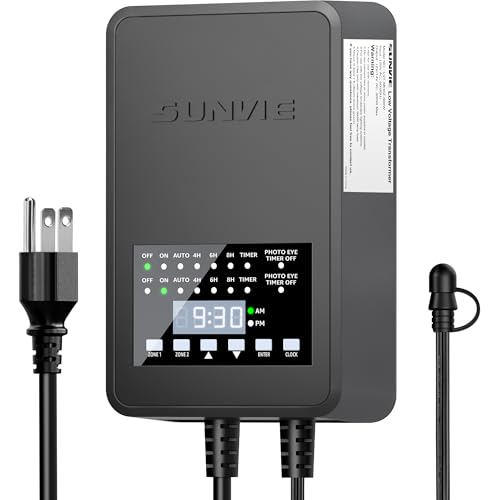
SUNVIE 300W Two-Zone Landscape Transformer with Timer
$119.99A 120 V to 12 or 14 V transformer with two independently controlled zones, photocell, timer and countdown modes and circuit protection.
Best for: larger systems with two schedules
Check price on AmazonHow we chose
We did not test these products in person. Picks are researched from manufacturer specifications and owner manuals, engine and safety certifications where they apply, warranty terms, public recall records, and the recurring themes in verified owner reviews. We favor established brands with large review counts and parts support, match each pick to a real yard size or task, and place it in the tier where its price and capability actually belong.
Frequently asked questions
Are solar or low-voltage landscape lights better?
Low-voltage lights are better for brightness and reliability: they run from a transformer on a timer and light the same every night. Solar lights are better for easy installation and zero running cost, but output depends on sun and fades as batteries age. Use low-voltage fixtures like the Lumina 3W LED path lights for steps and entries, and solar for decorative marking.
How long do solar path lights last?
The housing can last years, but the battery is the weak point. Owners commonly report shorter run times after a season or two as rechargeable cells lose capacity, and much shorter nights in late fall and winter. Choose lights with glass or metal parts rather than thin plastic, check whether the battery is replaceable, and clean the solar panels a few times a year so they charge fully.
Can I install low-voltage landscape lighting myself?
In most cases, yes. A plug-in system uses a transformer in an existing GFCI outdoor outlet and 12 V cable that can be laid in mulch or a shallow trench, and kits like the Malibu 150W kit include everything. Hire a licensed electrician for a new outlet, a hardwired transformer or 120 V fixtures, and call 811 before trenching.
What size transformer do I need for landscape lights?
Add up the wattage of every fixture, then choose a transformer rated well above that total. SUNVIE says to keep load under 80 percent of rated watts, and Malibu recommends about 90 W on a 120 W unit. Ten 4 W LED fixtures total 40 W, so a 120 W transformer leaves room to add lights later. Long runs may need heavier cable to avoid dim fixtures at the end.
Why do my solar lights not stay on all night?
Usually the battery is not getting a full charge. Common causes are shade from trees or buildings, dirty panels, short winter days, several cloudy days in a row, and aging batteries that hold less charge. Move lights to spots with more direct sun, wipe the panels clean, and replace batteries if the lights allow it. For all-night light every night, a low-voltage system is the reliable answer.
Researched, not professional advice. This page is compiled from published specifications, manuals, labels and owner-review consensus, not hands-on testing. Follow the manufacturer's instructions and product label, and consult a qualified professional where safety, chemicals, fuel or structures are involved. As an Amazon Associate we earn from qualifying purchases.