Snow Removal
Track vs Wheel Snow Blower: When Tracks Are Worth $200 More
Quick answer
Choose a track snow blower if your driveway is steep, icy, uneven or gravel; tracks grip where wheels spin. Choose wheels for flat paved driveways, where they turn more easily. Honda sells the same 28-inch HSS928 both ways: the track version costs $3,599.00 and the wheeled version $3,399.00.
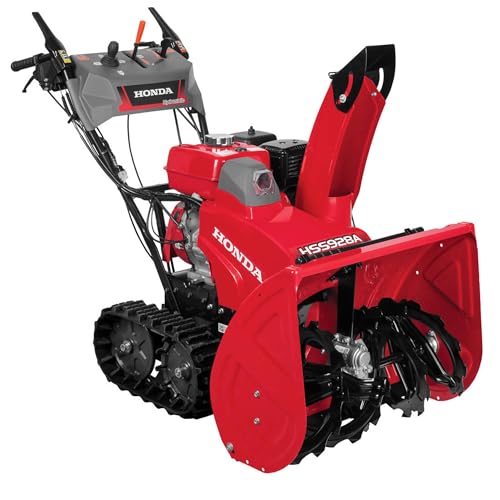
Honda HSS928AATD 28 in. Two-Stage Track Snow Blower
$3,599.00Rubber tracks, auger height control lever.
Best for: steep or icy driveways where wheels lose traction
Check price on Amazon
Honda HSS928AAWD 28 in. Two-Stage Wheeled Snow Blower
$3,399.0014-inch tires, electric joystick chute.
Best for: large flat paved driveways where a wheeled machine turns more easily
Check price on AmazonA track snow blower replaces the two drive wheels with rubber tracks, spreading the machine's weight over a larger contact patch so it grips on inclines, ice and packed snow. Honda's HSS928 is the cleanest comparison available, because the track and wheel versions share the GX270 engine, hydrostatic drive, 28-inch width, 21.7-inch intake, 52-foot throw and 3-year residential warranty. The difference in list price is $200.
That makes the decision unusually clear: the question is not power or size, it is what your driveway surface and slope demand. Tracks cost you some ease of turning on flat pavement. Wheels cost you traction on hills. Figures here are drawn from Honda's published specifications and owner reports, rather than side-by-side testing.
On this page
How do track and wheel snow blowers compare?
| Track: HSS928AATD | Wheel: HSS928AAWD | |
|---|---|---|
| Price | $3,599.00 | $3,399.00 |
| Width, intake, throw | 28 in, 21.7 in, 52 ft | 28 in, 21.7 in, 52 ft |
| Engine and drive | GX270, hydrostatic | GX270, hydrostatic |
| Traction on slopes and ice | Best: cleated low-temperature rubber tracks | Good on flat ground; chains not needed under normal conditions per Honda |
| Turning on flat pavement | Takes more effort | Easier |
| Gravel driveways | Excellent; auger height control lever | Good with skid shoes set high |
| Highlighted listing feature | Auger height control with a thumb lever | Electric joystick chute, 198 degrees |
| Pushing into berms | Tracks resist spinning | Wheels can spin on packed snow |
| Wear parts | Tracks | Tires |
| Steep driveway, 12 x 50 ft, moderate snow | 7 passes, about 5 min | 7 passes, about 5 min |
Honda figures from its Amazon listings. Clearing time depends on width, not drive type, on a driveway where both machines keep traction.
Should I buy a track or wheel snow blower?
Choose tracks if:
- Your driveway slopes enough that a car struggles on it in snow.
- You regularly clear icy, packed or rutted surfaces.
- You have gravel and want to tilt the housing up with the auger height control.
- You push hard into tall plow berms where wheels spin.
Choose wheels if:
- Your driveway is flat, paved and smooth.
- You turn often, around parked cars, walks and tight corners.
- You want the electric joystick chute highlighted on Honda's wheeled listing.
- You would rather spend less; a flat drive does not need tracks, and a wheeled two-stage like the Husqvarna ST124 at $999.00 may be all you need.
Are track snow blowers better on steep driveways?
Yes, and steep driveways are the main reason tracks exist on residential machines. Honda describes the tracks as pliable, low-temperature rubber with gripping cleats for traction and balance on inclines, rough ground and ice. A wheeled machine on a slick grade can lose traction climbing and slide sideways when turning; a tracked machine holds its line and lets you clear uphill with control.
Clear up and down the slope where you can, rather than across it, and many snow blower manuals say exactly that; follow yours. The steep driveway sizing page covers width for sloped drives, and the best snow blowers for steep driveways lists machines built for it.
Are track snow blowers hard to turn?
Harder than wheels, yes. A track has a long contact patch, so pivoting a tracked machine means the tracks have to skid sideways across the surface. On pavement that takes noticeable effort, which is why tracked models commonly include steering assists such as individual track clutches or triggers. Check the operator's manual for how your model steers.
Some makers have tried to split the difference. Ariens' Compact 24 RapidTrak uses a track system designed to turn more like a wheeled machine, though it is currently out of stock on Amazon. Tire chains are the other middle ground: they improve a wheeled machine's grip on ice, and Honda notes its wheeled HSS928 does not need them under normal conditions.
Do tracks matter on a gravel driveway?
They help. Gravel is uneven, and a wheeled machine can dip into ruts and let the scraper bar catch stones. Tracks bridge those dips, and Honda's tracked HSS928 adds an auger height control lever that raises or lowers the housing with a thumb press, so you can ride higher over gravel early in the season and lower once the snow base freezes. A wheeled two-stage with skid shoes set high still works fine on reasonably level gravel. Our gravel driveway snow blower picks cover both.
Which track and wheel snow blowers are worth considering?
Honda HSS928AATD 28 in. Two-Stage Track Snow Blower
$3,599.00Cleated low-temperature tracks, hydrostatic drive and auger height control on Honda's GX270 platform, with a 3-year residential warranty.
Best for: steep, icy or gravel driveways
Check price on Amazon Honda HSS928AAWD 28 in. Two-Stage Wheeled Snow Blower
$3,399.00The same engine and drive on 14-inch pneumatic tires, plus an electric joystick chute with 198 degrees of rotation.
Best for: large flat paved driveways
Check price on Amazon
Honda HSS1332AATD 32 in. Two-Stage Track Snow Blower
$4,099.00A GX390 engine and 31.9-inch path with hydrostatic track drive, rated at 2,750 pounds per minute and a 56-foot throw.
Best for: very long, sloped driveways
Check price on AmazonHow we chose
We did not test these products in person. Picks are researched from manufacturer specifications and owner manuals, engine and safety certifications where they apply, warranty terms, public recall records, and the recurring themes in verified owner reviews. We favor established brands with large review counts and parts support, match each pick to a real yard size or task, and place it in the tier where its price and capability actually belong.
Frequently asked questions
Is a track snow blower worth it?
A track snow blower is worth it on steep, icy, rutted or gravel driveways, where tracks keep traction that wheels lose. On flat, smooth pavement, tracks add turning effort and cost without much benefit. Honda prices its tracked HSS928AATD $200 above the wheeled HSS928AAWD, so if your driveway has any meaningful slope, the track version is a reasonable upgrade on an already premium machine.
Can I put chains on a wheeled snow blower instead of buying tracks?
Tire chains can improve a wheeled snow blower's grip on ice and packed snow, and they are far cheaper than tracks. Honda notes its wheeled HSS928 does not need chains under normal snow conditions. Chains help most on moderate slopes and icy flat surfaces. They do not match tracks on steep grades, and they can scratch pavers or stamped concrete, so check the surface before fitting them.
Do track snow blowers damage pavers or concrete?
Rubber tracks are generally gentle on pavement because they spread weight over a larger area. The bigger risk to pavers and decorative concrete on any two-stage machine is the steel scraper bar and skid shoes. Setting the skid shoes slightly higher, or fitting composite skid shoes such as the Ariens kit on compatible Ariens machines, reduces gouging and rust marks on decorative surfaces.
Are track snow blowers slower than wheeled ones?
Not on the driveway. Clearing time is set by clearing width and your walking pace, so a 28-inch track and 28-inch wheeled machine clear a 12 by 50-foot steep driveway in about the same 7 passes and 5 minutes when both keep traction. Tracked machines can be slower to reposition between passes because they take more effort to turn, especially on flat pavement.
What size snow blower do I need for a steep driveway?
A 24 to 26-inch two-stage is the usual recommendation for a typical 12 by 50-foot steep driveway, which takes about 8 passes and 6 minutes of moderate snow with a 24-inch machine. Traction matters more than width on a grade, so a self-propelled two-stage with tracks or strong tires and reverse is the priority. Single-stage machines have no drive and are hard to control on steep slopes.
Researched, not professional advice. This page is compiled from published specifications, manuals, labels and owner-review consensus, not hands-on testing. Follow the manufacturer's instructions and product label, and consult a qualified professional where safety, chemicals, fuel or structures are involved. As an Amazon Associate we earn from qualifying purchases.