Grills and Griddles
Gas Grill Buying Guide: Size, BTU, Grates and Build Quality
Quick answer
Buy a gas grill by primary cooking area first: about 80 sq in per person, so roughly 320 sq in for a family of four. Then judge build quality, not BTU: a cast-aluminum or thick stainless cookbox, heavy grates and a 10-year or longer warranty. The Weber Genesis E-325 is the benchmark.
A gas grill is a burner box fueled by propane or natural gas, with a lid, cooking grates, heat-spreading bars or plates and a grease system underneath. Every grill on a store floor lights and gets hot. What separates a grill that cooks evenly for ten years from one that rusts out in three is the cookbox material, the grate mass, the burner design, how well the lid holds heat and whether the maker still sells parts after the model changes.
This guide walks through each decision in the order that matters. Start by sizing the grill with the grill size calculator, then use the sections below to judge BTU claims, grates, fuel type, warranty and budget. If you already know you want a shortlist, the best gas grills roundup ranks the models by tier. Our benchmark for most families is the Weber Genesis E-325 Gas Grill (Propane) ($849.00), and the Weber Spirit E-325 Gas Grill (Propane) ($499.00) is the value floor for a grill built to last.
On this page
- What should I look for when buying a gas grill?
- What is the difference between primary and total cooking area?
- Does BTU matter when buying a gas grill?
- Are cast iron or stainless steel grill grates better?
- Do I need a side burner or a sear burner on a gas grill?
- Should I buy a propane or natural gas grill?
- How can I tell if a gas grill is well built?
- What warranty should a good gas grill have?
- How much should I spend on a gas grill?
- Budget tier: grills that cover the basics
- Mid-range tier: the grills most families should buy
- Premium tier: capacity, infrared and rotisserie
- What accessories do I need with a new gas grill?
What should I look for when buying a gas grill?
Shop in this order, because each step narrows the field before price starts pulling you around:
- Primary cooking area. Size to the number of people you usually feed, not the biggest party you host once a year.
- Cookbox and lid. Cast aluminum and thick stainless hold heat and do not rust through. Thin painted steel is the first part to fail on cheap grills.
- Grates. Heavy cast iron or thick stainless rods sear better and last longer than thin stamped grates.
- Burners and heat spreaders. Stainless or cast burners with a design that sheds grease, plus bars or plates that cover the burners completely.
- Fuel. Propane for flexibility, natural gas if you have a line and cook often.
- Warranty and parts. Long, component-by-component coverage and a parts catalog you can actually order from.
- Extras last. Side burners, infrared sear burners and rotisseries are worth money only if you will use them.
Most people overbuy burners and underbuy build quality. A three-burner grill with a heavy cookbox, like the Weber Spirit E-325, will cook more evenly than a thin five-burner grill that costs the same.
What is the difference between primary and total cooking area?
Primary cooking area is the grate directly over the burners, where food actually grills. Total cooking area adds the warming rack above it, and sometimes the side burner. Marketing copy leads with the total because it is the bigger number. A grill listed at 780 sq in total may have 570 sq in of primary grate, which is the case for the Broil King Baron 520 Pro. Always size from primary area. Plan about 80 sq in of primary grate per person for a full meal of mains and sides, and check your number with the grill size calculator or the grill size for a family of 4 page.
| People you cook for | Primary area needed (sq in) | Typical burners | Catalog examples with published primary area |
|---|---|---|---|
| 2 | 160 | 1 to 2 | Cuisinart Petite Gourmet (150), Charbroil Grill2Go X200 (200) |
| 4 | 320 | 2 to 3 | Coleman RoadTrip 285 (285), Weber Spirit E-325 (3 burners) |
| 6 | 480 | 3 to 4 | Napoleon Prestige 500 RSIB (500), Broil King Regal S 420 Pro (500) |
| 8 | 640 | 4 to 5 | Charbroil Amplifire 4-Burner (535), Broil King Baron 520 Pro (570) |
| 10 | 800 | 5 to 6 | Broil King Regal S 690 Pro IR (750), Lion L90000 40 in. built-in (802) |
| 12 or more | 960 | 6 or twin head | Cook in batches on a 750 sq in grill, or add a griddle |
Primary area only; warming racks excluded. Areas are from manufacturer listings. You rarely cook for every guest at once, so a grill one size down works if you are willing to cook in two rounds.
Does BTU matter when buying a gas grill?
BTU (British thermal unit) is the fuel a burner consumes per hour, not the heat that reaches your steak. A higher number means the grill burns more gas, and it says nothing about how much of that heat escapes out the back vents. The old rule of 80 to 100 BTU per square inch of primary grate is a rough floor, not a quality score. Heat retention comes from a heavy cookbox, a lid that seals, heavy grates and heat plates that spread the flame evenly. The table below uses published specs to show how similar the ratios really are across very different price points.
| Grill | Main burner BTU | Primary area (sq in) | BTU per sq in | What the ratio does not show |
|---|---|---|---|---|
| Bull Outlaw drop-in | 60,000 | 575 | 104 | Welded stainless burners, dual-lined hood |
| Broil King Regal S 420 Pro | 50,000 | 500 | 100 | Stainless cookbox, 15-year warranty |
| Napoleon Prestige 500 RSIB | 48,000 | 500 | 96 | Separate 18,000 BTU infrared rear burner |
| Napoleon Built-In 500 32 in. | 48,000 | 531 | 90 | 7.5 mm stainless grids, dual-level sear plates |
| Broil King Regal S 690 Pro IR | 60,000 | 750 | 80 | Infrared side burner rated to 1700 F |
| Broil King Baron 520 Pro | 45,000 | 570 | 79 | Five burners for zoned indirect cooking |
BTU per sq in = main burner BTU divided by primary cooking area. Side, sear and rotisserie burners excluded. Several popular grills, including current Weber Spirit and Genesis models, are not listed here because a main burner BTU figure was not in the catalog data.
Are cast iron or stainless steel grill grates better?
Cast iron holds the most heat and leaves the darkest sear marks, but it rusts if the coating chips or it sits wet. Porcelain-enameled cast iron, used on the Weber Spirit and Genesis, adds a glassy coating that resists rust until it chips, so use a bristle-free brush and avoid banging the grates. Stainless steel grates are lower maintenance and do not rust in normal use; what matters is thickness. Heavy stainless rods, such as the 7.5 mm grids on the Napoleon Built-In 500 or the 9 mm wave grids on the Napoleon Built-In 700, store enough heat to sear. Thin stainless wire grates do not.
- Choose cast iron if you want maximum sear and do not mind oiling grates and storing the grill covered.
- Choose heavy stainless if the grill lives uncovered, you live near salt air, or you want the least upkeep.
- Skip thin stamped steel on any grill you expect to keep more than a few seasons.
Do I need a side burner or a sear burner on a gas grill?
A side burner is a stovetop-style burner on the shelf for sauces, beans, corn or a pot of oil. It is worth paying for if you cook whole meals outside; if you mostly grill burgers and bring sides from the kitchen, it becomes an expensive shelf. The Weber Genesis E-435 and Charbroil Amplifire 4-Burner include one.
A sear burner is a high-output zone for crusting steaks. Some grills get there with boosted conventional burners, like the Weber Spirit E-325's Boost Burners that Weber says add 40 percent more power to the sear zone. Others use a ceramic infrared burner: the Napoleon Prestige 500 RSIB has an infrared side burner Napoleon says reaches 1800 F in 30 seconds, and the Broil King Regal S 690 Pro IR lists one rated to 1700 F. A rear rotisserie burner is only worth it if you will actually roast chickens and roasts on a spit. For a flat-top alternative to a side burner, compare the griddle vs gas grill page.
Should I buy a propane or natural gas grill?
Buy the fuel version your patio can actually use, because most cart grills cannot be converted after purchase. Propane holds about 21,548 BTU per pound, so a full 20 lb tank stores roughly 431,000 BTU. Divide that by the BTU per hour you burn to estimate cooking time: a grill burning 30,000 BTU per hour on high empties a tank in about 14 hours, and in about 29 hours at half throttle. Keep a spare, like the Flame King 20 lb tank with gauge, and check levels by weight with a propane tank scale.
Natural gas never runs out and costs less per BTU in many areas, but the grill must be ordered as a natural gas model, like the Weber Spirit E-325 Gas Grill (Natural Gas) or Broil King Regal S 420 Pro Gas Grill (Natural Gas), and the line must be run by a licensed plumber or gas fitter, usually with a permit. Only convert fuels with the manufacturer's approved kit where one exists. The full cost and convenience breakdown is on propane vs natural gas grill, and run times for any tank are in the propane tank runtime calculator.
How can I tell if a gas grill is well built?
You can judge most of a grill in five minutes at the store, or from the parts diagram in the owner manual online:
- Cookbox: cast aluminum or heavy stainless. Weber lists a cast-aluminum cook box on the Spirit E-210 and E-325; Broil King uses a stainless cookbox with cast aluminum end caps on the Regal S line. Painted thin steel will eventually rust through.
- Lid: it should close with a solid sound and not rock. Double-lined hoods, like the Bull Outlaw's, hold heat in wind.
- Grates: lift one. Heavy is good.
- Burners: stainless or cast, with a design that sheds drippings. Look for flame tamers, bars or plates that fully shield them.
- Grease path: a funnel or tray you can reach from the front without moving the grill.
- Frame and casters: give the cart a push. Racking or wobble gets worse with age and weather.
- Certification: look for a CSA or ETL listing for the fuel type.
- Parts: search the model number plus "replacement burner" before you buy. Brands like Weber, Broil King and Napoleon keep parts available for years.
What warranty should a good gas grill have?
Warranty length is the maker telling you how long it expects the grill to survive, so read the component breakdown, not the headline. Many "lifetime" warranties cover only the cookbox, while burners, igniters and grates carry much shorter terms. Registration is often required. The figures below are from catalog listings; confirm current terms with the manufacturer before you buy.
| Grill | Listed warranty | What to check |
|---|---|---|
| Weber Spirit E-325 | 10-year limited | Component terms in the Weber warranty document |
| Broil King Regal S 420 Pro | 15-year top-to-bottom | Registration requirements |
| Broil King Regal S 690 Pro IR | 15-year | Infrared burner coverage |
| Blaze Prelude LBM 32 built-in | Lifetime residential | Exclusions for installation and electrical parts |
| Charbroil Grill2Go X200 | 5-year burner and lid | Shorter terms on other parts |
| Charbroil Amplifire 4-Burner | 3-year | Expect a shorter service life |
Warranty terms change. Coastal use, commercial use and missing registration can void or shorten coverage.
How much should I spend on a gas grill?
Below about $400, grills are built to a price and usually last a few seasons; they are fine for occasional use. Between $500 and $900 you get the first grills built around cast aluminum or heavy cookboxes and long warranties, which is the sweet spot for most families. From about $1,100 to $2,000 you are buying capacity, stainless construction and features like infrared burners and rotisseries. Above that, you are paying for flagship finishes such as the Weber Summit FS38 E, or for a built-in grill for an island. The two price-capped roundups are gas grills under $500 and gas grills under $1,000.
Budget tier: grills that cover the basics
For two to four people and a few cooks a month. The Weber Spirit E-325 Gas Grill (Propane) is the grill we would steer most first-time buyers toward, because its warranty and parts support outlast the cheaper options.

Weber Spirit E-325 Gas Grill (Propane)
$499.00Three burners with Boost Burners for the sear zone, cast-iron grates, a cast-aluminum cook box and a 10-year limited warranty. It is the least expensive grill here built to be kept for a decade.
Best for: weeknight grilling for a family of four
Check price on Amazon
Nexgrill 4-Burner Stainless Gas Grill with Side Burner
$399.00Four 12,000 BTU burners plus a 12,000 BTU side burner and stainless grates at one of the lowest prices for a four-burner. Expect thinner materials and a shorter life than the Weber.
Best for: occasional use on a tight budget
Check price on Amazon
Charbroil Pro Series Amplifire 4-Burner Gas Grill with Side Burner
$649.99Ships with a griddle insert and charcoal trays, 535 sq in of primary space and a 200 sq in warming rack. Charbroil lists a 3-year warranty.
Best for: trying griddle and charcoal cooking on one cart
Check price on AmazonMid-range tier: the grills most families should buy
Weekly grilling, occasional hosting and indirect cooking for chicken pieces and roasts. The Weber Genesis E-325 Gas Grill (Propane) and the Broil King Baron 520 Pro Gas Grill (Propane) are the two to compare; Broil King vs Weber covers the differences.

Weber Genesis E-325 Gas Grill (Propane)
$849.00PureBlu tapered burners, an extra-large sear zone and grates that accept Weber Crafted inserts. The grill most households can buy once and keep.
Best for: serious home grillers
Check price on Amazon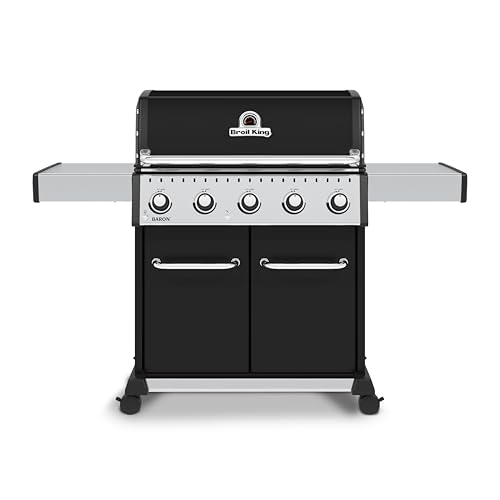
Broil King Baron 520 Pro Gas Grill (Propane)
$1,174.00Five stainless Dual-Tube burners, 570 sq in primary and 780 sq in total. Narrow zones make it easy to run one side hot and roast on the other.
Best for: indirect cooking and bigger cuts
Check price on Amazon
Napoleon Rogue 525 4-Burner Gas Grill (Propane)
$809.10Four main burners over a 28.75 by 18 inch cooking area, reversible cast-iron grids and side shelves that fold down so the grill tucks into small spaces.
Best for: small patios that still want four burners
Check price on AmazonPremium tier: capacity, infrared and rotisserie
For people who feed eight or more, cook sides outside and will actually use infrared searing or a rotisserie.
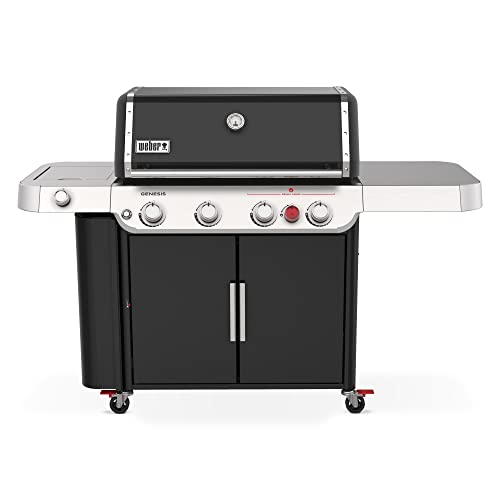
Weber Genesis E-435 Gas Grill with Side Burner (Propane)
$1,499.00Four main burners, an expandable second-level grate, a side burner and an extra-large prep table: a compact outdoor kitchen on wheels.
Best for: hosts who cook sides and mains outside
Check price on Amazon
Broil King Regal S 690 Pro IR Gas Grill (Propane)
$2,699.00Twin-head, six burners totaling 60,000 BTU over 750 sq in of primary space, an infrared side burner, a rear rotisserie burner with kit and a 15-year warranty.
Best for: feeding 12 or more
Check price on Amazon
Napoleon Prestige 500 RSIB Gas Grill (Propane)
$1,879.00Four stainless main burners, an infrared side burner Napoleon says hits 1800 F in 30 seconds, an 18,000 BTU infrared rear burner and an included rotisserie kit.
Best for: steakhouse searing plus rotisserie
Check price on AmazonWho should not buy this tier: Skip this tier if you cook for four or fewer or rarely use a side burner. A 60,000 BTU twin-head grill takes longer to preheat, burns a 20 lb tank in about seven hours on high and needs a larger patio to keep its clearances. A Weber Genesis E-325 Gas Grill (Propane) and a good instant-read thermometer will serve most families better.
What accessories do I need with a new gas grill?
Budget about $100 to $150 for the gear that protects the grill and the cook. A bristle-free brush like the GRILLART 18 in. Bristle-Free Grill Brush and Scraper removes the risk of loose wire bristles ending up in food. An TempPro TempSwift 0.5 Sec Instant-Read Meat Thermometer does more for results than extra BTU. A fitted cover, such as the Weber Premium Grill Cover for Spirit Gas Grills for Spirit models or the universal Unicook 58 in. Heavy-Duty Grill Cover, keeps pollen and rain out of the burners. A grill mat protects a wood or composite deck from grease. The full list is in best grill accessories, and a complete starter kit is laid out in the intermediate outdoor cooking setup. Smokers and pellet grills are a different category; SmokerCalc covers those.
How we chose
We did not test these products in person. Picks are researched from manufacturer specifications and owner manuals, engine and safety certifications where they apply, warranty terms, public recall records, and the recurring themes in verified owner reviews. We favor established brands with large review counts and parts support, match each pick to a real yard size or task, and place it in the tier where its price and capability actually belong.
Frequently asked questions
How many square inches of grill do I need for a family of four?
Plan about 320 square inches of primary cooking area for a family of four, using the common rule of 80 square inches per person. That leaves room for burgers or chicken plus vegetables and a cool zone to move food off the flame. A three-burner grill such as the Weber Spirit E-325 fits most families of four. Size from primary area, not total area, because warming racks inflate the listed number.
Is a higher BTU gas grill better?
No. BTU measures how much gas the burners consume per hour, not how hot the grates get. A grill with a heavy cast-aluminum or stainless cookbox, a tight lid and heavy grates can outcook a thinner grill with more BTU, because it keeps the heat instead of venting it. Around 80 to 100 BTU per square inch of primary grate is typical across quality grills, so treat BTU as a floor, not a score.
How long should a good gas grill last?
A well-built gas grill kept covered and cleaned commonly lasts 10 to 15 years with replacement burners, igniters and grates along the way. Budget grills with thin painted steel often need replacing in three to five seasons. Warranty length is a useful signal: Weber lists a 10-year limited warranty on the Spirit E-325 and Broil King lists 15 years on its Regal S models.
Can I convert a propane grill to natural gas later?
Only if the manufacturer sells an approved conversion kit for that exact model, and many cart grills have none. Conversions change the orifices and often the valves and regulator, so they should be done with the maker's kit and ideally by a qualified gas technician. If you have a natural gas line or plan to add one, buy the natural gas version from the start, such as the Weber Spirit E-325 NG.
What grill grate material is easiest to maintain?
Heavy stainless steel grates are the easiest to maintain because they do not rust in normal use and do not need oiling. Porcelain-enameled cast iron is a close second as long as the coating does not chip. Bare cast iron gives the best sear but needs a light coat of oil after cleaning and a covered grill to prevent rust. Thin stainless wire grates are easy to clean but hold little heat.
Is it worth paying extra for a grill with an infrared sear burner?
It is worth it if you cook steaks, chops or burgers often and want a hard crust fast. Infrared burners heat a ceramic or metal emitter that radiates intense heat; Napoleon says its side infrared burner on the Prestige 500 reaches 1800 F in 30 seconds. If you mostly cook chicken, fish and vegetables at medium heat, a well-built conventional grill with a boosted sear zone is enough.
Researched, not professional advice. This page is compiled from published specifications, manuals, labels and owner-review consensus, not hands-on testing. Follow the manufacturer's instructions and product label, and consult a qualified professional where safety, chemicals, fuel or structures are involved. As an Amazon Associate we earn from qualifying purchases.