Robot Mowers
Robot Mower for Multiple Lawn Zones: Wire vs RTK Mapping
Quick answer
A robot mower can cover multiple lawn zones two ways. Wire models like the Husqvarna Automower 430X need a wired corridor or guide wire between zones. RTK and vision models like the Mammotion LUBA 2 AWD 3000X map each zone in an app. Size the mower to the combined area at 75 percent loading.
Most houses split the lawn: a front yard, a back yard, maybe a side strip, joined by a narrow passage beside the house or separated by a driveway. One robot can mow all of it if it can find its way between zones and has enough capacity for the combined area plus the travel.
Our top pick is the ECOVACS GOAT A3000 LiDAR Robot Mower at $2,999.99. Its dual LiDAR mapping needs no wire and no RTK antenna, which matters in exactly the places multi-zone yards have trouble: narrow side yards and lawn beside the house, where walls and eaves block satellite signal. Size your zones with the robot mower calculator.
On this page
Can one robot mower handle a front and back yard?
Yes, if three conditions hold. First, the mower can get from one zone to the other on its own, through a passage wide enough for it, or you are willing to carry it. Second, its rated area covers the combined lawn at no more than 75 percent, with extra margin for travel between zones. Third, its navigation works in every zone: satellite RTK can struggle in a narrow side yard between two houses, and wire can struggle nowhere but takes the longest to install.
Zones that are not physically connected, such as a front lawn cut off by a driveway and a walled patio, usually mean carrying the mower or crossing pavement. Some app-mapped models can drive a defined path across a paved area between zones; check the maker's documentation for your exact layout.
Boundary wire corridors vs RTK and vision mapping: which is better for multiple zones?
A boundary wire mower stays inside a loop of wire and follows guide wire back to its station. An RTK mower positions itself by satellite with centimeter-level corrections and follows boundaries you draw in an app. Vision and LiDAR models see their surroundings. For multi-zone yards the differences look like this; the full comparison is in boundary wire vs RTK robot mower.
| Factor | Boundary wire (e.g. 430X) | RTK or RTK + vision (e.g. LUBA, iQ) | LiDAR (e.g. GOAT A3000, i215) |
|---|---|---|---|
| How zones connect | Wire loop runs through a corridor; guide wire leads the mower | Zones and connecting paths drawn in an app | Zones and paths mapped by the mower's sensors |
| Narrow side yard beside the house | Works; follow the manual's minimum passage width | Signal can weaken between buildings | Works well near walls |
| Heavy tree cover | Most reliable | Accuracy can drop | Not satellite-dependent |
| Crossing a driveway or walk | Wire can be laid in a pavement joint or the mower carried | Some models drive a mapped path across pavement | Some models drive a mapped path across pavement |
| Installation effort | Highest: every edge pegged or trenched | Mapping walk plus any antenna setup | Mapping walk |
| Changing zones later | Move or add wire | Redraw in the app | Remap in the app |
| Example and price | Automower 430X $2,167.79 | LUBA 2 AWD 3000X $1,998.00 | GOAT A3000 $2,999.99 |
Capabilities vary by model and firmware. Confirm multi-zone and path features in the maker's app documentation before buying.
How much boundary wire does a two-zone lawn need?
More than the lawn area suggests, because the corridor and guide wire add length. Here is an example of a front and back lawn joined by a side yard.
| Part | Size | Wire |
|---|---|---|
| Front lawn loop | 40 x 60 ft (2,400 sq ft) | 200 ft |
| Back lawn loop | 80 x 100 ft (8,000 sq ft) | 360 ft |
| Side-yard corridor, both edges | 40 ft long | 80 ft |
| Guide wire from station to front zone | About 100 ft run | 100 ft |
| 10% slack | About 75 ft | |
| Total | 10,400 sq ft of lawn | About 815 ft |
Example layout only. A single-zone lawn of the same 10,400 square feet as a square would need about 410 feet of perimeter wire. Wire-free models need none.
How do I size a robot mower for several lawn zones?
Add up the zones, divide by 0.75, and pick a mower rated for at least that area. Then add a little more for travel if the zones are far apart or joined by a long corridor, since time spent driving is time not mowing. The example yard above, 10,400 square feet in two zones, needs a rating of about 13,900 square feet, so the Segway Navimow i215 LiDAR ($1,599.00, rated about 16,100) fits at 65 percent. A front, back and side yard totaling half an acre needs about 29,000 square feet of rating, which points to the GOAT A3000, LUBA 2 AWD 3000X or Automower 430X; see the half-acre page. If a walk-behind is the alternative, that 10,400-square-foot yard takes about 35 minutes per mow plus moving between zones, roughly 15 hours a season.
Best robot mowers for multiple lawn zones
Six robots covering the three navigation approaches, from small split yards to half-acre layouts.

ECOVACS GOAT A3000 LiDAR Robot Mower
$2,999.99Dual LiDAR mapping without wire or RTK antenna handles narrow side yards and lawns beside walls. Rated for three quarters of an acre with a 13-inch cut and 45-minute recharge.
Best for: front and back yards joined by a side passage
Check price on Amazon
Mammotion LUBA 2 AWD 3000X Robot Mower
$1,998.00RTK plus AI vision maps zones without wire, four-wheel drive handles 80 percent slopes, and a three-quarter-acre rating covers split lawns up to about 24,500 square feet with headroom.
Best for: sloped multi-zone yards with open sky
Check price on Amazon
Husqvarna Automower 420iQ Robot Mower
$1,841.66Wire-free EPOS positioning rated for one acre, so front, back and side lawns totaling up to about 32,700 square feet stay at 75 percent loading.
Best for: large multi-zone lots with open sky
Check price on Amazon
Husqvarna Automower 430X Robot Mower
$2,167.79Boundary and guide wire give dependable navigation through corridors and under trees. Rated for 0.8 acre with a 9.45-inch cut, it covers up to about 26,100 square feet of zones.
Best for: shaded yards where satellite models struggle
Check price on Amazon
Segway Navimow i215 LiDAR Robot Mower
$1,599.00LiDAR fused with vision needs no satellites or antenna, so it works in tight side yards. Rated for about 16,100 square feet, it suits split lawns up to about 12,000 square feet.
Best for: small front and back yards
Check price on Amazon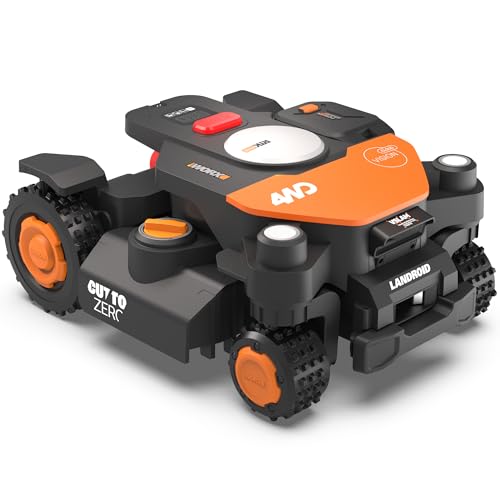
WORX Landroid Vision Cloud WR342 4WD Robot Mower
$2,069.99Cloud RTK with no local antenna, vision and 4WD for 84 percent slopes. Rated for a half acre, it covers split lawns up to about 16,300 square feet with headroom.
Best for: terraced or sloped small zones
Check price on AmazonHow we chose
We did not test these products in person. Picks are researched from manufacturer specifications and owner manuals, engine and safety certifications where they apply, warranty terms, public recall records, and the recurring themes in verified owner reviews. We favor established brands with large review counts and parts support, match each pick to a real yard size or task, and place it in the tier where its price and capability actually belong.
Frequently asked questions
Can a robot mower go from the front yard to the back yard?
Yes, if there is a passage it can drive through and it knows the route. Wire models follow a corridor of boundary wire and a guide wire. RTK, vision and LiDAR models follow a path you map in the app. If the zones are separated by a fence, steps or a wall, you will need to carry the mower or give each area its own mower.
Is boundary wire or RTK better for multiple zones?
RTK and vision mapping is easier to set up and change: you draw zones and paths in an app instead of pegging wire through every corridor. Boundary wire is more dependable under heavy trees and in narrow passages between houses where satellite signal weakens. LiDAR models are a middle path that works near buildings without wire. Pick based on how much open sky each zone has.
How do I size a robot mower for a front and back yard?
Add the square footage of every zone, divide by 0.75, and choose a mower rated for at least that area. Allow extra if the zones are far apart, because travel time is not mowing time. For example, 10,400 square feet of front and back lawn needs a rating of about 13,900 square feet, which the Segway Navimow i215 LiDAR covers at 65 percent loading.
Can a robot mower cross a driveway?
Some can. Several app-mapped RTK and vision models let you define a channel across a paved area so the mower drives between zones; others need you to carry it or install a second charging station. With boundary wire, the wire can be laid in a pavement joint or expansion gap. Check the maker's documentation and never route a mower across a street or public sidewalk.
Researched, not professional advice. This page is compiled from published specifications, manuals, labels and owner-review consensus, not hands-on testing. Follow the manufacturer's instructions and product label, and consult a qualified professional where safety, chemicals, fuel or structures are involved. As an Amazon Associate we earn from qualifying purchases.