Chainsaws and Wood
Best Chainsaws for Firewood (2026): Bar Length, Gas vs Battery
Quick answer
The best chainsaw bar length for firewood is 16 to 20 inches for most homeowners, or about 2 inches longer than the wood you cut most often. The Husqvarna 455 Rancher (55cc, 20 in bar, rated for 13 to 24 in bars) is the top pick for regular firewood, while battery saws suit pruning and storm cleanup.
Pick a chainsaw by the diameter of the wood you cut most, not the biggest tree on the property. A bar about 2 inches longer than that diameter lets you finish most cuts in one pass while keeping the saw light enough to control. For a homeowner cutting firewood, that lands on a 16 to 20 inch bar on a 40 to 55cc engine, or a 50cc-class battery saw for lighter duty.
Our top pick is the Husqvarna 455 Rancher at $589.99. If you mostly trim limbs and clean up after storms, the EGO CS1613 or Husqvarna 120 Mark III is plenty, and a larger saw would only be heavier. Get your number from the chainsaw bar length calculator, and read the chainsaw safety guide before your first cut.
On this page
- What is the best chainsaw bar length for firewood?
- Chainsaw bar length vs tree diameter: what size bar do I need?
- What engine size do I need for each bar length?
- Beginner picks: light saws for limbs, pruning and occasional firewood
- Intermediate picks: 18 to 20 inch saws for a winter of firewood
- Expert picks: 55 to 60cc saws for large hardwood
- How do the picks compare on specs?
- Gas vs battery chainsaw: which should a homeowner buy?
- What else do I need to run a chainsaw safely?
- What should I check before buying a chainsaw?
What is the best chainsaw bar length for firewood?
A chainsaw bar is the steel guide the chain runs around, and its length is measured from the front of the saw body to the tip. As general guidance, choose a bar about 2 inches longer than the wood diameter you cut most. Homeowner firewood usually comes from 8 to 18 inch rounds, so a 16 to 20 inch bar is the practical range.
- 16 in bar: the sweet spot for occasional firewood, limbing and storm cleanup on 38 to 45cc gas saws or 56V battery saws.
- 18 in bar: the best all-rounder for someone who burns wood every winter and processes a few cords of mixed hardwood.
- 20 in bar: for bucking 16 to 18 in hardwood rounds regularly, on a 50cc or larger engine.
- 24 in bar and up: for landowners with large trees who already have experience. A longer bar is heavier, harder to control and puts more of the kickback-prone tip in play.
Longer is not safer or faster for small wood. A 20 inch bar on a 6 inch limb adds weight at arm's length and exposes more chain, which is why many owners keep a small saw for limbing and a larger one for bucking.
Chainsaw bar length vs tree diameter: what size bar do I need?
Use the diameter you cut most often. Technically a skilled operator can cut wood up to nearly twice the bar length by cutting from both sides, but that technique demands precise control and is not a reason for a homeowner to buy a short bar for big wood. The same numbers appear on the chainsaw bar length chart.
| Wood you cut most | Suggested bar | Typical power | Example saw |
|---|---|---|---|
| Branches up to 6 in | 10 to 12 in | 20V to 40V battery, or a pole saw overhead | CRAFTSMAN V20 12 in. |
| 6 to 10 in limbs and small trees | 12 to 14 in | 30 to 40cc gas or 56V battery | EGO CS1613 (16 in.) |
| 10 to 14 in rounds | 16 in | 38 to 45cc gas or 50cc-class battery | Husqvarna 120 Mark III |
| 14 to 16 in rounds | 18 in | 40 to 50cc gas | Echo CS-4510 |
| 16 to 18 in hardwood | 20 in | 50 to 55cc gas | Husqvarna 450 Rancher |
| 18 to 22 in hardwood | 20 to 24 in | 55 to 60cc gas | Husqvarna 455 Rancher |
| Over 22 in, or any large leaning or storm-damaged tree | 24 in plus | 60cc plus, or a certified arborist | Echo CS-590 Timber Wolf |
Always stay within the bar range your saw manual lists. A bar longer than the engine is rated for cuts slowly and wears the chain and sprocket.
What engine size do I need for each bar length?
Engine displacement and bar length go together: each saw manual lists a minimum and maximum bar. Husqvarna's listings give some of the clearest ranges, and battery makers express their saws as gas equivalents.
| Saw | Power | Shipped bar | Rated bar range (maker) |
|---|---|---|---|
| Husqvarna 120 Mark III | 38cc, 1.8 HP | 16 in | 14 to 18 in |
| Husqvarna 440 | 40cc, 2.4 HP | 18 in | See manual |
| Echo CS-4510 | 45cc | 18 in | See manual |
| Husqvarna 450 Rancher | 50.2cc, 3.2 HP | 20 in | 13 to 20 in |
| Husqvarna 455 Rancher | 55cc, 3.5 HP | 20 in | 13 to 24 in |
| Echo CS-590 Timber Wolf | 59.8cc | 20 in | See manual |
| EGO CS1613 | 56V, rated 40cc equivalent | 16 in | Fixed 16 in |
| EGO CS1815 | 56V 2500W, rated 50cc equivalent | 18 in | Fixed 18 in |
| Greenworks 80V 18 in. | 80V, rated 50cc equivalent | 18 in | Fixed 18 in |
Gas equivalent ratings are manufacturer claims, not a measured standard.
Beginner picks: light saws for limbs, pruning and occasional firewood
For first-time owners who trim limbs, clear storm debris and cut an occasional fire pit load. These saws are light enough to control well while you build good habits.

Husqvarna 120 Mark III 16 in. Gas Chainsaw
$219.99A 38cc, 1.8 HP X-Torq engine with air purge, a combined choke and stop control that reduces flooding, and an inertia-activated chain brake. Husqvarna recommends 14 to 18 in bars, so the 16 in bar sits right in the middle.
Best for: light firewood and yard cleanup on a budget
Check price on Amazon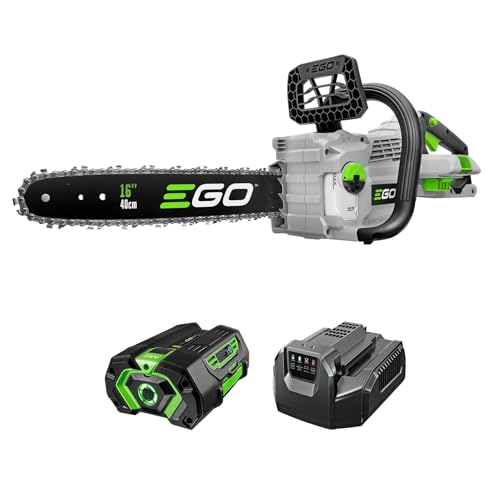
EGO Power+ CS1613 16 in. Chainsaw Kit with 4.0Ah Battery
$299.00EGO rates the brushless motor as a 40cc gas equivalent with chain speeds up to 20 m/s, on a 16 in bar with 3/8 in. pitch, .043 in. gauge chain. Tool-free tensioning and IPX4 weather resistance keep upkeep simple, and there is no fuel to mix or store.
Best for: pruning and storm cleanup without gas
Check price on AmazonIntermediate picks: 18 to 20 inch saws for a winter of firewood
For owners who heat part of the house with wood, drop small trees and buck mixed hardwood rounds most weekends in fall. Expect more weight and more capability.

Husqvarna 450 Rancher 20 in. Gas Chainsaw
$354.99A 50.2cc, 3.2 HP X-Torq engine with Smart Start, Air Injection centrifugal air cleaning and LowVib, rated for 13 to 20 in bars. It is the step where bucking 16 in hardwood stops feeling like work.
Best for: regular firewood and storm cleanup on rural lots
Check price on Amazon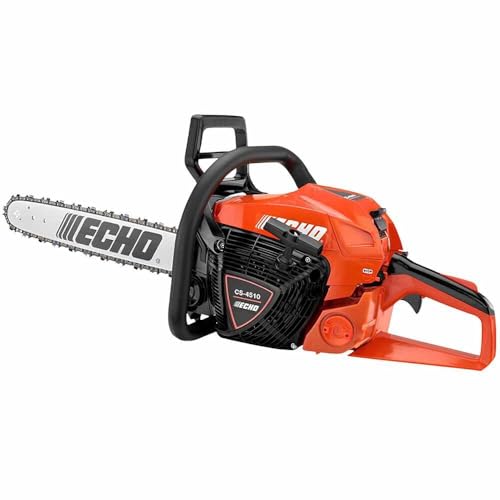
ECHO CS-4510 45cc 18 in. Rear Handle Gas Chainsaw
$398.99A 45cc rear-handle saw shipped with an 18 in. bar and 20BPX chain, sitting between homeowner and pro saws in weight and power. It suits owners who want an 18 in. bar without stepping up to a 50cc engine.
Best for: firewood and property maintenance with less weight
Check price on Amazon
EGO Power+ CS1815 18 in. Chainsaw Kit with 6.0Ah Battery
$399.00A 2500W brushless motor EGO rates as a 50cc gas equivalent, 22 m/s chain speed, an 18 in. bar and up to 330 cuts on a 4x4 per 6.0Ah charge. A color display shows chain speed, charge and brake status, and the tool carries a 5-year warranty.
Best for: battery users bucking firewood and felling small trees
Check price on AmazonExpert picks: 55 to 60cc saws for large hardwood
For experienced operators on acreage who process several cords a year, buck 18 to 22 in hardwood and maintain their own chains. These saws are heavier and less forgiving.

Husqvarna 455 Rancher 20 in. Gas Chainsaw
$589.99A 55cc, 3.5 HP X-Torq engine rated for 13 to 24 in bars, with a 7 degree offset front handle, Air Injection filtration and LowVib. It keeps chain speed up in big rounds where 45cc saws bog.
Best for: heavy firewood seasons and larger trees
Check price on Amazon
ECHO CS-590 Timber Wolf 59.8cc 20 in. Gas Chainsaw
$478.99A 59.8cc engine on a 20 in. bar, the largest displacement saw in this roundup. The extra power helps when bucking large, dense hardwood and running longer bars within the manual limits.
Best for: woodlot owners bucking big hardwood
Check price on AmazonWho should not buy this tier: Skip this tier if you cut storm limbs a few times a year or have never run a chainsaw. A 55 to 60cc saw is heavier, produces more reactive force, and a 20 to 24 in bar puts more chain near you. It is also not a license to fell big trees: large, leaning or storm-damaged trees under tension are a job for a certified arborist regardless of how capable the saw is.
How do the picks compare on specs?
| Model | Price | Bar length | Engine | Voltage | Battery |
|---|---|---|---|---|---|
| Husqvarna 120 Mark III 16 in. Gas Chainsaw | $219.99 | 16 in | 38 cc | - | - |
| EGO Power+ CS1613 16 in. Chainsaw Kit with 4.0Ah Battery | $299.00 | 16 in | - | 56V | 4 Ah |
| Husqvarna 450 Rancher 20 in. Gas Chainsaw | $354.99 | 20 in | 50.2 cc | - | - |
| ECHO CS-4510 45cc 18 in. Rear Handle Gas Chainsaw | $398.99 | 18 in | 45 cc | - | - |
| EGO Power+ CS1815 18 in. Chainsaw Kit with 6.0Ah Battery | $399.00 | 18 in | - | 56V | 6 Ah |
| Husqvarna 455 Rancher 20 in. Gas Chainsaw | $589.99 | 20 in | 55 cc | - | - |
| ECHO CS-590 Timber Wolf 59.8cc 20 in. Gas Chainsaw | $478.99 | 20 in | 59.8 cc | - | - |
Gas vs battery chainsaw: which should a homeowner buy?
A battery chainsaw is the better buy for pruning, limbing, storm cleanup and a modest amount of firewood, especially for owners who dislike pull starts and fuel storage. A gas chainsaw is the better buy for heating with wood, cutting dense hardwood over 14 inches regularly, or working far from a charger. The side-by-side is on gas vs battery chainsaw, and the battery shortlist is on best battery chainsaws.
- Runtime: the EGO CS1815 is rated for up to 330 cuts on a 4x4 per 6.0Ah charge. Firewood rounds are far larger than a 4x4, so expect fewer cuts; a spare battery is the realistic plan for a firewood day.
- Power: top battery saws claim 50cc equivalence. A 55 to 60cc gas saw still holds chain speed better in big hardwood over long sessions.
- Upkeep: gas saws need a 2-cycle fuel mix (typically 50:1; follow the manual), air filter cleaning and off-season fuel care. Use the two-cycle mix ratio calculator or ethanol-free premix.
- Cost over time: the gas vs battery cost calculator compares fuel, oil and battery replacement.
Both types need bar and chain oil, sharp chains and the same protective gear.
What else do I need to run a chainsaw safely?
Budget for protective gear and upkeep items at the same time as the saw. The full list is on best chainsaw safety gear.
- Chaps: Husqvarna apron chainsaw chaps ($89.97) use pull-apart fibers designed to clog the drive sprocket and are certified to ASTM F1897.
- Helmet with face screen and muffs: the Husqvarna forestry helmet meets ANSI Z89.1 Type I with 24 dB NRR ear muffs.
- Bar and chain oil: Husqvarna X-Guard bar and chain oil, refilled at every fuel stop.
- Fuel: VP Racing SEF 50:1 premix for saws that sit between uses, or Echo Power Blend 50:1 oil to mix your own.
- Sharpening: an Oregon field sharpening kit with the file size your chain uses.
What should I check before buying a chainsaw?
- Bar range in the manual. Buy a saw whose rated range includes the bar you need, rather than forcing an oversized bar onto a small engine.
- Weight and balance. Owners who are older or new to saws do better with a lighter 16 to 18 in saw they can hold steady than a heavy 20 in saw.
- Chain brake and chain catcher. Every pick here has a chain brake; the Husqvarna saws list inertia activation, which can trigger in a kickback without hand contact.
- Anti-vibration. LowVib dampening on the Husqvarna saws reduces fatigue over long bucking sessions.
- Service access. Gas saws need a dealer or shop for carburetor work; battery saws need genuine batteries, which are the largest ongoing cost.
- What comes next. Most firewood owners add a splitter; see best log splitters and how to split firewood.
How we chose
We did not test these products in person. Picks are researched from manufacturer specifications and owner manuals, engine and safety certifications where they apply, warranty terms, public recall records, and the recurring themes in verified owner reviews. We favor established brands with large review counts and parts support, match each pick to a real yard size or task, and place it in the tier where its price and capability actually belong.
Frequently asked questions
Is a 16 or 18 inch chainsaw better for firewood?
An 18 inch chainsaw is better if you burn wood every winter and cut 12 to 16 inch hardwood rounds, because it finishes most cuts in one pass. A 16 inch chainsaw is better for occasional firewood, limbing and storm cleanup, because it is lighter and easier to control. Choose the bar about 2 inches longer than the wood diameter you cut most often, within your saw's rated range.
Can a 16 inch chainsaw cut a 20 inch tree?
Experienced operators can cut wood nearly twice the bar length by cutting from both sides, so a 16 inch saw can technically cut through a 20 inch log. It takes more time, precise alignment and more exposure to the bar tip. Felling a 20 inch tree is a different matter: large trees, and any leaning or storm-damaged tree under tension, should be handled by a certified arborist.
What size chainsaw does a homeowner need?
Most homeowners need a 16 to 18 inch chainsaw with a 40 to 50cc gas engine or a 50cc-class battery motor. That handles limbs, storm cleanup and firewood from 8 to 16 inch rounds. Only step up to a 20 to 24 inch, 55cc or larger saw if you regularly buck big hardwood, and step down to a 12 inch battery saw if you only trim branches.
Are battery chainsaws good enough for firewood?
Battery chainsaws are good enough for a moderate amount of firewood. The EGO CS1815 and Greenworks 80V 18 in. are both rated as 50cc gas equivalents on 18 inch bars. Firewood rounds drain packs faster than the 4x4 cuts brands quote, so plan on a spare battery. For several cords of large hardwood each year, a 50 to 55cc gas saw is still the better tool.
What fuel mix does a chainsaw use?
Most modern 2-cycle chainsaws from Husqvarna and Echo run a 50:1 gasoline and 2-cycle oil mix, which is 2.6 ounces of oil per gallon of fuel. Always follow your manual, use fresh gasoline at the octane it specifies and avoid storing mixed fuel for long. Ethanol-free premix such as VP Racing SEF 50:1 is rated stable for 2 years in the tank, which helps saws that sit between seasons.
How often should I sharpen a chainsaw chain?
Sharpen a chainsaw chain whenever it produces fine dust instead of chips, pulls to one side, or needs you to push the saw into the cut. For firewood cutting that often means a quick touch-up with a file every tank or two of fuel, and immediately after the chain hits dirt, rocks or metal. A dull chain raises kickback risk and strains both gas engines and battery motors.
Researched, not professional advice. This page is compiled from published specifications, manuals, labels and owner-review consensus, not hands-on testing. Follow the manufacturer's instructions and product label, and consult a qualified professional where safety, chemicals, fuel or structures are involved. As an Amazon Associate we earn from qualifying purchases.