Grills and Griddles
Grill Size Calculator: How Big a Gas Grill You Need
Quick answer
Plan about 80 square inches of primary cooking area per person for everyday meals. A household of 2 is well served by 250 to 300 square inches, a family of 4 by about 320 to 450 square inches on a 3-burner grill, and a family of 6 or regular cookouts for 10 by 480 to 600 square inches on a 4-burner.
Grill size is really a question of cooking area: the primary grate where food sits directly over the burners. Warming racks add to the total square inches on the box but not to how much you can sear at once. Enter how many people you usually cook for, the biggest group you host and what you cook most, and the calculator recommends a primary cooking area and burner count, then filters gas grills that fit. For flat-top cooking, use the griddle size calculator.
Grill size calculator
Primary cooking area
Gas grills that fit your crowd
Top matches update when you calculate.
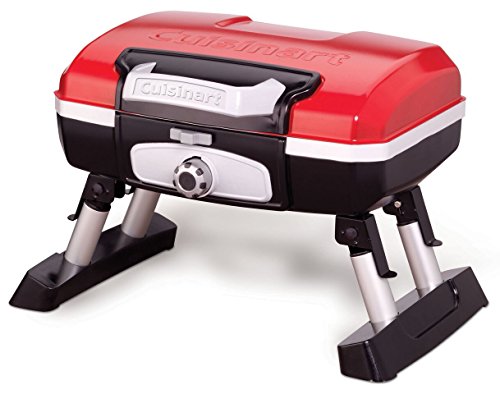
Cuisinart Petite Gourmet Portable Gas Grill
$149.99A 5,500 BTU briefcase-style grill with a 150 sq in grate that folds to 22.5 by 17.5 inches and cleans up with dishwasher-safe grates.
Best for: picnics and apartment balconies
Check price on Amazon
Coleman RoadTrip 285 Portable Stand-Up Propane Grill
$419.99Three adjustable burners across 285 sq in with quick-fold legs, wheels and push-button ignition, running on 16.4 oz cylinders with a 3-year warranty.
Best for: tailgating and RV trips
Check price on Amazon
Weber Q 2800N+ Portable Gas Grill
$449.00A 250 to 700F range, a Plus burner for searing or low roasting, a high-dome lid for whole chickens and space for two full racks of ribs.
Best for: full-size grilling results in a portable body
Check price on Amazon
Weber Spirit E-210 Gas Grill (Propane)
$399.00A two-burner cabinet grill with a cast-aluminum cook box, porcelain-enameled cast-iron grates and a 10-year limited warranty, sized for small patios and couples.
Best for: small patios and cooking for 2 to 4
Check price on Amazon
Weber Spirit E-325 Gas Grill (Propane)
$499.00Three burners with Weber Boost Burners that add 40% more power to the sear zone, plus cast-iron grates and a 10-year limited warranty at an entry price.
Best for: weeknight grilling for a family of four
Check price on Amazon
Weber Genesis E-325 Gas Grill (Propane)
$849.00Genesis PureBlu tapered burners, an extra-large sear zone and grates that accept the Weber Crafted grillware system for griddle, wok and pizza stone inserts.
Best for: serious home grillers who want room to grow
Check price on Amazon
Nexgrill 4-Burner Stainless Gas Grill with Side Burner
$399.00Four 12,000 BTU burners, a 12,000 BTU side burner, stainless grates and a double-door cabinet at one of the lowest prices for a full-size four-burner.
Best for: a full-size grill on a tight budget
Check price on Amazon
Charbroil Pro Series Amplifire 4-Burner Gas Grill with Side Burner
$649.99A 3-in-1 cabinet grill that ships with a griddle insert and charcoal trays, 535 sq in of primary space and a 200 sq in warming rack, backed by a 3-year warranty.
Best for: one grill that can also griddle and cook over charcoal
Check price on Amazon
Weber Spirit S-425C Stainless Gas Grill (Propane)
$749.00A four-burner stainless Spirit with two Boost Burners, locking casters and a Weber Works side table that accepts drop-in prep accessories.
Best for: upgrading to four burners without Genesis pricing
Check price on Amazon
Napoleon Rogue 525 4-Burner Gas Grill (Propane)
$809.10Four main burners over a 28.75 by 18 inch cooking area with reversible cast-iron grids and folding side shelves that tuck the grill into small spaces.
Best for: balconies and small patios that still want four burners
Check price on Amazon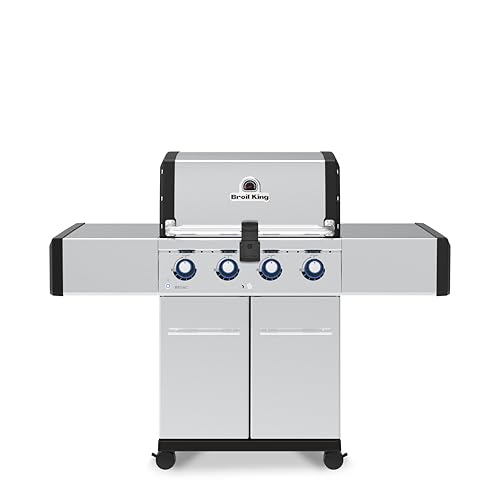
Broil King Regal S 420 Pro Gas Grill (Natural Gas)
$1,359.00Four stainless Dual-Tube burners, reversible stainless V-grids, a stainless cookbox with cast aluminum end caps and a 15-year top-to-bottom warranty, plumbed for natural gas.
Best for: a long-warranty natural gas grill
Check price on Amazon
Napoleon Prestige 500 RSIB Gas Grill (Propane)
$1,879.00Four stainless main burners, an infrared side burner that reaches 1800F in 30 seconds, an 18,000 BTU infrared rear burner and an included rotisserie kit.
Best for: steakhouse searing plus rotisserie in one cart
Check price on Amazon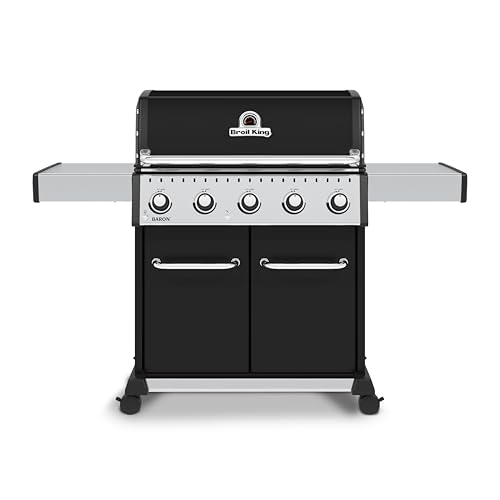
Broil King Baron 520 Pro Gas Grill (Propane)
$1,174.00Five stainless Dual-Tube burners across 570 sq in of primary space and 780 sq in total, a wide five-zone layout for indirect cooking.
Best for: multi-zone indirect cooking
Check price on Amazon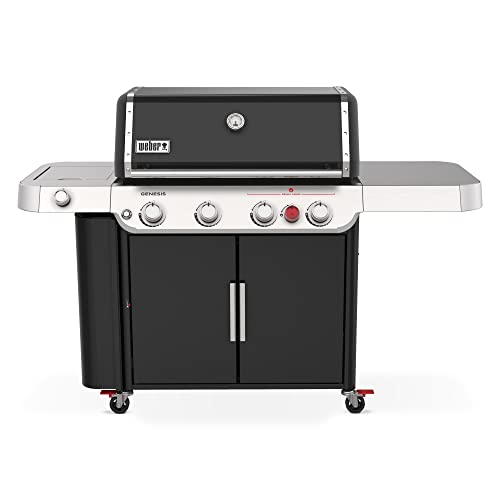
Weber Genesis E-435 Gas Grill with Side Burner (Propane)
$1,499.00Four main burners, an expandable second-level grate, a side burner for sauces and an extra-large prep table make it a compact outdoor kitchen on wheels.
Best for: hosts who cook sides and mains outside
Check price on Amazon
Broil King Regal S 690 Pro IR Gas Grill (Propane)
$2,699.00A twin-head six-burner with 750 sq in of primary space, a 10,000 BTU infrared side burner rated to 1700F, a 15,000 BTU rear rotisserie burner with kit and a 15-year warranty.
Best for: feeding big crowds and rotisserie roasting
Check price on AmazonOn this page
What size grill do I need for my family?
Everyday means cooking a full meal for everyone at once. Party means cooking for the group in two batches, which is how most hosts actually grill.
| Group | Everyday, all at once | Party, two batches | Burners | Grill class |
|---|---|---|---|---|
| 2 people | 160 sq in | 80 sq in | 1 to 2 | portable or compact 2-burner |
| 4 people | 320 sq in | 160 sq in | 2 to 3 | 3-burner full-size |
| 6 people | 480 sq in | 240 sq in | 3 to 4 | 4-burner full-size |
| 8 people | 640 sq in | 320 sq in | 2 to 3 | 3-burner full-size |
| 10 people | 800 sq in | 400 sq in | 2 to 3 | 3-burner full-size |
| 12 people | 960 sq in | 480 sq in | 3 to 4 | 4-burner full-size |
| 16 people | 1280 sq in | 640 sq in | 4 to 5 | 5 or 6-burner, or a 36 in griddle alongside |
| 20 people | 1600 sq in | 800 sq in | 4 to 5 | 5 or 6-burner, or a 36 in griddle alongside |
How much food fits on a grill per square inch?
| Food | Space each, with room to flip | Fits on 750 sq in |
|---|---|---|
| 4 in burger patty | 25 sq in | 30 |
| Hot dog or sausage | 8 sq in | 90 |
| Boneless chicken breast | 30 sq in | 25 |
| 12 oz strip or ribeye steak | 45 sq in | 16 |
| Pork chop | 35 sq in | 21 |
| Corn on the cob | 16 sq in | 46 |
| Vegetable skewer | 14 sq in | 53 |
How is grill size calculated?
The calculator estimates primary area = people x 80 square inches for an everyday meal, and party area = guests x 80 / 2 because hosts cook in batches. It then takes the larger of the two, adds 20 percent if you want a clear indirect zone for thick cuts, whole chickens or keeping food warm, and rounds to the burner count typical for that area. The 80 square inch figure comes from the space common foods need with room to flip: about 25 square inches for a burger, 30 for a chicken breast and 45 for a steak, plus sides.
BTU rating does not size a grill. A higher BTU number mostly reflects a larger firebox or more burners, and heat retention from the lid, firebox and grates matters more to how evenly and efficiently a grill cooks. A well-built 3-burner grill often outcooks a thin 4-burner.
Is a 3-burner or 4-burner grill better?
For most families of up to four, a 3-burner grill is the better buy: enough area for dinner and one burner to turn off for indirect cooking. The Weber Spirit E-325 Gas Grill (Propane) ($499.00) and the step-up Weber Genesis E-325 Gas Grill (Propane) are the common picks. Choose a 4-burner once you regularly cook for six or more, want a sear zone plus an indirect zone at the same time, or host cookouts for ten. The Broil King Baron 520 Pro Gas Grill (Propane) gives 570 square inches of primary area across five burners, and the Napoleon Prestige 500 RSIB Gas Grill (Propane) adds a side burner, infrared rear burner and rotisserie. For a full comparison of the Weber lines, see Weber Spirit vs Genesis.
Should I get a grill or a griddle for a big family?
A griddle cooks more food per square inch for breakfasts, smash burgers, fajitas, fried rice and anything small or chopped, because nothing falls through the grates and you can crowd the surface. A grill does steaks, chicken on the bone, vegetables with char marks and indirect roasting better. Many families end up with both: a 3-burner grill for dinners and a 36 inch griddle for weekend breakfasts and crowds. The trade-offs are laid out in griddle vs gas grill.
Which gas grills match my result?
The grid under the calculator filters to your recommended area. As a guide: for two people or a small balcony, the Weber Spirit E-210 Gas Grill (Propane) or the portable Weber Q 2800N+ Portable Gas Grill; for a family of four, the Weber Spirit E-325 Gas Grill (Propane); for six and regular guests, the Broil King Baron 520 Pro Gas Grill (Propane) or Charbroil Pro Series Amplifire 4-Burner Gas Grill with Side Burner; and for big entertaining, the 750 square inch Broil King Regal S 690 Pro IR Gas Grill (Propane). Tiered picks are in the best gas grills, and full kits with tank, cover and tools are in the outdoor cooking setup.
Frequently asked questions
What size grill do I need for a family of 4?
A family of four needs about 320 to 450 square inches of primary cooking area, which is a typical 3-burner gas grill. That fits eight burgers with room for vegetables, or four steaks and sides, and leaves one burner off for indirect cooking. If you host other families often or cook thick cuts and sides together, step up to about 500 square inches on a 4-burner.
How many square inches of grill do I need per person?
Plan about 80 square inches of primary grate per person for an everyday mixed meal. Burgers and hot dogs pack tighter, around 25 and 8 square inches each, while steaks and chicken breasts need 30 to 45 square inches with room to flip. For parties, most hosts cook in batches, so about 40 square inches per guest on the grill at one time is enough.
Does total cooking area or primary cooking area matter more?
Primary cooking area matters more, because that is the grate directly over the burners where you actually sear and cook. Total cooking area adds the warming rack, which is useful for toasting buns and holding food, but it runs cooler and is not usable for most cooking. Compare grills on primary area and treat the warming rack as a bonus.
Is a bigger grill harder to heat and more expensive to run?
A bigger grill with more burners uses more propane only when you light every burner. With four or five burners you can light two for a small meal and use roughly the same fuel as a smaller grill. The real costs of a larger grill are purchase price, patio space and a heavier cover, not fuel. Buy for the meals you cook regularly, not the one party a year.
What size grill do I need for a party of 20?
For 20 guests, cooking in two or three batches, you need roughly 700 to 800 square inches of primary cooking area, a large 5 or 6-burner grill. Alternatively, pair a 3 or 4-burner grill with a 36 inch griddle, which handles burgers, dogs and sides for a crowd faster than a grill alone and costs less than a premium 6-burner.
Researched, not professional advice. This page is compiled from published specifications, manuals, labels and owner-review consensus, not hands-on testing. Follow the manufacturer's instructions and product label, and consult a qualified professional where safety, chemicals, fuel or structures are involved. As an Amazon Associate we earn from qualifying purchases.