Watering and Irrigation
Best Garden Hoses: 5/8 vs 3/4 Inch, Hybrid vs Rubber (2026)
Quick answer
The best garden hose for running sprinklers is the Flexzilla 3/4 in x 100 ft: at 8 GPM over 100 ft, a 3/4 inch hose loses about 9 psi versus about 22 psi for 5/8 inch (calculated). For everyday watering, a Flexzilla 5/8 in x 50 ft is enough. Choose rubber like Dramm ColorStorm for hot water.
Hose diameter decides how much water reaches the far end. A 5/8 inch hose is the standard for hand watering and short runs. A 3/4 inch hose has about 44 percent more bore area, so it loses far less pressure over long distances, which is what impact, traveling and oscillating sprinklers need. Material decides how the hose handles: hybrid polymer is light and flexible, rubber is heavy and durable in heat and cold, and lightweight woven hoses are easiest to drag.
Our top pick is the Flexzilla 3/4 in x 100 ft ($89.00), which pairs a high-flow bore with a hybrid polymer that lays flat and resists kinks. Check your own setup with the hose pressure loss calculator, and see hybrid vs rubber garden hose for the materials debate.
On this page
- 5/8 vs 3/4 inch garden hose: which diameter do I need?
- Hybrid vs rubber vs vinyl garden hose: which material is best?
- Beginner picks: light 5/8 inch hoses for everyday watering
- Intermediate picks: kink-resistant 100 ft runs and a light 3/4 inch hose
- Expert picks: 3/4 inch for sprinklers and rubber that lasts
- How do the garden hose picks compare on specs?
- What length garden hose should I buy?
- Which accessories and upgrades go with a new hose?
5/8 vs 3/4 inch garden hose: which diameter do I need?
Buy 5/8 inch for hand watering, nozzles, short runs under about 50 ft, and lightweight everyday use. Buy 3/4 inch when you run sprinklers 75 ft or more from the spigot, chain hoses together, or have low water pressure to begin with. Friction loss rises steeply as diameter shrinks: roughly, going from 5/8 to 3/4 inch cuts pressure loss by more than half at the same flow. A 1/2 inch hose is fine only for short, low-flow jobs such as a patio or a wall-mount reel near the plants.
The catch with 3/4 inch hoses is weight and storage: they hold more water, weigh more when full, and take about a third more room on a reel. See best hose reels for capacity by diameter.
| Flow (GPM) | 1/2 in hose | 5/8 in hose | 3/4 in hose |
|---|---|---|---|
| 4 | 18 | 6 | 3 |
| 6 | 39 | 13 | 5 |
| 8 | 66 | 22 | 9 |
| 10 | 100 (not practical) | 34 | 14 |
Calculated with the Hazen-Williams formula for smooth hose (C = 140) at nominal inside diameter. Real hoses vary with actual bore, fittings and couplings. Double the loss for 200 ft.
Hybrid vs rubber vs vinyl garden hose: which material is best?
Hybrid polymer hoses such as Flexzilla are the best all-rounder for most homeowners: lighter than rubber, flexible in cold, and resistant to kinks. Rubber hoses such as the Dramm ColorStorm are heavier and cost more but tolerate hot water and rough use, and owners commonly report they last many seasons. Multi-layer reinforced vinyl like the Gilmour Flexogen is a good value for long, kink-resistant runs. Lightweight woven hoses like zero-G are the easiest to carry but not meant for hot water.
| Material | Example | Weight | Cold flexibility | Hot water | Rating or warranty |
|---|---|---|---|---|---|
| Hybrid polymer | Flexzilla | Light | All-weather, lays flat | Not listed | Crush-resistant aluminum fittings |
| Rubber | Dramm ColorStorm | Heaviest | Coils easily in cold | Up to 160 F | Lifetime guarantee |
| 8-layer vinyl | Gilmour Flexogen | Medium | Kink resistant | Not listed | 500 psi, brass couplings |
| Rubber and vinyl | Gilmour Pro Commercial | Heavy | Steel spring guard at spigot | Not listed | 400 psi burst |
| Kink-free woven | zero-G | About 50% lighter than commercial vinyl | Flexible to 35 F | Max feed water 80 F | 600+ psi burst, drinking water safe |
Beginner picks: light 5/8 inch hoses for everyday watering
For hand watering, washing the car and watering beds near the house.
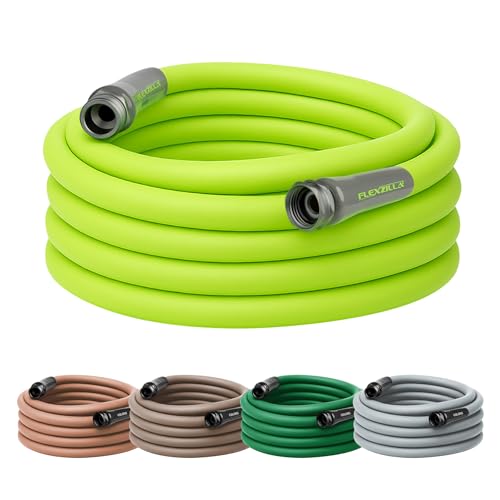
Flexzilla Garden Hose, 5/8 in x 50 ft
$39.97A lightweight hybrid polymer hose that will not kink under pressure, coils easily and lays flat with zero memory, with an abrasion-resistant cover, crush-resistant anodized aluminum fittings and an O-ring for a leak-free spigot seal.
Best for: everyday watering near the house
Check price on Amazon
zero-G Lightweight Garden Hose, 5/8 in x 100 ft
$69.98About half the weight of commercial vinyl, with a non-expanding design, a 600 psi plus burst rating, crush-proof couplings, and a drinking-water-safe, lead-free rating. Its max feed water temperature is 80 F, so keep it off hot taps.
Best for: a long hose that is easy to carry
Check price on AmazonIntermediate picks: kink-resistant 100 ft runs and a light 3/4 inch hose
For reaching the back of the yard and feeding sprinklers without dragging a heavy rubber hose.

Gilmour Flexogen Heavy Duty Garden Hose, 5/8 in x 100 ft
$55.99A made-in-USA 8-layer hose rated to 500 psi, with crush and corrosion resistant brass couplings and a construction that resists kinks and twists over a long pull.
Best for: long pulls across the yard
Check price on Amazon
zero-G Pro Kink Free Garden Hose, 3/4 in x 75 ft
$72.98A 3/4 inch version of the lightweight, non-expanding zero-G hose with a 600 psi plus burst rating and kink resistance, for more flow without the weight of rubber. Like the 5/8 version, it is not meant for water over 80 F.
Best for: lightweight high-flow sprinkler runs
Check price on AmazonExpert picks: 3/4 inch for sprinklers and rubber that lasts
For sprinkler-heavy yards, hot water use and owners who want to buy once.
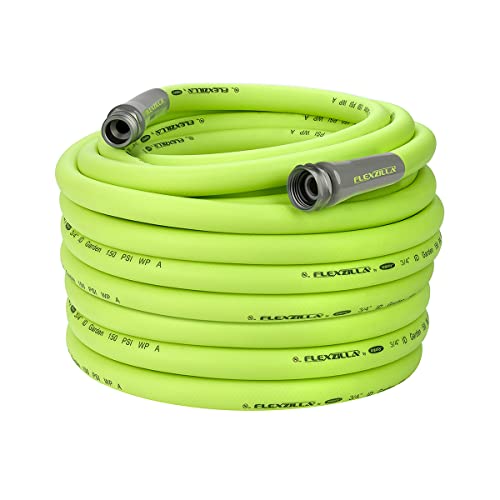
Flexzilla Garden Hose, 3/4 in x 100 ft
$89.00A 3/4 inch hybrid polymer hose at 100 ft that carries enough flow to run impact and traveling sprinklers far from the spigot, while staying flexible in all weather and lying flat without memory.
Best for: running sprinklers far from the spigot
Check price on Amazon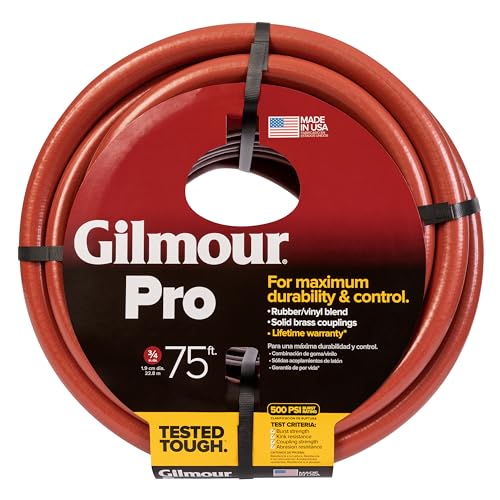
Gilmour Pro Commercial Heavy Duty Hose, 3/4 in x 75 ft
$72.59Double-reinforced commercial rubber and vinyl with a 400 psi burst strength, brass couplings with O-rings, a non-marring red cover and a steel spring coil at the spigot end to stop kinks where most hoses fail. Made in the USA.
Best for: high-flow sprinklers and rough use
Check price on Amazon
Dramm ColorStorm Premium Rubber Garden Hose, 5/8 in x 50 ft
$79.99A made-in-USA rubber hose rated for hot water up to 160 F that coils easily even in cold weather, with crush-proof nickel-plated couplings and a lifetime guarantee.
Best for: people who want rubber that lasts
Check price on AmazonWho should not buy this tier: Skip heavy 3/4 inch and rubber hoses if you mostly hand-water pots and beds near the house, if carrying a full 100 ft hose is hard for you, or if your storage is a small wall reel: a 5/8 inch hybrid is lighter and fits. Skip rubber if the hose lives in hot sun on dark pavement and you rarely need hot water; hybrids handle most homeowner jobs for less.
How do the garden hose picks compare on specs?
| Model | Price | Diameter | Length | Material |
|---|---|---|---|---|
| Flexzilla Garden Hose, 3/4 in x 100 ft | $89.00 | 0.75 in | 100 ft | hybrid polymer |
| Gilmour Pro Commercial Heavy Duty Hose, 3/4 in x 75 ft | $72.59 | 0.75 in | 75 ft | rubber and vinyl |
| Dramm ColorStorm Premium Rubber Garden Hose, 5/8 in x 50 ft | $79.99 | 0.625 in | 50 ft | rubber |
| Gilmour Flexogen Heavy Duty Garden Hose, 5/8 in x 100 ft | $55.99 | 0.625 in | 100 ft | 8 layer vinyl |
| zero-G Pro Kink Free Garden Hose, 3/4 in x 75 ft | $72.98 | 0.75 in | 75 ft | kink resistant woven |
| zero-G Lightweight Garden Hose, 5/8 in x 100 ft | $69.98 | 0.625 in | 100 ft | kink resistant woven |
| Flexzilla Garden Hose, 5/8 in x 50 ft | $39.97 | 0.625 in | 50 ft | hybrid polymer |
What length garden hose should I buy?
Measure from the spigot to the farthest spot you water, following the path the hose will actually take around corners and beds, then add about 10 percent. Buying far more than you need costs pressure, weight and storage space. If you need more than 100 ft, a 3/4 inch hose or a second spigot is better than chaining three 5/8 inch hoses. Two 100 ft lengths of 5/8 inch hose at 8 GPM lose roughly 44 psi in friction alone, which can leave a traveling sprinkler barely moving on a typical 50 to 60 psi supply.
Couplings matter as much as the hose body, because most hoses fail at the ends. Brass couplings, as on the Gilmour hoses, resist corrosion and crushing; Flexzilla uses crush-resistant anodized aluminum; Dramm uses crush-proof nickel-plated fittings; and zero-G lists its couplings as crush-proof up to 1,800 lbf. Replace a leaking washer before replacing a hose, and avoid driving over any coupling. Each quick-connect fitting also adds a small restriction, so use them sparingly on long sprinkler runs.
| Job | Diameter | Length | Example |
|---|---|---|---|
| Hand watering beds and pots | 5/8 in | 25 to 50 ft | Flexzilla 5/8 x 50 |
| Car washing, patio cleanup | 5/8 in | 50 ft | Dramm ColorStorm 5/8 x 50 |
| Oscillating sprinkler near the house | 5/8 in | 50 to 100 ft | Gilmour Flexogen 5/8 x 100 |
| Impact or traveling sprinkler far away | 3/4 in | 75 to 100 ft | Flexzilla 3/4 x 100 |
| Rough use, contractor style | 3/4 in | 75 ft | Gilmour Pro Commercial 3/4 x 75 |
| Feeding an electric pressure washer | 5/8 in or larger | As short as practical | Check the washer manual |
Which accessories and upgrades go with a new hose?
A good nozzle makes a hose far more useful: the Dramm Revolver has nine metal-bodied patterns from mist to jet with thumb flow control. A reel keeps the hose off the lawn and out of the sun; see best hose reels. To stop dragging hoses at all, a smart hose timer paired with a traveling sprinkler automates watering (see best lawn sprinklers and best smart sprinkler controllers). If you feed a pressure washer from your hose, water supply matters as much as psi; the best electric pressure washers page covers inlet requirements.
How we chose
We did not test these products in person. Picks are researched from manufacturer specifications and owner manuals, engine and safety certifications where they apply, warranty terms, public recall records, and the recurring themes in verified owner reviews. We favor established brands with large review counts and parts support, match each pick to a real yard size or task, and place it in the tier where its price and capability actually belong.
Frequently asked questions
Is a 5/8 or 3/4 inch garden hose better?
A 5/8 inch hose is better for hand watering and short runs because it is lighter and cheaper. A 3/4 inch hose is better for sprinklers and long runs because its larger bore loses much less pressure: at 8 GPM over 100 ft, about 9 psi versus about 22 psi for 5/8 inch by Hazen-Williams calculation. Choose by distance to the farthest sprinkler and your water pressure.
Is a hybrid or rubber garden hose better?
Hybrid polymer hoses such as Flexzilla are lighter, stay flexible in cold, and resist kinks, which makes them the better choice for most homeowners. Rubber hoses such as Dramm ColorStorm are heavier and more expensive but handle hot water up to 160 F and rough use, and many carry lifetime guarantees. Pick rubber for hot water or heavy daily use, hybrid for everything else.
How much pressure does a 100 ft garden hose lose?
It depends on flow and diameter. By Hazen-Williams calculation for smooth hose, 100 ft of 5/8 inch hose loses about 6 psi at 4 GPM, 13 psi at 6 GPM and 22 psi at 8 GPM. A 3/4 inch hose loses about 3, 5 and 9 psi at the same flows. Fittings, couplings and elevation add more, so use the hose pressure loss calculator for your setup.
What is the best garden hose that does not kink?
Flexzilla hybrid hoses are listed as not kinking under pressure and laying flat with no memory, zero-G hoses are sold as kink-resistant and non-expanding, and the Gilmour Flexogen uses an 8-layer build designed to resist kinks and twists. The Gilmour Pro Commercial adds a steel spring guard at the spigot, where kinks most often start. Store any hose on a reel to prevent kinks.
Are expandable garden hoses good?
Expandable hoses are light and compact, but they are generally less durable than hybrid, vinyl or rubber hoses, and many owners report leaks or bursts sooner. They also tend to have smaller effective bores that restrict flow to sprinklers. For a lightweight hose that does not shrink and stretch, a non-expanding woven hose such as zero-G is a more durable alternative.
Can I leave my garden hose out in winter?
It is better not to. Water left inside can freeze and split the hose or couplings, and freezing water in a connected hose can damage the spigot. Before the first hard freeze, disconnect the hose, drain it fully, coil it, and store it in a garage or shed. Rubber hoses coil more easily in cold weather, but they still should not be stored full of water.
Researched, not professional advice. This page is compiled from published specifications, manuals, labels and owner-review consensus, not hands-on testing. Follow the manufacturer's instructions and product label, and consult a qualified professional where safety, chemicals, fuel or structures are involved. As an Amazon Associate we earn from qualifying purchases.