Watering and Irrigation
Hose Pressure Loss Calculator: PSI Lost Over Garden Hose Length
Quick answer
At 5 gallons per minute, a 5/8 inch garden hose loses about 9 psi per 100 feet, a 3/4 inch hose about 4 psi and a 1/2 inch hose about 28 psi. So 100 feet of 5/8 inch hose on a 60 psi spigot leaves roughly 51 psi at the end, while 100 feet of 1/2 inch hose leaves only about 32 psi before fittings.
Water loses pressure to friction as it flows through a hose, and the loss grows quickly with length, flow and a smaller inside diameter. That is why an impact or traveling sprinkler that works well on 50 feet of hose sputters on 150 feet of thin hose. Enter your spigot pressure, the flow your sprinkler or nozzle needs, and your hose length and diameter, and the calculator shows the pressure lost and the pressure left at the end. Planning a permanent system instead? Use the sprinkler zone calculator.
Hose pressure loss calculator
Pressure at the hose end
Hoses and reels that keep the pressure up
Top matches update when you calculate.
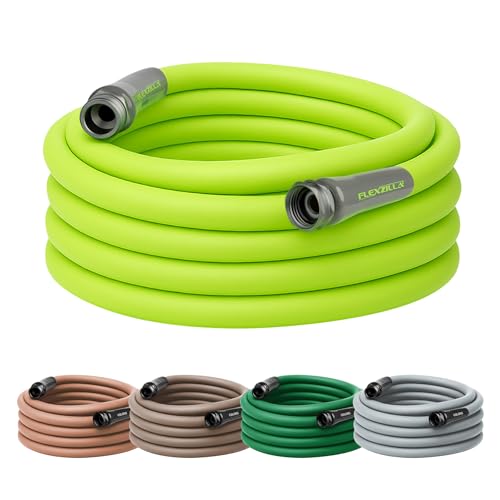
Flexzilla Garden Hose, 5/8 in x 50 ft
$39.97A lightweight hybrid polymer hose that lays flat with no memory, with crush-resistant anodized aluminum fittings.
Best for: everyday watering near the house
Check price on Amazon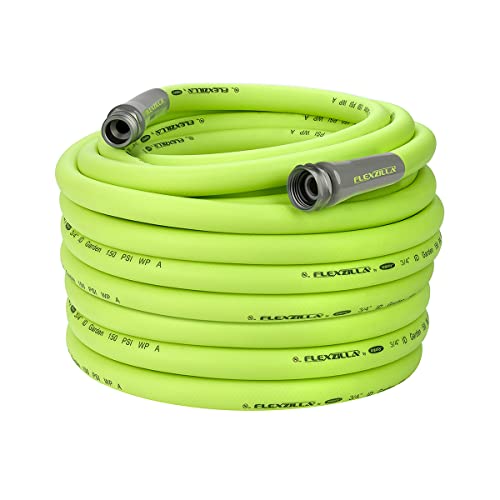
Flexzilla Garden Hose, 3/4 in x 100 ft
$89.00The same flexible hybrid polymer in a 3/4 inch bore, which carries more flow over 100 ft to impact and traveling sprinklers than a 5/8 inch hose.
Best for: running sprinklers far from the spigot
Check price on Amazon
Gilmour Flexogen Heavy Duty Garden Hose, 5/8 in x 100 ft
$55.99A made-in-USA 8-layer hose rated to 500 psi with crush-resistant brass couplings, built to resist kinks over a long run.
Best for: long pulls across the yard
Check price on Amazon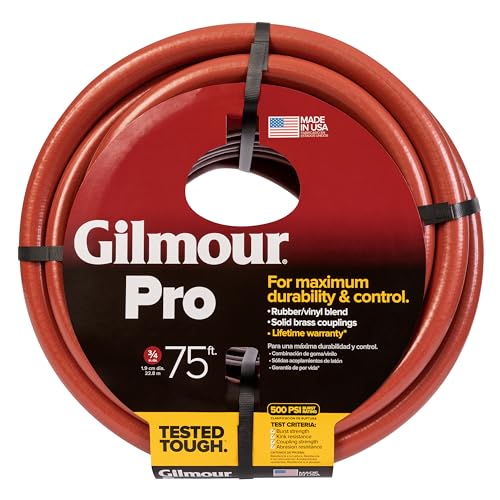
Gilmour Pro Commercial Heavy Duty Hose, 3/4 in x 75 ft
$72.59A double-reinforced commercial rubber and vinyl hose with 400 psi burst strength, brass couplings and a steel spring guard at the spigot, made in the USA.
Best for: high-flow sprinklers and rough use
Check price on Amazon
Dramm ColorStorm Premium Rubber Garden Hose, 5/8 in x 50 ft
$79.99A made-in-USA rubber hose rated for hot water to 160 F that coils easily in cold weather, with nickel-plated couplings and a lifetime guarantee.
Best for: people who want rubber that lasts
Check price on Amazon
zero-G Lightweight Garden Hose, 5/8 in x 100 ft
$69.98A non-expanding, drinking-water-safe hose about half the weight of commercial vinyl, with a 600 psi plus burst rating and crush-proof couplings.
Best for: a long hose that is easy to drag
Check price on Amazon
zero-G Pro Kink Free Garden Hose, 3/4 in x 75 ft
$72.98A 3/4 inch version of the lightweight non-expanding zero-G hose for higher flow without the weight of rubber.
Best for: lightweight high-flow sprinkler runs
Check price on Amazon
Suncast Metal Decorative 200 ft Hose Reel Cart
$159.99A powder-coated steel cart holding 200 ft of 5/8 inch vinyl hose, with aluminum leak-free connections, a swivel crank and flat-free wheels.
Best for: rolling a long hose around the yard
Check price on Amazon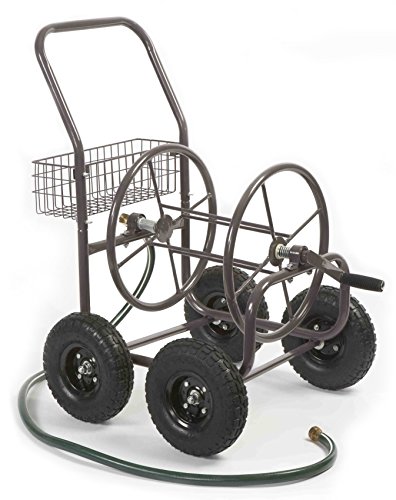
Liberty Garden 4-Wheel Steel Hose Reel Cart, 250 ft
$167.65A heavy 13-gauge steel four-wheel cart with a basket and crank that holds 250 ft of 5/8 inch hose, enough for chained hoses to a traveling sprinkler.
Best for: very long hose runs on acreage
Check price on Amazon
Giraffe Tools Retractable Wall Mount Hose Reel, 5/8 in x 115 ft
$219.99A 180 degree swivel wall reel with 115 ft of retractable 5/8 inch hybrid hose plus lead, any-length lock and a guided auto rewind.
Best for: full-size flow with auto rewind
Check price on Amazon
Nelson Rain Train Traveling Sprinkler, 13,500 sq ft
$77.75A cast iron tractor that follows the laid-out hose up to 200 ft with three speeds and automatic shut-off, covering up to 13,500 sq ft in one run.
Best for: big lawns without in-ground irrigation
Check price on Amazon
Dramm Revolver Heavy Duty Metal Hose Nozzle, 9 Patterns
$17.19A metal-bodied 9-pattern nozzle with thumb flow control and an insulated grip, covering mist through jet, with a lifetime guarantee.
Best for: hand watering seed and spot cleanup
Check price on AmazonOn this page
How much pressure does a garden hose lose per 100 feet?
| Flow | 1/2 in hose | 5/8 in hose | 3/4 in hose |
|---|---|---|---|
| 2 GPM | 5.1 psi | 1.7 psi | 0.7 psi |
| 4 GPM | 18.3 psi | 6.2 psi | 2.5 psi |
| 6 GPM | 38.7 psi | 13.1 psi | 5.4 psi |
| 8 GPM | 65.9 psi | 22.2 psi | 9.2 psi |
| 10 GPM | 99.7 psi | 33.6 psi | 13.8 psi |
| 12 GPM | 139.7 psi | 47.1 psi | 19.4 psi |
How much pressure is left at the end of a long hose?
| Hose length | 1/2 in | 5/8 in | 3/4 in |
|---|---|---|---|
| 25 ft | 53 psi | 58 psi | 59 psi |
| 50 ft | 46 psi | 55 psi | 58 psi |
| 75 ft | 39 psi | 53 psi | 57 psi |
| 100 ft | 32 psi | 51 psi | 56 psi |
| 150 ft | 19 psi | 46 psi | 54 psi |
| 200 ft | 5 psi | 41 psi | 52 psi |
How is hose pressure loss calculated?
- Friction loss, psi per foot = 4.52 x flow in GPM raised to 1.852 / (C raised to 1.852 x inside diameter in inches raised to 4.87), the Hazen-Williams equation for water
- Total friction loss = loss per foot x hose length
- Elevation = 0.433 psi lost for each foot the hose end is above the spigot
- Pressure at the end = spigot pressure minus friction and elevation losses
Diameter dominates because loss scales with roughly the fifth power of the inside diameter: a 3/4 inch hose loses less than half as much as a 5/8 inch hose at the same flow, and a 1/2 inch hose loses about three times as much as a 5/8 inch hose. Real hoses vary in inside diameter, and expandable hoses and those with narrow couplings lose more than the formula suggests. Static pressure read on a gauge with no water flowing is higher than the pressure available while water runs.
Which hose diameter should I buy?
For hand watering and short runs up to about 50 feet, a 5/8 inch hose such as the Flexzilla Garden Hose, 5/8 in x 50 ft is the practical standard. For 75 to 100 feet and more, or for impact and traveling sprinklers that need higher flow, step up to 3/4 inch: the Flexzilla Garden Hose, 3/4 in x 100 ft and Gilmour Pro Commercial Heavy Duty Hose, 3/4 in x 75 ft deliver noticeably more pressure at the far end. Lightweight woven hoses like the zero-G Lightweight Garden Hose, 5/8 in x 100 ft are easier to drag but check coupling size. A cart or reel sized to the hose length, such as the Liberty Garden 4-Wheel Steel Hose Reel Cart, 250 ft, stops kinks that add loss. See the best garden hoses and hybrid vs rubber garden hoses.
Why does my sprinkler not reach at the end of the hose?
Most often it is friction loss from a long or narrow hose, followed by kinks, restrictive quick connects, splitters running two sprinklers at once, and an uphill run. Impact sprinklers need decent pressure to rotate and throw full distance, and traveling sprinklers such as the Nelson Rain Train Traveling Sprinkler, 13,500 sq ft need enough flow to drive their wheels over a long hose. Fixes, in order of cost: shorten the hose, remove splitters and restrictive fittings, run one sprinkler at a time, and switch the long run to 3/4 inch hose. For regular lawn watering over long distances, a permanent line or in-ground zone is more reliable.
Frequently asked questions
Does a longer hose reduce water pressure?
Yes. Friction loss increases in direct proportion to length, so doubling the hose length doubles the pressure lost at a given flow. At 5 gallons per minute, 50 feet of 5/8 inch hose loses about 4.5 psi, while 150 feet loses about 14 psi. The effect is much larger with 1/2 inch hose and much smaller with 3/4 inch hose.
Is a 3/4 inch hose better than 5/8 inch?
For long runs and high-flow sprinklers, yes. A 3/4 inch hose loses less than half the pressure of a 5/8 inch hose at the same flow, so more pressure reaches the sprinkler. The trade-offs are weight, cost and reel capacity. For hand watering near the house, a lighter 5/8 inch hose is easier to handle and plenty.
How much flow does a garden hose deliver?
A 5/8 inch hose on a typical 40 to 60 psi supply often delivers roughly 9 to 17 GPM with the end fully open over a short run, falling with length and smaller diameters. Sprinklers and nozzles restrict flow to much less, typically 2 to 6 GPM, which is the flow to use when estimating pressure loss. A bucket test at the hose end measures your real flow.
Do expandable hoses lose more pressure?
Generally yes. Expandable hoses have a narrow inner tube and often small plastic fittings, which increase friction loss, and their diameter changes with pressure. They are convenient for short hand watering, but for sprinklers or long runs a conventional 5/8 or 3/4 inch hose delivers more consistent pressure and tends to last longer.
Does water pressure drop going uphill?
Yes, by about 0.433 psi for every foot of vertical rise, on top of friction loss. A sprinkler 20 feet above the spigot loses about 8.7 psi to elevation alone. Going downhill adds pressure by the same amount. For sloped yards, combine elevation with the friction loss from the calculator to estimate what reaches the sprinkler.
Researched, not professional advice. This page is compiled from published specifications, manuals, labels and owner-review consensus, not hands-on testing. Follow the manufacturer's instructions and product label, and consult a qualified professional where safety, chemicals, fuel or structures are involved. As an Amazon Associate we earn from qualifying purchases.