Lighting and Exterior
Best Low Voltage Landscape Lighting (2026): Kits and Transformers
Quick answer
The best low voltage landscape lights for most homes are cast aluminum LED fixtures like the Lumina 3W LED path lights on a transformer sized at total fixture watts divided by 0.8. Eight 3W path lights plus six 4W spotlights draw 48W, so a 60W minimum, and the Malibu 120W Power Pack covers it with room to grow.
Low voltage landscape lighting uses a plug-in transformer to step household 120V power down to about 12V, which runs through direct-burial cable to path lights and spotlights. It is brighter and more reliable than solar, and because the cable carries low voltage, most homeowners can install it themselves. The best setup pairs durable LED fixtures such as the Lumina 3W path lights ($189.99) and Lumina 4W spotlights ($128.99) with a correctly sized transformer like the SUNVIE 300W Two-Zone ($119.99).
Size the transformer before you buy anything: run your fixture count through the landscape lighting transformer calculator. The picks here come from published fixture wattage, ingress protection (IP) ratings, transformer features and owner-review themes.
On this page
- What are the best low voltage landscape lights?
- What size transformer do I need for landscape lighting?
- Solar vs hardwired landscape lights: which is better?
- Beginner pick: a complete kit for your first wired install
- Intermediate pick: LED spotlights for trees and the front of the house
- Expert pick: a two-zone LED system for the whole yard
- How do the landscape lighting picks compare on specs?
- What is the best outdoor lighting for a home?
- How do I install low voltage landscape lighting step by step?
What are the best low voltage landscape lights?
Landscape lighting has two jobs: path lights that wash light down onto walkways and beds, and spotlights that uplight trees, walls and the front of the house. The best fixtures for both are cast metal (not plastic stakes), LED, and rated at least IP65.
- Best path lights: Lumina 3W LED Path Lights (8-Pack). Cast aluminum, IP65, 8 in. shade for downlight without glare, pre-wired with UL-listed direct burial cable. Transformer not included.
- Best spotlights: Lumina 4W LED Spotlights (6-Pack). Tempered glass lenses and a 160-degree adjustable knuckle for trees, flags and walls.
- Best complete kit: Malibu 10-Light Kit with 150W Transformer. Six path lights, four spotlights, 75 ft of cable and the transformer in one box.
- Best transformer for larger systems: SUNVIE 300W Two-Zone. Two independently controlled outputs, photocell, timer and countdown modes, and built-in circuit protection.
- Best small transformer: Malibu 120W Power Pack. Detachable photocell and 4, 6, 8 or 10-hour countdown; the maker recommends loading it to about 90W.
What size transformer do I need for landscape lighting?
Add the wattage of every fixture, then divide by 0.8. That keeps the transformer loaded to no more than about 80 percent of its rating, which leaves headroom for voltage drop, heat and a few fixtures you add later. The transformer calculator does this math for any mix of fixtures.
| Fixtures | Total fixture watts | Watts divided by 0.8 | Transformer to buy |
|---|---|---|---|
| 8 Lumina 3W path lights | 24 W | 30 W | 120 W (Malibu Power Pack) |
| 8 path lights (3W) plus 6 spotlights (4W) | 48 W | 60 W | 120 W (Malibu Power Pack) |
| 16 path lights (3W) plus 6 spotlights (4W) | 72 W | 90 W | 120 W at the maker's 90 W guidance, or 300 W for growth |
| 16 path lights (3W) plus 12 spotlights (4W) | 96 W | 120 W | 150 W minimum, 300 W two-zone recommended |
| Malibu kit: 6 halogen path (10W) plus 4 halogen spots (20W) | 140 W | 175 W | 200 W or larger (the included 150 W runs at about 93 percent) |
| 24 path lights (3W) plus 18 spotlights (4W) | 144 W | 180 W | 300 W (SUNVIE Two-Zone) |
| Whole-yard system, 60 LED fixtures at 4W | 240 W | 300 W | 300 W at the limit; consider two transformers |
Watts are the fixture ratings published by Lumina and Malibu. Always use the actual wattage printed on your fixtures or bulbs.
Solar vs hardwired landscape lights: which is better?
For lighting you rely on, wired low voltage wins. Solar stake lights run on a small panel and battery, so their output depends on how much direct sun the panel got that day. In shade, on cloudy stretches, and on short winter days, they dim early or never come on. Low voltage fixtures run every night at full output on a timer or photocell.
Note that "hardwired" gets used for two different systems. Low voltage (12V) systems plug into an outdoor outlet through a transformer, and homeowners can install them. Line voltage (120V) fixtures, such as the Lithonia HomeGuard motion flood and LEONLITE 25W security light, connect to household wiring in a junction box, and that work belongs to a licensed electrician.
Solar still has a place: accent lights where cable cannot reach, like the NYMPHY solar spotlights on a far shrub bed, or a renter's walkway using Mancra solar path lights. For the full side-by-side, read solar vs low voltage landscape lights and our best solar path lights.
Beginner pick: a complete kit for your first wired install
If you have never run landscape cable, start with everything in one box and a transformer that is easy to set.

Malibu 10-Light Low Voltage Landscape Kit with 150W Transformer
$259.99Six path lights, four spotlights, 75 ft of cable and a 150W transformer, all in metal fixtures with connectors and stakes. The fixtures are halogen, so the ten lights draw about 140W and load the transformer near its limit; swapping spotlights to LED later frees up capacity.
Best for: a first wired landscape lighting install
Check price on Amazon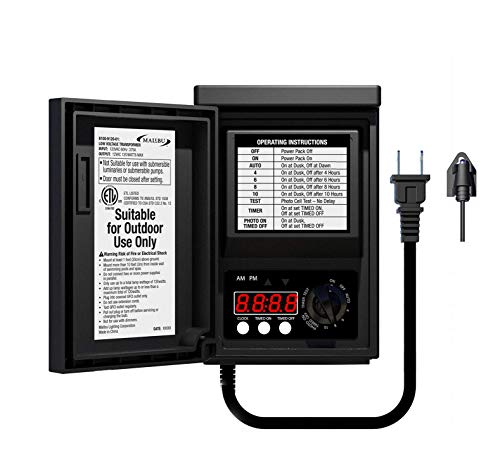
Malibu 120 Watt Landscape Power Pack with Sensor
$69.99A 120W transformer with a detachable photocell, dusk-to-dawn and 4 to 10-hour countdown modes and circuit protection. Malibu recommends running it at about 90W, which still powers roughly 22 to 30 LED fixtures at 3 to 4W each.
Best for: powering up to about 90W of LED fixtures
Check price on AmazonIntermediate pick: LED spotlights for trees and the front of the house
Once path lights are in, uplighting is what makes a house look finished from the street. These add accent light efficiently.
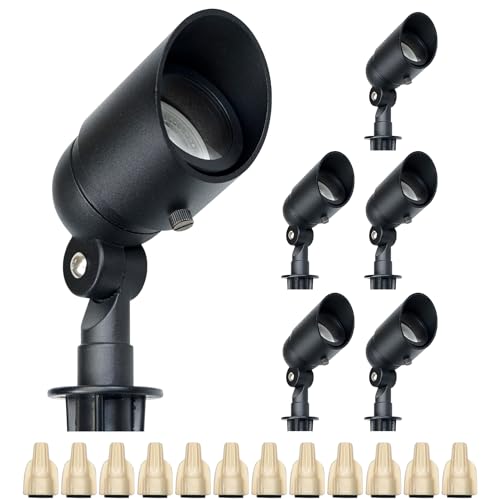
Lumina Lighting 4W LED Low Voltage Spotlights (6-Pack)
$128.99Cast aluminum with tempered glass lenses, IP65 sealing and a 160-degree adjustable knuckle. At 4W each, six spotlights draw 24W, a fraction of equivalent halogen spots.
Best for: uplighting trees and the front of the house
Check price on Amazon
Kasa EP40 Outdoor Smart Plug (2 Outlets)
$17.28Two IP64 outlets controlled independently from an app, each rated 15A, with sunrise and sunset scheduling. Plug a transformer into one outlet and string lights into the other to run the whole patio on a schedule.
Best for: putting lights on a sunset schedule
Check price on AmazonExpert pick: a two-zone LED system for the whole yard
For front and back yards on different schedules, or systems past about 100W, build your own system from quality fixtures and a large transformer.

Lumina Lighting 3W LED Low Voltage Path Lights (8-Pack)
$189.99Cast aluminum IP65 path lights with an 8 in. shade that throws a wide circle of light down onto the path instead of into your eyes, and replaceable G4 LED bulbs so a failed bulb does not mean a new fixture.
Best for: upgrading a walkway with durable LED fixtures
Check price on Amazon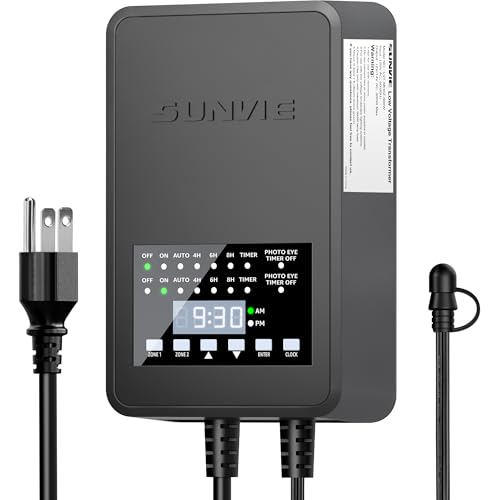
SUNVIE 300W Two-Zone Landscape Transformer with Timer
$119.99Converts 120V to 12 or 14V across two independently controlled zones, each with manual, auto, countdown, timer and photocell modes. The 14V tap helps offset voltage drop on long cable runs, and circuit protection resets after a fault.
Best for: larger systems that need two lighting schedules
Check price on AmazonWho should not buy this tier: Skip a DIY system this size if your outdoor outlet is not GFCI protected, if you need a new outlet installed, or if the layout crosses long driveways and hardscape where cable has to be trenched under pavers. Those jobs need an electrician or a landscape lighting contractor. If you only want a few lights along a short path, the Malibu kit or the Lumina path lights on a 120W Malibu transformer are plenty.
How do the landscape lighting picks compare on specs?
| Model | Price | Type | Count | Power | Power | Length |
|---|---|---|---|---|---|---|
| Lumina Lighting 3W LED Low Voltage Path Lights (8-Pack) | $189.99 | path light | 8 | low voltage | 3 W | - |
| Lumina Lighting 4W LED Low Voltage Spotlights (6-Pack) | $128.99 | spotlight | 6 | low voltage | 4 W | - |
| Malibu 10-Light Low Voltage Landscape Kit with 150W Transformer | $259.99 | path and spot light kit | 10 | low voltage | 150 W | 75 ft |
| SUNVIE 300W Two-Zone Landscape Transformer with Timer | $119.99 | low voltage transformer | - | low voltage | 300 W | - |
| Malibu 120 Watt Landscape Power Pack with Sensor | $69.99 | low voltage transformer | - | low voltage | 120 W | - |
| Kasa EP40 Outdoor Smart Plug (2 Outlets) | $17.28 | outdoor smart plug (2 outlets) | - | plug in | - | - |
What is the best outdoor lighting for a home?
Most homes are best served by three layers rather than one bright fixture.
- Safety and security lighting at doors, driveways and side yards. Motion floodlights like the Lithonia HomeGuard (switchable 2150 or 2600 lumens and 3000K to 5000K color, 5-year limited warranty) or the Ring Floodlight Cam 4K Pro (2000 lumens plus a camera) mount to a junction box. See the Ring Floodlight Cam 4K Pro review.
- Path and step lighting so people can see edges and grade changes. Low voltage path lights spaced about 8 to 10 ft apart give overlapping pools of light without a runway look.
- Accent and patio lighting: spotlights on trees and architecture, plus outdoor string lights over seating.
Match color temperature across layers. Warm white around 2700K to 3000K looks natural on stone, brick and plants; 5000K daylight reads as security lighting. The landscape lighting planning guide walks through layout, fixture spacing and cable routing.
How do I install low voltage landscape lighting step by step?
- Plan and add up watts. Sketch fixture locations, total the fixture watts and size the transformer at watts divided by 0.8.
- Check the outlet. Mount the transformer near a GFCI-protected outdoor outlet with an in-use weatherproof cover, at least 1 ft above grade or as the manual specifies.
- Call 811. Call 811 a few days before digging so buried utility lines are marked, even for shallow cable trenches.
- Lay out cable and fixtures. Run direct-burial cable from the transformer, place fixtures on stakes and connect them with the supplied waterproof connectors.
- Test at night. Power the system after dark, aim spotlights and check that the farthest fixtures are not visibly dimmer than the nearest.
- Bury and set the timer. Bury cable a few inches deep or under mulch, then set the photocell, timer or countdown mode.
How we chose
We did not test these products in person. Picks are researched from manufacturer specifications and owner manuals, engine and safety certifications where they apply, warranty terms, public recall records, and the recurring themes in verified owner reviews. We favor established brands with large review counts and parts support, match each pick to a real yard size or task, and place it in the tier where its price and capability actually belong.
Frequently asked questions
What is the best brand of low voltage landscape lighting?
For DIY homeowners, look for cast aluminum or brass LED fixtures with at least an IP65 rating and replaceable bulbs rather than a specific brand name. In our catalog, Lumina Lighting path lights and spotlights meet that bar at DIY prices, Malibu offers the most complete starter kits, and SUNVIE makes a capable two-zone 300W transformer. Professional-grade brands sold through installers cost more and mostly add longer warranties.
How many lights can I put on a 120 watt transformer?
Divide the transformer rating by your fixture wattage after leaving headroom. Loading to 80 percent gives 96W usable on a 120W transformer, which runs about 32 fixtures at 3W or 24 at 4W. Malibu recommends running its 120W Power Pack at about 90W, which is 30 fixtures at 3W. Halogen fixtures at 10 to 20W each drop that count to between about 5 and 9.
Are solar landscape lights as good as low voltage?
No, not for reliable brightness. Solar lights depend on how much direct sun each panel received, so they dim early in shade, on cloudy days and in winter when days are short. Low voltage LED lights run at full output every night on a timer or photocell. Solar is still useful for spots cable cannot reach, rentals, and decorative accents where brightness is less important.
Do I need an electrician to install landscape lighting?
Not for a plug-in low voltage system. A transformer that plugs into an existing GFCI-protected outdoor outlet, with 12V cable and stake-mounted fixtures, is a common DIY project. You do need a licensed electrician to add a new outdoor outlet, install line voltage fixtures such as hardwired floodlights, or wire anything inside a junction box. Always call 811 before digging trenches for cable.
How far apart should landscape path lights be?
Space path lights about 8 to 10 ft apart for most walkways, closer if the fixture has a small shade or low output, and farther if it throws a wide circle of light. Stagger them on alternating sides of a path instead of lining both edges, which looks like an airport runway. Test placement at night before burying cable, since the right spacing depends on fixture height and shade size.
Why are my farthest landscape lights dimmer?
That is voltage drop: the longer the cable run and the higher the load, the lower the voltage reaching the last fixtures. Fixes include using heavier gauge cable, splitting one long run into two shorter runs fed from the transformer, keeping the load under about 80 percent, and using a transformer with a 14V tap like the SUNVIE 300W to boost voltage at the start of long runs. LED fixtures are less sensitive than halogen.
Researched, not professional advice. This page is compiled from published specifications, manuals, labels and owner-review consensus, not hands-on testing. Follow the manufacturer's instructions and product label, and consult a qualified professional where safety, chemicals, fuel or structures are involved. As an Amazon Associate we earn from qualifying purchases.