Mowers
Best Mowers for Hills (2026): Riders, Walk-Behinds and Robots
Quick answer
The best riding mower for hills is the Husqvarna TS 375XD lawn tractor, whose differential lock drives both rear wheels for traction on damp slopes. Follow its manual slope limit. For banks steeper than that, use a rear-wheel-drive walk-behind, or a robot such as the Mammotion LUBA 2 AWD, rated for 80 percent slopes.
Hills change the mower question from "how fast?" to "how safely?" Riding mowers tip or slide when a slope exceeds what their weight and tires can hold. That is why every operator manual publishes a maximum slope, and why many hilly properties are best mowed with two machines: a rider for the gentle ground and a walk-behind or robot for the banks.
Our top pick is the Husqvarna TS 375XD 54 in. Lawn Tractor at $5,199.00, a heavy tractor with a differential lock for traction. For the steep parts, the Mammotion LUBA 2 AWD 3000X Robot Mower is rated for 80 percent slopes, and no one has to ride or walk the bank at all. Check the slope and size of your lawn in the mower type calculator.
On this page
- How steep is too steep for a riding mower?
- What slope can each type of mower handle?
- What is the best riding mower for 2 acres with hills?
- What is the best riding mower for 1 acre with hills?
- Beginner pick: rear-wheel-drive walk-behinds for steep banks
- Intermediate pick: robot mowers rated for steep slopes
- Expert pick: heavy tractor or top-tier AWD robot
- How do the hill picks compare on specs?
- Is front or rear-wheel drive better for mowing hills?
- Which robot mowers are rated for 45 percent slopes and higher?
- How do I mow a steep slope safely, step by step?
How steep is too steep for a riding mower?
Too steep is any slope beyond the maximum in your mower's operator manual. Many residential riding mower manuals set that limit at around 15 degrees or less, which is about a 27 percent grade, and some set it lower. The manual's number assumes dry, firm turf. On wet grass, loose soil or near drop-offs, ditches and water, the safe limit is lower.
Slope percent is rise divided by run, times 100. To measure it, lay a straight 10 foot board on the slope pointing downhill, level it with a carpenter's level, and measure from the low end of the board to the ground. A 2 foot gap is a 20 percent slope, about 11 degrees. Many manuals include a printed slope gauge page for sighting against a tree or post.
What slope can each type of mower handle?
| Slope | Angle | Rise over 10 ft | Typical guidance |
|---|---|---|---|
| 10% | 5.7 degrees | 1 ft | Most riders and walk-behinds; slow down on turns |
| 15% | 8.5 degrees | 1.5 ft | Riders where the manual allows; zero-turns only on dry turf |
| 20% | 11.3 degrees | 2 ft | Near many riding mower manual limits; check yours |
| 27% | 15 degrees | 2.7 ft | Upper end of limits in many rider manuals; walk-behind or robot territory |
| 35% | 19.3 degrees | 3.5 ft | Rear-wheel-drive walk-behind across the slope, or a robot rated 45% |
| 45% | 24.2 degrees | 4.5 ft | Rated limit of Husqvarna Automower iQ and Segway Navimow i210 AWD |
| 80% | 38.7 degrees | 8 ft | Rated limit of Mammotion LUBA 2 AWD and LUBA 3 AWD |
| 84% | 40 degrees | 8.4 ft | Rated limit of WORX Landroid Vision Cloud WR342 |
Robot ratings are manufacturer figures for dry grass. Riding mower limits vary by model: the number in your operator manual always wins over this table.
What is the best riding mower for 2 acres with hills?
For 2 acres with hills, the best riding mower is the Husqvarna TS 375XD 54 in. Lawn Tractor. Its 24 HP Kawasaki V-twin and 54 inch fabricated deck mow 2 acres in about 72 minutes, and the differential lock drives both rear wheels together on damp grass. Front-wheel steering keeps you in control if the rear tires slip, which a zero-turn cannot do.
If the slopes are gentle and mostly dry, a hydrostatic tractor like the Husqvarna TS 140X 54 in. Lawn Tractor costs less. Mow up and down slopes, not across, unless your manual directs otherwise, and never turn sharply while on a slope. More in what size mower for 2 acres with hills.
What is the best riding mower for 1 acre with hills?
For 1 acre with hills, a 42 to 46 inch hydrostatic lawn tractor such as the Husqvarna TS 120 46 in. Lawn Tractor handles gentle slopes within its manual limit. On an acre with steep sections, consider skipping the rider entirely: the Husqvarna Automower 420iQ Robot Mower is rated for 1 acre and 45 percent slopes, and the Mammotion LUBA 3 AWD 5000 Robot Mower for 1.25 acres and 80 percent. A robot removes the rollover risk because nobody rides the slope.
For banks beyond any rider limit, keep a rear-wheel-drive walk-behind. See what size mower for 1 acre with hills and robot mower size for steep yards.
Beginner pick: rear-wheel-drive walk-behinds for steep banks
A self-propelled walk-behind is the traditional answer for banks too steep to ride. Rear-wheel drive matters: as you push uphill, weight shifts onto the rear wheels, which is where RWD mowers put their traction.

Greenworks 80V 21 in. Self-Propelled Mower Kit
$479.99Rear-wheel drive with variable speed and an 80V brushless motor, rated for half an acre per 4.0Ah charge. With no fuel sloshing and no oil, it is easier to handle on a bank than a gas mower, and it has a 4-year warranty.
Best for: Half-acre lawns with slopes
Check price on Amazon
PowerSmart 22 in. High Wheel Self-Propelled Gas Mower, 170cc
$347.98A value-brand 22 inch steel deck with 10 inch rear wheels and single-speed rear-wheel drive, which PowerSmart pitches for bagging on inclines. The 1.4-bushel bag adds weight over the drive wheels.
Best for: Bagging clippings on sloped lawns
Check price on Amazon
BILT HARD 21 in. 3-in-1 Self-Propelled Gas Mower, 201cc
$319.99A 201cc engine rated at 9.0 ft-lb of torque with rear-wheel drive and no-choke, no-primer starting. BILT HARD is a value brand, so expect simpler build quality, but the drive layout suits hills.
Best for: Budget buyers with a hilly yard
Check price on AmazonIntermediate pick: robot mowers rated for steep slopes
Robots take people off the slope entirely. These three carry the highest slope ratings in their size classes.

Mammotion LUBA 2 AWD 3000X Robot Mower
$1,998.00Four-wheel drive is rated for 80 percent slopes, about 38 degrees, with RTK plus AI vision navigation, a 15.8 inch dual-blade disc and up to 10,700 sq ft per charge, rated for 0.75 acre overall.
Best for: Steep lawns up to 3/4 acre
Check price on Amazon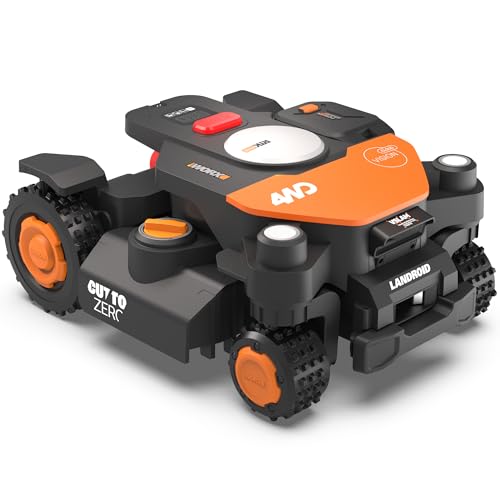
WORX Landroid Vision Cloud WR342 4WD Robot Mower
$2,069.994WD is rated for 84 percent slopes, about 40 degrees, the highest rating here. Cloud RTK needs no local antenna, and vision-based navigation takes over in shade. Rated for half an acre.
Best for: Hilly half-acre yards
Check price on Amazon
Husqvarna Automower 420iQ Robot Mower
$1,841.66Rated for 45 percent slopes and 1 acre with wire-free EPOS positioning and radar obstacle detection. Lower slope rating than the AWD robots, but it comes with Husqvarna dealer service.
Best for: Moderate hills up to 1 acre
Check price on AmazonExpert pick: heavy tractor or top-tier AWD robot
For large sloped properties: the most traction a residential rider offers, or the most capable robot for steep, complex ground.

Husqvarna TS 375XD 54 in. Lawn Tractor
$5,199.00A 24 HP, 726cc Kawasaki FR V-twin, 54 inch fabricated deck and a differential lock for traction on damp slopes. It is the heavy-duty tractor for big properties with rolling ground, within its manual limits.
Best for: Large properties with rolling slopes
Check price on Amazon
Mammotion LUBA 3 AWD 5000 Robot Mower
$3,299.00360-degree LiDAR, network RTK and dual-camera vision, four independent drive motors rated for 80 percent slopes, adaptive suspension for curbs and roots, and a rated 1.25 acres with up to 50 zones.
Best for: Steep, complex lawns up to 1.25 acres
Check price on Amazon Who should not buy this tier: Do not buy the TS 375XD expecting it to mow slopes beyond its manual limit: a differential lock adds traction, not rollover resistance. Skip the LUBA 3 if your lawn has deep holes, soft ground that ruts under wheels, or no reliable cellular or network coverage for its RTK corrections. And no rider in this list is a substitute for a walk-behind on a steep embankment next to water or a drop-off.
How do the hill picks compare on specs?
| Model | Price | Deck width | Drive | Max slope | Rated area | Horsepower | Boundary |
|---|---|---|---|---|---|---|---|
| Husqvarna TS 375XD 54 in. Lawn Tractor | $5,199.00 | 54 in | - | - | - | 24 hp | - |
| Greenworks 80V 21 in. Self-Propelled Mower Kit | $479.99 | 21 in | rwd | - | - | - | - |
| PowerSmart 22 in. High Wheel Self-Propelled Gas Mower, 170cc | $347.98 | 22 in | rwd | - | - | - | - |
| BILT HARD 21 in. 3-in-1 Self-Propelled Gas Mower, 201cc | $319.99 | 21 in | rwd | - | - | - | - |
| Mammotion LUBA 2 AWD 3000X Robot Mower | $1,998.00 | - | - | 80% | 32,670 sq ft | - | rtk+vision |
| WORX Landroid Vision Cloud WR342 4WD Robot Mower | $2,069.99 | - | - | 84% | 21,780 sq ft | - | rtk+vision |
| Husqvarna Automower 420iQ Robot Mower | $1,841.66 | - | - | 45% | 43,560 sq ft | - | rtk |
| Mammotion LUBA 3 AWD 5000 Robot Mower | $3,299.00 | - | - | 80% | 54,450 sq ft | - | rtk+vision |
Is front or rear-wheel drive better for mowing hills?
Rear-wheel drive is better for hills. When you push a mower uphill, its weight shifts back onto the rear wheels, so a rear-wheel-drive mower gains traction exactly where it needs it. A front-wheel-drive mower loses traction climbing, especially when the bag fills and adds weight at the back. Front-wheel drive is easier to pivot on flat lawns, which is why it suits level yards. See front vs rear-wheel drive self-propelled mowers.
With any walk-behind, mow across the face of the slope, never up and down, so the mower cannot roll back onto you and you cannot slip under the deck. Wear shoes with good grip, skip wet grass, and never pull the mower toward you.
Which robot mowers are rated for 45 percent slopes and higher?
| Model | Max slope | Approx. angle | Rated area | Navigation |
|---|---|---|---|---|
| WORX Landroid Vision Cloud WR342 | 84% | 40 degrees | 0.5 acre | Cloud RTK + vision, 4WD |
| Mammotion LUBA 3 AWD 5000 | 80% | 38.7 degrees | 1.25 acres | LiDAR + network RTK + vision, 4-motor AWD |
| Mammotion LUBA 2 AWD 3000X | 80% | 38.7 degrees | 0.75 acre | RTK + vision, 4WD |
| Husqvarna Automower 440iQ | 45% | 24.2 degrees | 2 acres | EPOS RTK |
| Husqvarna Automower 420iQ | 45% | 24.2 degrees | 1 acre | EPOS RTK |
| Husqvarna Automower 430X | 45% | 24.2 degrees | 0.8 acre | Boundary wire |
| Segway Navimow i210 AWD | 45% | 24.2 degrees | 0.25 acre | Network RTK + vision, AWD |
| Segway Navimow i215 LiDAR | 45% | 24.2 degrees | 0.37 acre | Solid-state LiDAR + vision |
Manufacturer ratings. Slope capability falls on wet grass, and steep areas near the rated limit reduce effective coverage per charge.
How do I mow a steep slope safely, step by step?
- Measure the slope. Use a 10 foot board and a level, or a slope gauge page from your manual, and compare the result to the mower manual limit.
- Wait for dry grass. Mow slopes only when the grass and soil are dry. Wet turf is the most common cause of tire slide on riders.
- Choose the direction. With a riding mower, mow up and down the slope unless the manual says otherwise. With a walk-behind, mow across the face.
- Clear the area. Remove sticks, rocks and toys, and mark holes, stumps and drop-offs. Keep children and pets indoors.
- Go slow and avoid sharp turns. Use a low speed, avoid stopping or turning on the slope, and never mow in reverse without looking behind you.
- Leave the steepest parts to other tools. Use a walk-behind, string trimmer or slope-rated robot on banks beyond the limit, and keep riders away from edges of ditches and water.
How we chose
We did not test these products in person. Picks are researched from manufacturer specifications and owner manuals, engine and safety certifications where they apply, warranty terms, public recall records, and the recurring themes in verified owner reviews. We favor established brands with large review counts and parts support, match each pick to a real yard size or task, and place it in the tier where its price and capability actually belong.
Frequently asked questions
What is the best riding mower for hills?
The Husqvarna TS 375XD is the best riding mower for hills among the models sold on Amazon. It is a heavy lawn tractor with a 24 HP Kawasaki V-twin, a fabricated 54 inch deck and a differential lock for traction on damp slopes. Stay within the maximum slope in its operator manual, and mow only when the grass is dry.
Are zero turn mowers bad on hills?
Zero-turn mowers are the least forgiving riding mowers on hills. They steer and brake through the rear drive wheels, so if those tires lose grip on wet or steep grass, you lose steering and braking at the same time. They can be used on gentle, dry slopes within their manual limit. Steep ground is better handled by a tractor, walk-behind or robot.
Should you mow up and down or across a hill?
It depends on the mower, so check the manual. Riding mower manuals generally say to mow up and down slopes, because a rider mowing across a slope can tip sideways. Walk-behind manuals generally say to mow across the slope, so the mower cannot roll back onto you and you cannot slip under the deck. Never mow slopes when the grass is wet.
What is the best self-propelled mower for hills?
A rear-wheel-drive self-propelled mower is best for hills, because weight shifts onto the rear wheels as you climb. The Greenworks 80V 21 inch mower pairs rear-wheel drive with variable speed and a half-acre rating. Among gas models, the PowerSmart 22 inch high wheel and BILT HARD 21 inch 201cc mowers both use rear-wheel drive at lower prices.
Can robot mowers handle steep hills?
Yes, within their ratings. The WORX Landroid Vision Cloud WR342 is rated for 84 percent slopes, about 40 degrees, and the Mammotion LUBA 2 AWD 3000X and LUBA 3 AWD 5000 for 80 percent. Husqvarna Automower iQ models are rated for 45 percent. Ratings assume dry grass, and robot mowers take people off the slope entirely.
How do I measure the slope of my yard?
Lay a straight 10 foot board on the slope pointing downhill, level it with a carpenter's level, and measure the gap from the low end of the board to the ground in feet. Multiply by 10 to get the slope percent: a 2 foot gap means a 20 percent slope, about 11 degrees. Smartphone inclinometer apps give a quick estimate too.
Researched, not professional advice. This page is compiled from published specifications, manuals, labels and owner-review consensus, not hands-on testing. Follow the manufacturer's instructions and product label, and consult a qualified professional where safety, chemicals, fuel or structures are involved. As an Amazon Associate we earn from qualifying purchases.