Pressure Washing
Best Pressure Washers for Home Use (2026): PSI, GPM and Picks
Quick answer
For most homes the best pressure washer is a 2,500 to 3,300 PSI machine flowing 2.0 GPM or more. The Simpson PowerShot PS3228 (3,300 PSI, 2.5 GPM, Honda GX200, triplex pump) is the top pick for driveways and siding, while a 2,000 PSI electric such as the Sun Joe SPX3000 handles cars, furniture and decks.
The best pressure washer PSI for home use is 2,000 to 3,300, paired with at least 1.2 GPM for light jobs and 2.0 GPM or more for concrete and siding. Most exterior surfaces around a house need far less than a machine's maximum pressure, so the real reasons to buy a bigger unit are flow (faster rinsing) and durability, not raw PSI.
Our top pick is the Simpson PowerShot PS3228 at $659.00: a Honda GX200 engine, a AAA triplex plunger pump and 3,300 PSI at 2.5 GPM. If you only wash vehicles, patio furniture and a small deck, a $169.00 Sun Joe SPX3000 is the honest answer and you can skip everything else on this page. Run your own surfaces through the pressure washer PSI calculator before you shop.
On this page
- What PSI pressure washer is best for home use?
- What PSI should I use on each surface?
- Pressure washer GPM vs PSI: which matters more?
- Beginner picks: electric pressure washers for cars, decks and furniture
- Intermediate picks: driveway-capable electric and first gas machines
- Expert picks: triplex-pump gas pressure washers built to last
- How do the picks compare on specs?
- Should I buy a gas or electric pressure washer?
- What accessories make a home pressure washer work better?
- What should I check before buying a pressure washer?
What PSI pressure washer is best for home use?
A pressure washer is a pump that turns garden-hose water into a narrow high-pressure stream. PSI (pounds per square inch) is how hard that water hits the surface, and GPM (gallons per minute) is how much water carries the loosened dirt away. You need both, and you need to control PSI with the nozzle and your distance from the surface.
As general guidance, cars clean at 1,200 to 1,900 PSI, vinyl siding at 1,300 to 1,600 PSI, wood decks at 500 to 1,200 PSI depending on species, and concrete at 2,500 to 3,000 PSI or more. That spread explains the two sensible buys: a 2,000 to 2,500 PSI electric for vehicles, furniture, grills and decks, or a 3,000 to 3,400 PSI gas machine that covers concrete and then gets turned down with a wider tip and more distance for everything else.
- Townhome, condo or small patio: 2,000 PSI electric at 1.2 GPM.
- Typical suburban house with a two-car driveway: 3,000 PSI electric at 2.0 GPM or a 3,300 PSI gas unit at 2.4 to 2.5 GPM.
- Long driveway, large patio, fences and paint prep: 3,300 PSI gas with a triplex pump, or 4,000 PSI plus at 4.0 GPM for very large concrete areas.
What PSI should I use on each surface?
Start at the low end of each range with the widest tip, 12 to 18 inches from the surface, and move closer only if dirt is not lifting. Each surface has its own page with details: concrete driveways, vinyl siding, wood decks and cars.
| Surface | PSI range | Nozzle tip | Minimum useful GPM | Watch out for |
|---|---|---|---|---|
| Cars, trucks, boats | 1,200 to 1,900 | 40 degree (white) or soap tip | 1.2 | Clear coat edges, badges, window seals |
| Patio furniture (resin, metal) | 1,200 to 1,500 | 40 degree | 1.2 | Cushion fabric and wicker: hose only |
| Vinyl siding | 1,300 to 1,600 | 25 or 40 degree, spray downward | 1.2 | Water forced up under laps; never from a ladder |
| Cedar or redwood deck | 500 to 600 | 40 degree | 1.2 | Furring and gouges from close passes |
| Pressure-treated pine deck | 600 to 800 | 25 or 40 degree | 1.2 | Lifted grain; let it dry before sealing |
| Hardwood deck (ipe and similar) | Up to about 1,200 | 25 or 40 degree | 1.2 | Follow the decking supplier care sheet |
| Composite deck | Check maker limit (often about 1,500) | 40 degree fan | 1.2 | Warranty terms on pressure and tip |
| Brick and pavers | 1,500 to 2,500 | 25 degree or surface cleaner | 2.0 | Mortar joints and polymeric sand |
| Concrete driveway | 2,500 to 3,000+ | 15 or 25 degree, or surface cleaner | 2.0 to 2.5 | Stripes from uneven wand passes |
| Asphalt shingle roof | Do not pressure wash | Low-pressure soft wash only | n/a | Granule loss and voided shingle warranty |
Ranges are general guidance compiled from manufacturer manuals and surface makers. Your siding, decking or stain maker may set a lower limit, and that limit wins.
Pressure washer GPM vs PSI: which matters more?
PSI breaks the bond between grime and the surface; GPM rinses it away. Past about 2,500 PSI, flow usually matters more for how fast a job finishes, because a 2.5 GPM machine pushes roughly twice the water of a 1.2 GPM electric over the same patch. That is why a 3,300 PSI gas unit at 2.5 GPM cleans a driveway far faster than a 3,000 PSI label on a low-flow electric suggests.
A quick way to compare machines is cleaning units = PSI x GPM. It is a rough index, not an industry standard, and brands use different formulas: Greenworks lists 3,300 cleaning units for its 3,000 PSI, 2.0 GPM electric, which is not PSI x GPM. Compare machines using one formula, and use rated numbers rather than maximums, because many electrics only reach peak PSI and peak GPM at different moments. The full breakdown is on pressure washer PSI vs GPM.
| Model | Power | PSI | GPM | PSI x GPM |
|---|---|---|---|---|
| Greenworks 2000 PSI electric | Electric | 2,000 | 1.2 | 2,400 |
| Westinghouse ePX3500 (rated) | Electric | 2,000 | 1.2 | 2,400 |
| Karcher K 5 Premium | Electric | 2,000 | 1.4 | 2,800 |
| Sun Joe SPX3000 (max) | Electric | 2,500 | 1.2 | 3,000 |
| Greenworks 3000 PSI brushless | Electric | 3,000 | 2.0 | 6,000 |
| Champion 2800 PSI | Gas, 196cc | 2,800 | 2.1 | 5,880 |
| Simpson PowerShot PS3228 | Gas, Honda GX200 | 3,300 | 2.5 | 8,250 |
| Simpson Clean Machine 3400 | Gas, 208cc | 3,400 | 2.5 | 8,500 |
| Simpson PowerShot 4400 | Gas, 420cc | 4,400 | 4.0 | 17,600 |
The Sun Joe row uses its 2,500 max PSI; at its 2,030 PSI working pressure the product is about 2,436.
Beginner picks: electric pressure washers for cars, decks and furniture
For owners who clean a vehicle, a grill, patio furniture and a modest deck a few times a year. Electrics start with a switch, store on a shelf and need no winterizing beyond draining water from the pump.

Sun Joe SPX3000 Electric Pressure Washer
$169.00Sun Joe lists 2,500 max PSI and 2,030 PSI working pressure at 1.2 GPM, with five quick-connect tips (0, 15, 25, 40 degree and soap), a 34 in. stainless wand and two 0.9 liter detergent tanks. The 20 ft hose is short, so plan to move the machine as you work around a house.
Best for: cars, patio furniture and small decks
Check price on Amazon
Westinghouse ePX3500 Electric Pressure Washer
$169.00Rated 2,000 PSI and 1.2 GPM (2,500 PSI and 1.76 GPM at its extremes) in a 19 lb, 16.5 in. tall anti-tip body. It ships with a 25 ft braided hose, a 20 oz soap tank and 3-year limited service, labor and parts coverage.
Best for: small storage spaces and all-around light cleaning
Check price on AmazonIntermediate picks: driveway-capable electric and first gas machines
For a typical suburban house: a two-car driveway, a sidewalk, vinyl siding and a fence. This tier doubles the flow of entry electrics, which is what makes concrete go faster.

Greenworks 3000 PSI 2.0 GPM Brushless Electric Pressure Washer
$349.99A 14 amp brushless motor producing 3,000 PSI and 2.0 GPM, figures Greenworks says an independent lab verified. It adds a metal gun, a 25 ft kink-resistant hose and turbo plus soap nozzles, so it can run a surface cleaner without the upkeep of an engine.
Best for: driveways and siding without gas engine maintenance
Check price on Amazon
Simpson Clean Machine 3400 PSI 2.5 GPM Gas Pressure Washer
$329.99A 208cc CRX engine with low-oil shutdown drives a maintenance-free axial cam pump at 3,400 PSI and 2.5 GPM, on 10 in. pneumatic tires that roll over gravel and curbs. It is listed as 49-state compliant and not for sale in California.
Best for: homeowners stepping up to gas for concrete
Check price on Amazon
Kärcher K 5 Premium Electric Pressure Washer with Hose Reel
$386.01A water-cooled induction motor and non-corrosive pump rated at 2,000 PSI and 1.4 GPM, with a Vario Power wand that turns pressure down for delicate surfaces and a Dirt Blaster rotating wand for grime. The onboard hose reel keeps the 25 ft hose tidy.
Best for: weekly car and patio washing where tidy storage matters
Check price on AmazonExpert picks: triplex-pump gas pressure washers built to last
For large concrete areas, long driveways, fence and deck restoration, paint prep or anyone who pressure washes most weekends. Triplex plunger pumps are serviceable and designed for long hours, unlike most sealed axial cam pumps on homeowner units.

Simpson PowerShot PS3228 3300 PSI Honda GX200 Gas Pressure Washer
$659.00Honda GX200 engine with low-oil shutdown and a AAA triplex plunger pump with an integrated unloader and thermal relief, at 3,300 PSI and 2.5 GPM. Five quick-connect tips and a 25 ft MorFlex hose are included.
Best for: heavy regular use, paint prep and large driveways
Check price on Amazon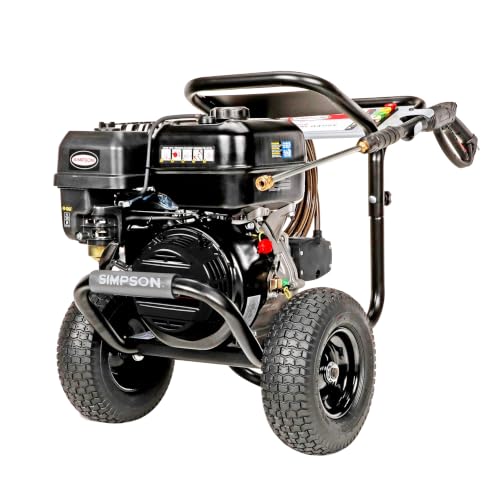
Simpson PowerShot 4400 PSI 4.0 GPM Gas Pressure Washer
$899.99A 420cc CRX engine and AAA industrial triplex pump at 4,400 PSI and 4.0 GPM, about double the flow of the top pick. The 50 ft, 3/8 in. hose and 13 in. pneumatic tires suit big properties where the machine stays put and the operator moves.
Best for: very large concrete areas and deck restoration
Check price on AmazonWho should not buy this tier: Skip this tier if you wash a car, a patio set and a small deck a few times a year. Gas machines need oil changes, stabilized fuel or a drained carburetor before storage, and an open outdoor spot to run, and a 4,400 PSI unit can etch wood, strip paint and cut skin if it is used carelessly. A 2,000 to 3,000 PSI electric does light work with none of that upkeep.
How do the picks compare on specs?
| Model | Price | Pressure | Flow | Hose | Engine |
|---|---|---|---|---|---|
| Sun Joe SPX3000 Electric Pressure Washer | $169.00 | 2,500 PSI | 1.2 GPM | 20 ft | - |
| Westinghouse ePX3500 Electric Pressure Washer | $169.00 | 2,500 PSI | 1.76 GPM | 25 ft | - |
| Greenworks 3000 PSI 2.0 GPM Brushless Electric Pressure Washer | $349.99 | 3,000 PSI | 2 GPM | 25 ft | - |
| Kärcher K 5 Premium Electric Pressure Washer with Hose Reel | $386.01 | 2,000 PSI | 1.4 GPM | 25 ft | - |
| Simpson Clean Machine 3400 PSI 2.5 GPM Gas Pressure Washer | $329.99 | 3,400 PSI | 2.5 GPM | 25 ft | 208 cc |
| Simpson PowerShot PS3228 3300 PSI Honda GX200 Gas Pressure Washer | $659.00 | 3,300 PSI | 2.5 GPM | 25 ft | - |
| Simpson PowerShot 4400 PSI 4.0 GPM Gas Pressure Washer | $899.99 | 4,400 PSI | 4 GPM | 50 ft | 420 cc |
Should I buy a gas or electric pressure washer?
Buy electric if your biggest job is a car, a deck or siding on a single-story house, you want to store the washer indoors, and you dislike engine maintenance. Buy gas if you have a large or stained driveway, want to run a surface cleaner quickly, or need to work far from an outlet. The detailed trade-offs are on electric vs gas pressure washer, and the shortlists live on best electric pressure washers and best gas pressure washers.
- Flow: homeowner electrics run 1.2 to 2.0 GPM; homeowner gas units run 2.1 to 2.6 GPM, and the Simpson PowerShot 4400 reaches 4.0 GPM.
- Noise and fumes: electrics are quieter and produce no exhaust. Gas engines produce carbon monoxide and must run outdoors, away from windows, doors and vents.
- Maintenance: electrics need pump protection from freezing. Gas adds oil changes, spark plugs and fuel storage.
- Water supply: a gas unit can starve if your spigot delivers less than the pump draws. Time how long your hose takes to fill a 5 gallon bucket: 2 minutes means 2.5 GPM, enough for most 2.5 GPM machines.
What accessories make a home pressure washer work better?
A surface cleaner is the single most useful add-on for concrete. It spins two nozzles under a hood at a fixed height, so a driveway comes out evenly instead of striped. The Westinghouse 15 in. surface cleaner ($39.99) fits machines with a 1/4 in. quick connect up to 3,400 PSI; it works best with 2.0 GPM or more, which is another reason flow matters.
Beyond that, most owners benefit from a longer high-pressure hose rated for their machine, a pressure-washer-safe detergent matched to the surface, and a pump saver or antifreeze product for machines stored where temperatures drop below freezing. For step-by-step technique on a whole house, see how to pressure wash a house.
What should I check before buying a pressure washer?
- Rated, not maximum, numbers. Look for PWMA-rated figures such as the Greenworks 2000 PSI lists, or a stated working pressure such as the 2,030 PSI listed for the Sun Joe SPX3000.
- Pump type. Axial cam pumps are typical on homeowner machines and are generally not rebuildable; triplex plunger pumps, as on the Simpson PowerShot PS3228, are built for longer service.
- Hose length and fittings. 25 ft is a practical minimum for a house. Check for M22 threads or quick connects if you plan to upgrade the hose or gun.
- Tips included. A 25 degree and 40 degree tip do most home jobs; a soap tip lets the machine draw detergent.
- Emissions and sale limits. Several gas models are listed as 49-state compliant, which means they cannot be shipped to California.
- Storage. Electrics fit a shelf. Gas units need floor space in a shed or garage, but they must be run outside.
How we chose
We did not test these products in person. Picks are researched from manufacturer specifications and owner manuals, engine and safety certifications where they apply, warranty terms, public recall records, and the recurring themes in verified owner reviews. We favor established brands with large review counts and parts support, match each pick to a real yard size or task, and place it in the tier where its price and capability actually belong.
Frequently asked questions
What is a good PSI for a home pressure washer?
A good PSI for a home pressure washer is 2,000 to 3,300. That range covers cars at 1,200 to 1,900 PSI, vinyl siding at 1,300 to 1,600 PSI and concrete at 2,500 to 3,000 PSI or more. Higher PSI matters less than flow, so look for at least 2.0 GPM if you plan to clean a driveway, and control pressure on delicate surfaces with a 40 degree tip and more distance.
Is 2,000 PSI enough to clean a concrete driveway?
A 2,000 PSI electric will clean a concrete driveway, but slowly, because concrete cleans best at 2,500 to 3,000 PSI and at least 2.0 GPM. At 1.2 GPM you will spend much longer rinsing, and a surface cleaner will not perform well. For a two-car driveway, a 3,000 PSI, 2.0 GPM electric such as the Greenworks brushless or a 3,300 PSI gas unit finishes far faster.
How do you calculate pressure washer cleaning units?
The simple method multiplies PSI by GPM. A 3,300 PSI machine flowing 2.5 GPM scores 8,250, while a 2,000 PSI, 1.2 GPM electric scores 2,400. It is a comparison index rather than a formal standard, and some brands publish cleaning units using their own formulas, so compare machines with the same method and use rated figures rather than peak numbers that may not occur together.
Can a pressure washer damage vinyl siding?
Yes. Too much pressure, a narrow tip or spraying upward can crack vinyl panels and force water behind the laps into the wall. Keep vinyl siding at about 1,300 to 1,600 PSI with a 25 or 40 degree tip, spray downward at an angle, stay 12 inches or more away and use detergent to do most of the work. Never use a 0 degree tip or work from a ladder.
Do I need a gas pressure washer to clean concrete?
No, but it helps on large areas. Concrete wants 2,500 to 3,000 PSI or more and plenty of flow. A 3,000 PSI, 2.0 GPM electric can clean a two-car driveway, especially with a surface cleaner. Gas machines at 2.5 GPM or more finish faster and suit long driveways, large patios and stained concrete. For occasional small slabs, electric is enough and far simpler to own.
How much water does a pressure washer use?
A pressure washer uses exactly its GPM rating while the trigger is pulled. A 1.2 GPM electric uses 72 gallons per hour of spraying, a 2.5 GPM gas unit uses 150 gallons and a 4.0 GPM machine uses 240. That is still less than a typical garden hose running open, because the pump uses less water at much higher pressure. Make sure your spigot can supply the pump's rated flow.
Researched, not professional advice. This page is compiled from published specifications, manuals, labels and owner-review consensus, not hands-on testing. Follow the manufacturer's instructions and product label, and consult a qualified professional where safety, chemicals, fuel or structures are involved. As an Amazon Associate we earn from qualifying purchases.