Patio Heat and Fire Pits
Best Smokeless Fire Pits (2026): Solo Stove, Breeo and TIKI
Quick answer
The best smokeless fire pit is the Breeo X Series 24, a double-wall corten steel pit with X Airflow secondary combustion that also cooks. "Smokeless" means much less smoke, not none: secondary combustion burns off smoke once the fire is hot. Dry firewood under 20% moisture matters more than the brand.
A smokeless fire pit is a double-wall wood fire pit that pulls air in low, heats it between the walls and jets it out through holes near the top rim, where the hot oxygen ignites smoke before it escapes. That second burn is called secondary combustion. It works well once the fire is established, and poorly with wet wood, a smothered fire or strong wind.
Our top pick, the Breeo X Series 24 Corten Steel Smokeless Fire Pit ($599.00), is made in the USA and accepts Breeo cooking accessories. Solo Stove's lineup, from the Solo Stove Bonfire 2.0 with Stand to the Solo Stove Yukon with Stand, covers every size, and TIKI adds stands and covers in the box. Size your pit with the fire pit size calculator.
On this page
- What is the best smokeless fire pit?
- Are smokeless fire pits really smokeless?
- Why is my smokeless fire pit smoking?
- Are smokeless fire pits worth it?
- Beginner pick: a smokeless pit that is easy to start with
- Intermediate pick: room for the whole group
- Expert pick: a permanent pit that lasts and cooks
- How do the smokeless fire pits compare on specs?
- Can I use a smokeless fire pit on a deck?
- How do I light a smokeless fire pit with the least smoke?
What is the best smokeless fire pit?
It depends on size and purpose. The Breeo X Series 24 is the best for people who want to cook over the fire and keep it in one place. The Solo Stove Yukon is the biggest stainless option at 27 inches. The Solo Stove Basecamp 24 is the best middle size, rated for 5 to 7 people. The TIKI Patio 25 and TIKI Reunion 27.5 include a stand and cover in the price, and TIKI lists a four-foot heat radius. For travel, the 19.5 inch Bonfire 2.0 weighs just over 20 lb and ships with a carry case.
The two brand questions people ask most are answered in Solo Stove vs Breeo and Solo Stove Bonfire vs Yukon.
Are smokeless fire pits really smokeless?
No. They are low-smoke once the fire is hot. Secondary combustion only works when the double wall is heated and the airflow is unobstructed, so every smokeless pit smokes at three moments: while lighting, when fresh wood is added cold, and as the fire dies to coals. Wind pushes smoke around no matter the design. Manufacturers themselves hedge: TIKI says its airflow "helps reduce smoke and ash" and Solo Stove says its design re-burns smoke "reducing smoke".
The single biggest factor is fuel. Wood that is wet or freshly cut spends its energy boiling off water, burns cool and smolders. The U.S. EPA's Burn Wise program recommends seasoned firewood at 20% moisture or less. A cheap firewood moisture meter settles the question in seconds.
Why is my smokeless fire pit smoking?
If a double-wall pit is smoking heavily, one of these is almost always the cause.
| Cause | Why it smokes | Fix |
|---|---|---|
| Wet or green wood | Water boils off and the fire burns too cool to re-burn smoke | Burn wood at 20% moisture or less; split, stack off the ground and cover the top |
| Wood piled above the top holes | Logs block the secondary air jets at the rim | Keep fuel below the row of top holes |
| Cold start | Walls are not hot enough for secondary combustion | Start small with dry kindling and add splits once the fire is established |
| Adding big logs to a dying fire | Cold fuel on low coals smolders | Add smaller splits early, or let the fire finish |
| Ash buildup | Ash blocks the bottom air intake holes | Empty the ash pan after the pit fully cools |
| Wind | Gusts disrupt airflow and push smoke sideways | Sit upwind, use a sheltered spot, skip gusty nights |
| Wrong fuel | Treated, painted or wet wood and trash smoke and release toxins | Burn only dry, untreated firewood or the maker's wood packs |
Moisture guideline from the U.S. EPA Burn Wise program.
Are smokeless fire pits worth it?
For most backyard fire users, yes, if you burn dry wood. The double wall means noticeably less smoke chasing people around the circle, more complete burning with less leftover wood, and removable ash pans on Solo Stove and TIKI models that make cleanup easy. The costs are price (roughly two to three times a basic steel bowl such as the Sunnydaze Crossweave 36 in. Wood-Burning Fire Pit), less side-radiated heat from the double wall than an open bowl, and a smaller burn chamber that needs feeding more often. If your wood is wet or you light a fire twice a year, a plain bowl with a spark screen is the honest alternative. Compare all fuels in best fire pits.
Beginner pick: a smokeless pit that is easy to start with
Your first smokeless pit, a small patio or deck, and you want everything you need in one box.

Solo Stove Bonfire 2.0 with Stand
$349.99A 19.5 inch 304 stainless pit with a ceramic coating, removable ash pan, stand and carry case at just over 20 lb, so it moves between the patio and the campsite.
Best for: low-smoke fires for 4 to 6 people
Check price on Amazon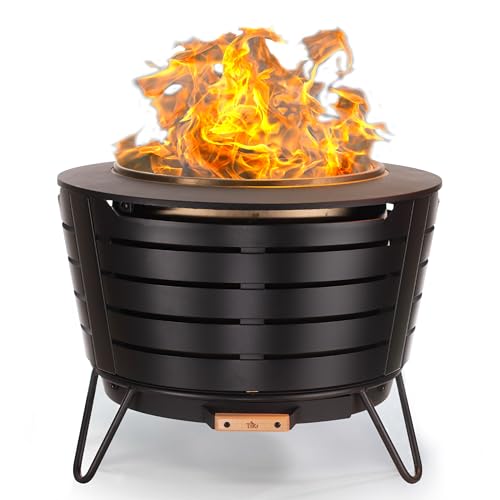
TIKI Patio Smokeless Fire Pit, 25 in.
$395.00A 25 inch, 16-gauge stainless, powder-coated pit with a four-foot heat radius, removable ash pan, stand and weather cover included. It burns firewood or TIKI Wood Packs.
Best for: backyard patios that want low smoke
Check price on AmazonIntermediate pick: room for the whole group
Regular fires for five to eight people and a spot on the patio or deck where the pit can stay.

Solo Stove Basecamp 24 in. Fire Pit with Stand
$399.99A 24.6 inch stainless pit at 30.5 lb with 360 degree airflow, removable ash pan and base plate, and a stand that raises it off heat-sensitive surfaces. Solo Stove rates it for 5 to 7 people.
Best for: a mid-size smokeless pit for a deck
Check price on Amazon
TIKI Reunion Smokeless Fire Pit, 27.5 in.
$450.00TIKI's largest round smokeless pit at 27.5 inches, in 16-gauge stainless with a four-foot heat radius, stand, cover and removable ash pan.
Best for: large backyard gatherings
Check price on AmazonExpert pick: a permanent pit that lasts and cooks
A long-term centerpiece, big fires, and possibly cooking steaks or vegetables over live wood.

Breeo X Series 24 Corten Steel Smokeless Fire Pit
$599.00Made-in-USA double-wall corten steel with X Airflow secondary combustion and compatibility with Breeo cooking accessories. Corten develops a protective weathered patina instead of paint that can peel.
Best for: a permanent patio centerpiece that also cooks
Check price on Amazon
Solo Stove Yukon with Stand
$599.01A 27 inch, 19.9 inch tall stainless pit at 44.1 lb, sold here with its dedicated stand, for the largest secondary-burn fire in the Solo Stove range.
Best for: big groups at a permanent spot
Check price on AmazonWho should not buy this tier: Skip this tier if you want to move the pit often, live where wood fires are restricted, or will not keep a supply of dry firewood. Both pits are heavy, a 27 inch chamber burns a lot of wood, and corten steel can leave rust-colored stains on pale concrete or pavers as it weathers. A Bonfire 2.0 or a propane bowl suits occasional use better.
How do the smokeless fire pits compare on specs?
| Model | Price | Diameter | Height | Weight | Smokeless design |
|---|---|---|---|---|---|
| Solo Stove Bonfire 2.0 with Stand | $349.99 | 19.5 in | - | - | Yes |
| TIKI Patio Smokeless Fire Pit, 25 in. | $395.00 | 25 in | - | - | Yes |
| Solo Stove Basecamp 24 in. Fire Pit with Stand | $399.99 | 24.6 in | - | 30.5 lb | Yes |
| TIKI Reunion Smokeless Fire Pit, 27.5 in. | $450.00 | 27.5 in | - | - | Yes |
| Breeo X Series 24 Corten Steel Smokeless Fire Pit | $599.00 | 27.5 in | - | - | Yes |
| Solo Stove Yukon with Stand | $599.01 | 27 in | 19.9 in | 44.1 lb | Yes |
Can I use a smokeless fire pit on a deck?
Only as the manufacturer allows. The bottom of a double-wall pit runs cooler than an open bowl, and Solo Stove sells its pits with stands meant to protect heat-sensitive surfaces, but embers still pop out of the top. Use the maker's stand, add a spark screen such as the Solo Stove Bonfire Shield Spark Screen for the Bonfire, keep a hose or extinguisher nearby, check HOA and local rules, and never place any fire pit under a roof or overhang. Long tools like the Solo Stove Fire Pit Tools 2-Piece Set keep hands out of the deep burn chamber. For a zero-ember option on a deck, a propane table from best propane fire pit tables is safer.
How do I light a smokeless fire pit with the least smoke?
- Empty the ash pan. Clear old ash from the pan and bottom intake holes once the pit is fully cold, so air can flow from the first minute.
- Use only dry fuel. Start with dry kindling and seasoned splits at 20% moisture or less; never use gasoline or lighter fluid.
- Build small and low. Light a small fire with fire starters and kindling, keeping all fuel below the row of top holes.
- Let the walls heat. Add wrist-thick splits a few at a time until the fire is roaring and the secondary jets appear at the rim, usually after 10 to 20 minutes.
- Feed it steadily. Add two or three splits at a time before the fire drops to coals, rather than one large log onto a dying fire.
How we chose
We did not test these products in person. Picks are researched from manufacturer specifications and owner manuals, engine and safety certifications where they apply, warranty terms, public recall records, and the recurring themes in verified owner reviews. We favor established brands with large review counts and parts support, match each pick to a real yard size or task, and place it in the tier where its price and capability actually belong.
Frequently asked questions
Do smokeless fire pits really work?
They reduce smoke substantially once the fire is hot, but none are truly smokeless. Air drawn in low is heated inside the double wall and exits near the rim, igniting smoke gases in a secondary burn. You will still see smoke while lighting, when cold wood is added, as the fire dies down and in wind. Burning firewood at 20% moisture or less makes the biggest difference.
Is Solo Stove or Breeo better?
Solo Stove offers more sizes in lighter stainless steel with removable ash pans and stands, which suits portability and decks. Breeo builds heavier double-wall corten steel pits in the USA and supports live-fire cooking accessories, which suits a permanent patio spot and cooking. For a movable, easy-clean pit, choose Solo Stove; for a fixed centerpiece that grills, choose Breeo.
Why does my Solo Stove still smoke?
The most common causes are damp firewood, logs stacked above the top airflow holes, a fire that has not heated the walls yet, and ash blocking the bottom intake. Burn seasoned wood at 20% moisture or less, keep fuel below the holes, build the fire gradually and empty the ash pan after it cools. Wind also defeats secondary combustion, so choose a sheltered spot.
What wood is best for a smokeless fire pit?
Dry, seasoned hardwood such as oak, maple, ash or hickory split to a size that fits below the top airflow holes. Aim for 20% moisture or less, which usually takes six months or more of drying for split, stacked and covered wood. Avoid green wood, treated or painted lumber, pallets and trash. Kiln-dried wood or the maker's wood packs are the most consistent option.
Do smokeless fire pits give off heat?
Yes, but differently from an open bowl. The double wall keeps more heat inside the burn chamber for secondary combustion, so less heat radiates out the sides and more rises from the top. TIKI lists a four-foot heat radius for its 25 and 27.5 inch pits. Sitting closer and burning a hotter, drier fire helps. For heat on cold nights, pair the pit with a patio heater.
Are smokeless fire pits allowed during burn bans?
Usually not. A smokeless fire pit is still an open wood fire, so it typically falls under the same restrictions as any recreational wood fire during a burn ban. CSA-approved propane fire pits are allowed during many campfire bans, but rules vary. Always check your local fire department, county or park regulations for the specific day before lighting any fire.
Researched, not professional advice. This page is compiled from published specifications, manuals, labels and owner-review consensus, not hands-on testing. Follow the manufacturer's instructions and product label, and consult a qualified professional where safety, chemicals, fuel or structures are involved. As an Amazon Associate we earn from qualifying purchases.