Chainsaws and Wood
Battery Chainsaw vs Gas: Power, Runtime and 5-Year Cost
Quick answer
Buy a battery chainsaw such as the EGO CS1815 if you prune, clean up after storms and cut occasional firewood on a suburban lot: it starts instantly, needs no fuel mix and is far quieter. Buy a gas saw like the Husqvarna 450 Rancher for heavy firewood seasons, 20 in bars and all-day cutting away from a charger.

EGO Power+ CS1815 18 in. Chainsaw Kit with 6.0Ah Battery
$399.00EGO rates it as a 50cc gas equivalent with up to 330 cuts on a 4x4 per 6.0Ah charge.
Best for: battery users felling small trees and bucking firewood
Check price on Amazon
Husqvarna 450 Rancher 20 in. Gas Chainsaw
$354.99A 50.2cc, 3.2 HP saw rated for 13 to 20 in bars that runs as long as you have fuel.
Best for: firewood cutting and storm cleanup on rural property
Check price on AmazonA battery chainsaw uses a brushless electric motor and a lithium pack to drive the chain; a gas chainsaw uses a two-stroke engine burning a 50:1 fuel and oil mix. For most homeowners the battery saw is now the better tool, because the jobs people actually do (limbs, fallen branches, a few rounds for the fire pit) take minutes, not hours. The EGO CS1815 ($399.00 with a 6.0Ah battery and charger) carries an 18 in bar, and EGO rates it as a 50cc gas equivalent.
Gas still wins when you cut for hours, need a 20 in or longer bar in dense hardwood, or work far from an outlet. The Husqvarna 450 Rancher ($354.99) is the classic homeowner-to-rancher step. Before you pick a bar, run the chainsaw bar length calculator: a bar about 2 in longer than the wood you cut most often is the usual guidance.
On this page
- How do battery and gas chainsaws compare on specs?
- Which should you choose, a battery or gas chainsaw?
- Is a battery chainsaw as powerful as a gas chainsaw?
- What does a gas vs battery chainsaw cost over 5 years?
- How much maintenance does each type of chainsaw need?
- What do owners commonly report about battery and gas chainsaws?
- Battery and gas chainsaws worth comparing
How do battery and gas chainsaws compare on specs?
| Factor | Battery: EGO CS1815 | Gas: Husqvarna 450 Rancher |
|---|---|---|
| Power | 2500W brushless motor, EGO rates as 50cc gas equivalent | 50.2cc, 3.2 HP X-Torq two-stroke |
| Bar length | 18 in, 3/8 in low profile chain | 20 in as sold, rated for 13 to 20 in bars |
| Runtime | Up to 330 cuts on a 4x4 per 6.0Ah charge (EGO) | As long as you have fuel; refills take a minute |
| Refill or recharge | 80 minutes on the included charger | 50:1 premix fuel plus bar oil |
| Starting | Press the trigger | Smart Start pull with choke |
| Noise between cuts | Silent; the chain stops when you release the trigger | Engine idles between cuts |
| Routine upkeep | Chain sharpening, bar oil, battery storage | Same, plus fuel mixing, air filter, spark plug and carburetor care |
| Stored for months | Store the pack partly charged indoors | Drain fuel or use ethanol-free premix to avoid a gummed carburetor |
| Cold weather | Lithium packs deliver less runtime when cold | Harder starting, full power once warm |
| Catalog price | $399.00 with battery and charger | $354.99 saw only |
Specs from EGO and Husqvarna listings. Gas-equivalent ratings are the maker's own comparison, not an industry standard.
Which should you choose, a battery or gas chainsaw?
Choose a battery chainsaw if:
- You cut a few times a season: pruning, storm branches, trimming along a fence line.
- Most of your wood is under about 14 in across, so a 16 or 18 in bar is plenty.
- You already own batteries from the same platform, which removes most of the price gap.
- Noise matters: early mornings, close neighbors or HOA rules.
- You hate pull starts or have had a gas saw refuse to start after sitting all winter.
Choose a gas chainsaw if:
- You heat with wood and buck several cords a year.
- You regularly cut hardwood rounds over 16 in and want a 20 in or 24 in bar.
- You work at a woodlot or rural property far from a charger for hours at a time.
- You want to swap bars: the Husqvarna 455 Rancher accepts 13 to 24 in bars.
Is a battery chainsaw as powerful as a gas chainsaw?
For homeowner work, close enough. Brushless motors deliver strong torque from a standstill, and EGO quotes chain speeds up to 22 m/s on the CS1815. Where a battery saw falls behind is sustained cutting in big, dense hardwood: runtime drops quickly when the bar is buried in a 16 in oak round, and you are limited to about an 18 in bar in most battery lineups. The "50cc equivalent" and "40cc equivalent" labels on the CS1815 and the smaller EGO CS1613 are marketing comparisons without a standard test, so treat them as rough.
A gas saw keeps the same power until the tank runs dry, and a two-minute refill puts you back to work. The Husqvarna 455 Rancher at 55cc and 3.5 HP and the ECHO CS-590 Timber Wolf at 59.8cc are the saws to look at when felling and bucking large trees is a regular job. If you mostly limb, a compact battery saw like the CRAFTSMAN V20 12 in is lighter still; CRAFTSMAN says it is 40 percent lighter than a 42cc gas saw with its 5Ah battery.
What does a gas vs battery chainsaw cost over 5 years?
The purchase prices look close: $399.00 for the EGO kit against $354.99 for the Husqvarna. The real difference is what you add. A gas saw needs two-stroke oil or premix every year; a six-pack of ECHO Power Blend 50:1 oil ($16.99) mixes six gallons, and ethanol-free VP Racing SEF premix ($29.82 for three quarts) costs more but prevents most storage problems. Both saws need bar oil such as Husqvarna X-Guard and periodic chains.
A battery saw has no fuel cost, but a single pack rarely finishes a big cleanup, and a second battery is expensive: an EGO 5.0Ah battery and charger kit lists at $369.00. Lithium packs also lose capacity with age; EGO covers its batteries for 3 years and the tool for 5. If you already own EGO batteries for a mower or blower, battery wins on 5-year cost easily. If you would buy a second pack only for the saw, a gas saw is usually cheaper for heavy users. Put your own hours into the gas vs battery cost calculator.
How much maintenance does each type of chainsaw need?
Both need the same chain care: keep the chain sharp (a Oregon field sharpening kit handles most touch-ups), check tension before every job, keep the bar oil reservoir full and clean the bar groove. A dull chain makes either saw work harder and increases kickback risk.
Gas saws add engine work: mixing fuel at the ratio in the manual, cleaning the air filter, replacing the spark plug, and dealing with stale fuel. The most common gas saw complaint in owner reviews is a hard start after a long stretch in storage, usually from ethanol fuel breaking down in the carburetor. Running the tank dry before storage or using ethanol-free premix largely prevents it. The two-cycle mix ratio calculator gives exact oil amounts for any fuel volume.
What do owners commonly report about battery and gas chainsaws?
Battery saw owners most often praise instant starting, low noise and the lack of fumes, and many say they use the saw far more often because there is no setup. The recurring complaints are runtime in large hardwood, the cost of extra batteries, and chain oil leaking from the reservoir while stored, which also happens with gas saws. Gas saw owners praise power and unlimited runtime, and complain about pull starting, vibration over long sessions and carburetor problems after storage. Neither group reports that battery saws are safer: the chain moves just as fast.
Battery and gas chainsaws worth comparing
Two battery and two gas saws that cover most homeowner needs. See the full best chainsaws and best battery chainsaws roundups for more.
EGO Power+ CS1815 18 in. Chainsaw Kit with 6.0Ah Battery
$399.00An 18 in bar, a 2500W brushless motor, tool-free tensioning and a color display with a work light. The included 6.0Ah pack is rated for up to 330 cuts on a 4x4.
Best for: storm cleanup and firewood without gas
Check price on Amazon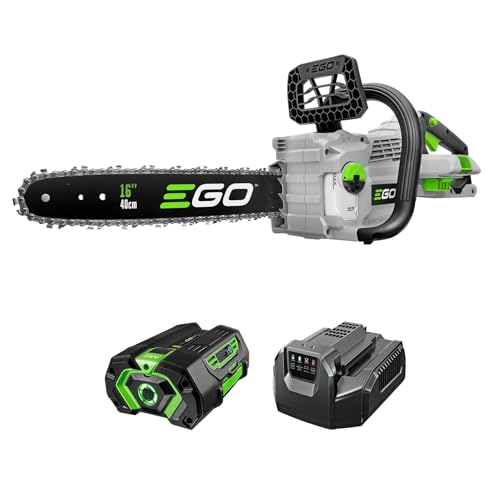
EGO Power+ CS1613 16 in. Chainsaw Kit with 4.0Ah Battery
$299.00A 16 in saw EGO rates as a 40cc equivalent with IPX4 weather resistance and a low-profile dial that lets it cut close to the ground.
Best for: pruning and small trees
Check price on Amazon Husqvarna 450 Rancher 20 in. Gas Chainsaw
$354.99A 50.2cc X-Torq engine with Smart Start, Air Injection filtration and LowVib, sized for 13 to 20 in bars and regular firewood work.
Best for: rural firewood and cleanup
Check price on Amazon
Husqvarna 455 Rancher 20 in. Gas Chainsaw
$589.99A 55cc, 3.5 HP saw that accepts bars up to 24 in, with a 7 degree offset front handle for bucking large rounds.
Best for: heating with wood and bigger trees
Check price on AmazonHow we chose
We did not test these products in person. Picks are researched from manufacturer specifications and owner manuals, engine and safety certifications where they apply, warranty terms, public recall records, and the recurring themes in verified owner reviews. We favor established brands with large review counts and parts support, match each pick to a real yard size or task, and place it in the tier where its price and capability actually belong.
Frequently asked questions
Is a battery chainsaw worth it for a homeowner?
Yes, for most homeowners who prune, clean up storm branches and cut occasional firewood. A saw like the EGO CS1815 starts with a trigger, needs no fuel mixing and makes no noise between cuts. It is less worth it if you cut several cords a year or need a bar longer than 18 in, because runtime in large hardwood is limited and extra batteries are expensive.
How many cuts does a battery chainsaw get per charge?
It depends on the battery and the wood. EGO rates the CS1815 at up to 330 cuts on a 4x4 with its 6.0Ah pack and the CS1613 at about 130 cuts on a 4x4 with a 4.0Ah pack. A 4x4 is a small cut, so expect far fewer cuts through 12 to 16 in hardwood rounds. A dull chain also shortens runtime noticeably.
Can a battery chainsaw cut firewood?
Yes. An 18 in battery saw handles firewood rounds up to about 14 to 16 in across without trouble, and many owners buck a season of wood with one. The limit is volume: a single battery may not finish a large pile, so plan on a second pack or breaks to recharge. If you split and burn several cords a year, a gas saw such as the Husqvarna 450 Rancher is more practical.
Are battery chainsaws safer than gas chainsaws?
Not meaningfully. Battery saws stop the chain when you release the trigger and do not idle, which helps, but the chain moves at similar speeds and kickback is just as violent. Wear the same protective gear with either: chainsaw chaps, an ANSI Z89.1 helmet with a face screen, eye and hearing protection and boots. Never cut above shoulder height and leave large or storm-damaged trees to a certified arborist.
What size chainsaw bar does a homeowner need?
Pick a bar about 2 in longer than the diameter of the wood you cut most often. A 14 to 16 in bar covers pruning and small trees, 18 in suits most firewood, and 20 in or more is for large hardwood and felling bigger trees. Longer bars are heavier and harder to control. The chainsaw bar length calculator sizes it from your wood.
Researched, not professional advice. This page is compiled from published specifications, manuals, labels and owner-review consensus, not hands-on testing. Follow the manufacturer's instructions and product label, and consult a qualified professional where safety, chemicals, fuel or structures are involved. As an Amazon Associate we earn from qualifying purchases.