Lawn Care
Best Grass Seed for Shade and Under Trees (2026)
Quick answer
For partial shade with at least 4 hours of sun, the best grass seed is a turf-type tall fescue such as Jonathan Green Black Beauty Tall Fescue. Deeper northern shade calls for fine fescues (creeping red, chewings, hard). In the South, St. Augustine plugs handle shade best. Under about 2 hours of sun, no lawn grass thrives.
Shade grass is not a special species so much as the most shade-tolerant grass that suits your climate. In cool-season regions that ranking runs fine fescue first, tall fescue second, and Kentucky bluegrass and perennial ryegrass last. In warm-season regions, St. Augustinegrass tolerates shade best, zoysia varies by variety, and bermudagrass needs full sun. Every grass still needs some direct or bright filtered light, and trees also compete for water and nutrients.
Our top pick for partly shaded lawns is Black Beauty Tall Fescue ($106.33), a 100 percent turf-type tall fescue blend the maker lists for sunny and shady areas. For the darker spots under trees, a pure fine fescue blend such as Outsidepride Creeping Red Fescue is the research-backed choice. Get pounds for your area from the grass seed calculator, and see fine fescue for the species profile.
On this page
- How many hours of sun does grass need?
- Which grass types are most shade tolerant?
- Beginner picks: shade mixes with fertilizer and a patch repair bag
- Intermediate picks: larger sun and shade blends for partly shaded lawns
- Expert picks: pure tall fescue for part shade and St. Augustine plugs for the South
- How do the shade seed picks compare?
- What is the best grass seed to grow under pine trees?
- How do I grow grass in shade step by step?
- How should I care for grass in shade?
- What tools make seeding a shaded lawn easier?
How many hours of sun does grass need?
As a rule of thumb from extension turf guidance, most lawn grasses need at least 4 to 6 hours of direct sun a day, or a full day of bright, dappled light, to stay dense. Fine fescues and shade-tolerant St. Augustine varieties can hang on with less. Below roughly 2 to 3 hours of direct sun, or under a dense evergreen canopy, grass thins every year no matter what seed you buy. Watch the spot on a clear day in the growing season and count the hours of direct light before you choose seed; shade from deciduous trees also deepens as leaves fill in.
| Direct sun per day | Cool-season choice | Warm-season choice | Realistic expectation |
|---|---|---|---|
| 6 hours or more | Any; bluegrass, rye or tall fescue | Bermuda, zoysia, St. Augustine, centipede | Full, dense lawn |
| 4 to 6 hours | Tall fescue or sun and shade mix | Zoysia or St. Augustine | Good lawn with care |
| 2 to 4 hours or bright dappled | Fine fescue blend | Shade-tolerant St. Augustine (for example Seville) | Thinner lawn, light traffic only |
| Under 2 hours or dense canopy | None reliably | None reliably | Use mulch or a shade groundcover |
Which grass types are most shade tolerant?
Fine fescue is a group of narrow-leaved cool-season grasses that tolerate shade, dry soil and low fertility better than any other common lawn grass. The trade-off: they wear poorly under foot traffic and dislike heat and heavy nitrogen. That is why many shade mixes blend fine fescue with tall fescue or bluegrass for durability. See St. Augustinegrass for the southern option.
| Grass | Season | Shade tolerance | Seed rate new (lb per 1,000 sq ft) | Nitrogen in shade |
|---|---|---|---|---|
| Fine fescues (creeping red, chewings, hard) | Cool | High | 4 to 5 | Low, about 1 lb N per year |
| Tall fescue | Cool | Moderate | 6 to 8 | Moderate, lower than in sun |
| Kentucky bluegrass | Cool | Low | 2 to 3 | Grows thin in shade |
| Perennial ryegrass | Cool | Low to moderate | 5 to 7 | Short-lived in shade |
| St. Augustinegrass | Warm | Highest warm-season | Plugs or sod only | Moderate |
| Zoysiagrass | Warm | Moderate, varies by variety | 1 to 2 | Low |
| Centipedegrass | Warm | Moderate | 0.25 to 0.5 | Low |
| Bermudagrass | Warm | Very low | 1 to 2 (hulled) | Avoid in shade |
University extension consensus. Grass in shade uses less nitrogen; many guides suggest roughly half the sun rate.
Beginner picks: shade mixes with fertilizer and a patch repair bag
For thin spots under a tree or along a north wall on a cool-season lawn, where you want one bag that does it all.
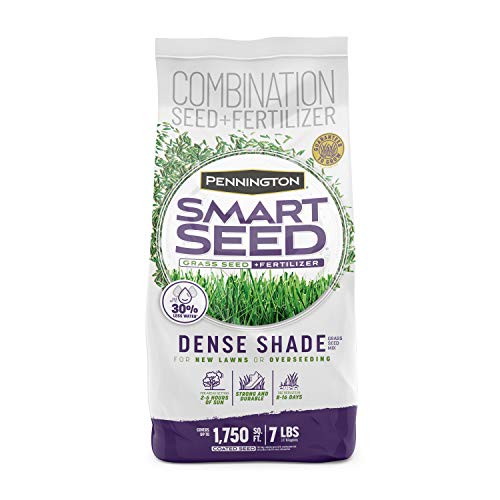
Pennington Smart Seed Dense Shade Mix, 7 lb
$28.47A perennial ryegrass, Kentucky bluegrass and tall fescue mix with fertilizer included, listed for areas with 2 to 6 hours of sun and covering 1,750 sq ft. The listing does not name fine fescue, so for the darkest spots a fine fescue blend is the better bet.
Best for: light to moderate shade on small areas
Check price on Amazon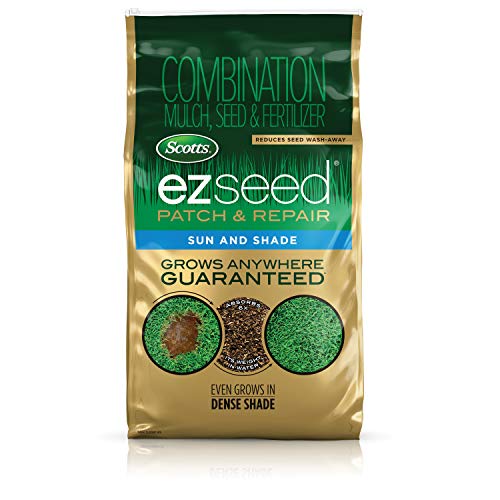
Scotts EZ Seed Patch and Repair Sun and Shade, 10 lb
$33.99Seed, expanding mulch, controlled-release fertilizer and a tackifier in one bag that Scotts says will grow in full sun and dense shade with proper care. Coverage is only 225 sq ft, so it is a patch product, not a lawn product.
Best for: bare spots under trees and on slopes
Check price on AmazonIntermediate picks: larger sun and shade blends for partly shaded lawns
For lawns that mix sunny and shaded areas and need one seed across both.
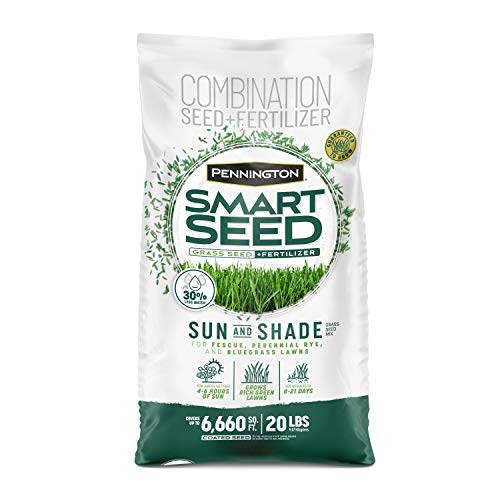
Pennington Smart Seed Sun and Shade Mix North, 20 lb
$57.21A seed-plus-fertilizer northern mix that Pennington lists for areas with 4 to 6 hours of sunlight, in a 20 lb bag covering up to 6,660 sq ft. It suits typical suburban lawns with a couple of maturing shade trees.
Best for: partly shaded northern lawns
Check price on Amazon
Jonathan Green Black Beauty Ultra Grass Seed, 7 lb
$43.99Tall fescue, Kentucky bluegrass and perennial ryegrass for full sun to partial shade, with a 7 to 14 day germination window, covering 1,400 sq ft new or 2,800 sq ft overseeded. It blends well with an existing tall fescue lawn.
Best for: overseeding a mixed sun and shade lawn
Check price on AmazonExpert picks: pure tall fescue for part shade and St. Augustine plugs for the South
Pure-species options for owners renovating a whole shaded lawn and willing to manage it for shade.

Jonathan Green Black Beauty Tall Fescue Blend, 25 lb
$106.33A 100 percent turf-type tall fescue blend listed for sunny and shady areas, with a waxy leaf coating and roots the maker says reach up to 4 ft deep, which helps where trees compete for water. The 25 lb bag overseeds 7,500 sq ft.
Best for: renovating a partly shaded cool-season lawn
Check price on Amazon
SodPods St. Augustine Seville Grass Plugs, 64 Count
$109.98Sixty-four 3 by 3 inch Seville St. Augustine plugs that the listing says perform in full sun to partial shade and cover 144 sq ft at 18 inch spacing once mature. St. Augustine does not grow from seed, so plugs or sod are the way in.
Best for: shaded warm-season lawns
Check price on AmazonWho should not buy this tier: Skip a 25 lb pure tall fescue bag if your shade is under about 3 to 4 hours of direct sun: tall fescue will thin out there, and fine fescue is the better seed. Skip St. Augustine plugs north of the warm-season zone, where they will not survive winter, and skip any grass entirely where the canopy is so dense that nothing green grows; a mulch bed will look better than thin, muddy turf.
How do the shade seed picks compare?
| Model | Price | Grass type | Bag size | New lawn coverage | Overseed coverage |
|---|---|---|---|---|---|
| Jonathan Green Black Beauty Tall Fescue Blend, 25 lb | $106.33 | tall fescue | 25 lb | 3,750 sq ft | 7,500 sq ft |
| Pennington Smart Seed Sun and Shade Mix North, 20 lb | $57.21 | sun shade mix | 20 lb | 6,660 sq ft | - |
| Jonathan Green Black Beauty Ultra Grass Seed, 7 lb | $43.99 | sun shade mix | 7 lb | 1,400 sq ft | 2,800 sq ft |
| Pennington Smart Seed Dense Shade Mix, 7 lb | $28.47 | sun shade mix | 7 lb | 1,750 sq ft | - |
| Scotts EZ Seed Patch and Repair Sun and Shade, 10 lb | $33.99 | sun shade mix | 10 lb | 225 sq ft | - |
| SodPods St. Augustine Seville Grass Plugs, 64 Count | $109.98 | st augustine | - | - | - |
What is the best grass seed to grow under pine trees?
In cool-season areas, a fine fescue blend such as creeping red fescue is the best bet under pines, because it tolerates shade, dry soil and low fertility. Be honest about the limits, though. Pines are evergreen, so the shade never lifts, and their roots take much of the water. Many established pine stands simply cannot support a lawn. A common belief is that pine needles make soil too acidic for grass; extension specialists generally note that needles have little effect on soil pH, so run a soil test before liming.
What improves your odds: have lower limbs removed to let in more light (hire a certified arborist for large trees; for small branches see best pole saws), rake needles regularly so they do not smother seedlings, seed in early fall, water deeply during dry spells, and do not pile more than a thin topdressing of soil over tree roots, which can harm the tree. Where grass still fails after a season or two, a mulch ring around the trunk is the better landscape choice.
How do I grow grass in shade step by step?
- Measure the light. Count hours of direct sun on a clear day with trees in full leaf; under 2 to 3 hours, plan mulch instead.
- Let in light. Remove low limbs where safe and appropriate, and clear leaves and needles off the area.
- Test the soil. Check pH and nutrients before adding lime or fertilizer; shade soils are often low in organic matter.
- Loosen the surface. Rake hard to expose soil; avoid deep tilling or heavy core aeration over shallow tree roots.
- Seed in early fall. Spread fine fescue or tall fescue at the bag rate in two directions, and rake it in lightly.
- Keep it moist. Water lightly once or twice a day until seedlings establish, then switch to deeper, less frequent watering.
- Keep leaves off. Remove falling leaves weekly in autumn so they do not smother new seedlings.
How should I care for grass in shade?
- Mow higher. Raise the deck about half an inch to an inch above your normal height; more leaf surface catches more light. See the mowing height chart.
- Feed less. Shade grass uses less nitrogen; heavy feeding pushes weak growth and disease. Fine fescue wants about 1 lb of nitrogen per 1,000 sq ft per year.
- Water deeply, less often. Tree roots compete for water, but constantly wet shade invites disease.
- Limit traffic. Fine fescue wears poorly; route paths with stepping stones.
- Overseed every fall. Shade lawns thin a little each year; a light overseed keeps them full. See how to overseed a lawn.
- Clear leaves fast. A matted leaf layer kills shade grass in weeks. On big treed lots, a tow sweeper from best lawn sweepers or a backpack leaf blower makes weekly cleanup realistic.
What tools make seeding a shaded lawn easier?
Under trees, a handheld Scotts Whirl spreads seed evenly around trunks and roots where a push spreader will not fit. For a whole partly shaded lawn, a push broadcast spreader with an edge shield, such as the Scotts EdgeGuard DLX, keeps seed out of beds; larger lots benefit from a tow-behind from best lawn spreaders. A thin layer of peat moss over the seed helps it stay damp where tree roots dry the surface.
How we chose
We did not test these products in person. Picks are researched from manufacturer specifications and owner manuals, engine and safety certifications where they apply, warranty terms, public recall records, and the recurring themes in verified owner reviews. We favor established brands with large review counts and parts support, match each pick to a real yard size or task, and place it in the tier where its price and capability actually belong.
Frequently asked questions
What is the best grass seed for shade?
For cool-season lawns with 4 to 6 hours of sun, a turf-type tall fescue such as Jonathan Green Black Beauty Tall Fescue is the best choice. For deeper shade with 2 to 4 hours of sun, choose a fine fescue blend such as creeping red, chewings or hard fescue. In warm-season regions, shade-tolerant St. Augustine varieties planted as plugs or sod handle shade best.
What is the best grass seed under pine trees?
A fine fescue blend, such as creeping red fescue, has the best chance under pines because it tolerates shade, dry soil and low fertility. Pines cast year-round shade and take much of the water, so many pine stands cannot hold a lawn. Remove lower limbs, rake needles often, seed in early fall and water in dry spells. If grass still fails, use a mulch ring.
Will grass grow in full shade?
Not reliably. Most lawn grasses need at least 4 to 6 hours of direct sun or a full day of bright, dappled light. Fine fescues and some St. Augustine varieties survive with roughly 2 to 4 hours. Below about 2 hours of direct sun, or under a dense evergreen canopy, lawns thin out every year regardless of seed, and mulch or a shade groundcover is usually a better choice.
Is tall fescue or fine fescue better for shade?
Fine fescue is more shade tolerant and handles dry, low-fertility soil under trees better, but it wears poorly under foot traffic and dislikes heat. Tall fescue tolerates moderate shade, has deep roots, and stands up to kids and dogs much better. Use tall fescue where there are at least 4 hours of sun and some traffic, and fine fescue in darker, quieter spots.
When should I plant grass seed in shade?
For cool-season shade grasses such as fine fescue and tall fescue, early fall is best: soil is warm, air is cooler, and under deciduous trees the canopy starts thinning as leaves drop, which gives seedlings more light. Rake falling leaves weekly so they do not smother the new grass. Spring seeding works but seedlings then face summer heat with young roots.
Should I fertilize grass in the shade?
Yes, but lightly. Grass in shade grows more slowly and uses less nitrogen, so many extension guides suggest roughly half the rate used in full sun. Fine fescue does well on about 1 lb of nitrogen per 1,000 sq ft per year, applied in fall. Too much nitrogen in shade produces weak, disease-prone growth. Test the soil before adding lime or phosphorus.
Researched, not professional advice. This page is compiled from published specifications, manuals, labels and owner-review consensus, not hands-on testing. Follow the manufacturer's instructions and product label, and consult a qualified professional where safety, chemicals, fuel or structures are involved. As an Amazon Associate we earn from qualifying purchases.