Lawn Care
Best Soil Test Kits for Lawns: Lab vs Home Tests (2026)
Quick answer
The most accurate lawn soil test is a university extension lab test, the gold standard for pH, lime and fertilizer recommendations. Among retail kits, the MySoil mail-in lab kit reports pH and 13 nutrients in 6 to 8 days; the Rapitest capsule kit suits quick pH spot checks. Lime only when a test shows low pH.
A soil test measures your soil's pH and plant-available nutrients so you add only what the lawn lacks. It is the cheapest lawn product you will buy and the one that decides whether the expensive ones work: fertilizer is partly wasted in very acidic soil, and lime on soil that is already neutral does harm. Most lawns do best between about pH 6.0 and 7.0; Jonathan Green cites 6.2 to 7.0.
We will be direct about accuracy. Your state's land-grant university extension lab is the gold standard: it measures buffer pH to calculate an actual lime rate and gives turf-specific recommendations, typically for a modest fee. Our top retail pick is the MySoil Soil Test Kit ($34.26), a prepaid mail-in lab analysis that is far more precise than color capsules. Once you have results, the lime calculator and fertilizer calculator turn them into bags and spreader settings.
On this page
- Are home soil test kits accurate compared with a lab test?
- Beginner pick: a capsule kit for quick pH checks
- Intermediate picks: a mail-in lab test and plain pelletized lime
- Expert picks: fast pH correction, soil structure amendments and a lime spreader
- How do the soil test and amendment picks compare?
- What does my soil pH mean for my lawn?
- How do I take a soil sample from my lawn?
- What should I buy after my soil test?
- How often should I test my lawn soil?
Are home soil test kits accurate compared with a lab test?
Home capsule kits give a rough pH reading that is useful for spotting a big problem, such as soil far below pH 6. They are much less reliable for nutrients, and nitrogen readings in particular say little, because soil nitrate changes quickly with rain and temperature. Most extension labs do not base lawn nitrogen advice on a soil nitrogen test at all; they recommend nitrogen by grass type. Inexpensive probe-style meters are generally considered unreliable for pH by extension specialists.
The bigger gap is lime. Knowing your pH is 5.6 does not tell you how much lime to add; that depends on the soil's buffering capacity, which labs measure as buffer pH. Only a lab test gives you a lime rate you can trust. Use a capsule kit for quick checks between lab tests, not instead of them. The how to test soil pH guide covers sampling and interpretation.
| Factor | University extension lab | Mail-in kit (MySoil) | Capsule kit (Rapitest) |
|---|---|---|---|
| pH | Lab measured | Lab measured | Color chart estimate |
| Buffer pH and lime rate | Yes, turf-specific | Recommendations provided; check whether buffer pH is reported | No |
| Phosphorus and potassium | Lab measured with state calibration | Lab measured, 13 nutrients | Color chart, rough |
| Nitrogen | Usually recommended by grass type | Reported | Color chart, least reliable |
| Turn-around | Varies by state and season | 6 to 8 days per listing | Minutes |
| Tests per purchase | One sample per fee | One sample | 40 tests (10 each pH, N, P, K) |
| Best use | Baseline before liming or renovation | Convenient lab result | Spot checks between lab tests |
Beginner pick: a capsule kit for quick pH checks
For spotting obviously acidic or alkaline areas and checking different parts of the yard cheaply.

Luster Leaf Rapitest Soil Test Kit, 40 Tests
$18.68An inexpensive capsule-and-color-chart kit with 40 tests, 10 each for pH, nitrogen, phosphorus and potash, plus a pH preference list. Read the pH result as an estimate, and the nutrient results as rough indicators only.
Best for: cheap at-home pH checks
Check price on AmazonIntermediate picks: a mail-in lab test and plain pelletized lime
For owners who want real numbers and a straightforward fix when the soil is acidic.

MySoil Soil Test Kit
$34.26A single-use prepaid mail-in lab test that measures pH and 13 plant-available nutrients and returns results in 6 to 8 days, with recommendations on what, how much and when to apply, in organic and non-organic options.
Best for: testing before liming or fertilizing
Check price on Amazon
Old Castle Pro Pelleted Dolomitic Limestone, 50 lb
$47.99A plain 50 lb bag of pelletized dolomitic limestone that flows through a standard broadcast spreader. Dolomitic lime adds magnesium as well as calcium, so choose it when your test shows magnesium is not already high. Apply only at the rate your test calls for.
Best for: correcting acidic soil on a budget
Check price on AmazonExpert picks: fast pH correction, soil structure amendments and a lime spreader
For owners acting on a lab report across a large lawn.

Jonathan Green Mag-I-Cal Soil Food for Acidic Soil, 15,000 sq ft
$61.20Soluble calcium carbonate with humates in a 54 lb bag covering 15,000 sq ft, which Jonathan Green says has the pH-adjusting power of up to 15 bags of limestone. That is a maker claim; retest before repeating it.
Best for: raising pH faster than ground limestone
Check price on Amazon
The Andersons NutraSoft OP Pelletized Gypsum, 40 lb
$28.45An OMRI-listed pelletized gypsum that disperses after watering and covers 6,600 sq ft. Gypsum is pH neutral and supplies calcium without raising pH; the maker says it loosens clay and repairs salt damage along drives. Extension research finds the clay benefit most reliable on sodium-affected soils.
Best for: salt-damaged edges and sodic clay
Check price on Amazon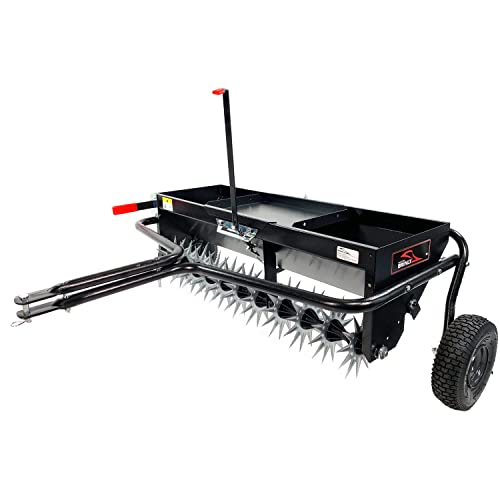
Brinly 40 in Tow-Behind Combination Aerator Spreader
$384.00A 40 inch tow-behind that perforates the soil while a 100 lb steel hopper drops seed, fertilizer or lime into the holes, which Brinly says ensures material enters the soil. It saves a separate lime pass on large lawns.
Best for: liming and overseeding acre lots
Check price on AmazonWho should not buy this tier: Skip every product in this tier until you have a lab result. Liming soil that is already near pH 7 can push it too high and lock up iron and other nutrients, gypsum will not fix acidic soil, and a tow combo spreader is overkill for a lawn under half an acre. Centipedegrass owners in particular should not lime without a test, since centipede prefers acidic soil around pH 5.0 to 6.0.
How do the soil test and amendment picks compare?
| Model | Price | Type | Bag size | Coverage |
|---|---|---|---|---|
| MySoil Soil Test Kit | $34.26 | mail in lab test | - | - |
| Luster Leaf Rapitest Soil Test Kit, 40 Tests | $18.68 | at home capsule test | - | - |
| Old Castle Pro Pelleted Dolomitic Limestone, 50 lb | $47.99 | pelletized dolomitic lime | 50 lb | - |
| Jonathan Green Mag-I-Cal Soil Food for Acidic Soil, 15,000 sq ft | $61.20 | soluble calcium carbonate | 54 lb | 15,000 sq ft |
| The Andersons NutraSoft OP Pelletized Gypsum, 40 lb | $28.45 | pelletized gypsum | 40 lb | 6,600 sq ft |
 The Andersons HumiChar Organic Soil Amendment, 40 lb The Andersons HumiChar Organic Soil Amendment, 40 lb | $104.88 | humic acid and biochar granule | 40 lb | - |
What does my soil pH mean for my lawn?
Lime raises pH slowly, over months, and works best when it is worked into the soil, which is why many owners lime right after core aeration. Extension services commonly advise applying no more than about 50 lb of lime per 1,000 sq ft to an established lawn at one time, splitting larger recommendations between fall and spring. The lime rate chart shows typical ranges by soil type, and centipedegrass explains why that grass is the exception.
| Soil pH | What it means | Typical action |
|---|---|---|
| Below 5.5 | Strongly acidic; nutrients poorly available | Lime at the lab rate, split across applications |
| 5.5 to 6.0 | Moderately acidic | Lime for most grasses; centipede is usually fine |
| 6.0 to 7.0 | Ideal range for most lawns | No lime; maintain |
| 7.0 to 7.5 | Slightly alkaline | No lime; consider iron for color |
| Above 7.5 | Alkaline | Never lime; ask your extension office about sulfur |
| Centipedegrass | Prefers about 5.0 to 6.0 | Avoid raising pH above 6.0 |
General extension guidance. Your lab report's specific recommendation takes priority.
How do I take a soil sample from my lawn?
- Split the yard into areas. Sample front lawn, back lawn and any problem area separately rather than mixing them.
- Use clean tools. Use a soil probe or trowel and a clean plastic bucket; galvanized metal can skew zinc results.
- Take 10 to 15 cores per area. Collect from random spots across the area, avoiding edges of drives, burn piles and recent spills.
- Sample 3 to 4 inches deep. For established turf, strip off grass and thatch and keep the top 3 to 4 inches of soil.
- Mix and dry. Mix cores well, remove roots and stones, and let the soil air dry if the lab or kit asks for it.
- Time it right. Sample at the same season each time, and wait several weeks after liming or fertilizing so results reflect the soil, not the product.
What should I buy after my soil test?
Follow the report, in order. If pH is low, lime first with a spreader that the manual allows for lime; note that the Chapin 8401C is not recommended for lime, while the Brinly combo aerator spreader lists lime. If phosphorus or potassium is low, choose a fertilizer with those numbers from the best lawn fertilizers page; if they are adequate, use a high-nitrogen, low-phosphorus product. Organic matter is low? A granular amendment such as The Andersons HumiChar spreads like fertilizer. A calibrated spreader matters for all of this, and on large lawns a tow-behind from best lawn spreaders keeps rates even. For a quick at-home pH check designed for lawns, Jonathan Green also sells a Soil pH Test Kit for Lawns.
How often should I test my lawn soil?
Test every two to three years for an established lawn, and before any renovation, new seeding or sod. Test annually for a couple of years after you start liming, so you can see whether pH is moving and stop before you overshoot. Keep reports together and sample the same way and season each time, so changes reflect the soil rather than your sampling. The how to read a fertilizer label guide helps you match the report's nutrient needs to a bag.
How we chose
We did not test these products in person. Picks are researched from manufacturer specifications and owner manuals, engine and safety certifications where they apply, warranty terms, public recall records, and the recurring themes in verified owner reviews. We favor established brands with large review counts and parts support, match each pick to a real yard size or task, and place it in the tier where its price and capability actually belong.
Frequently asked questions
What is the most accurate soil test for lawns?
A test from your state university extension soil lab is the most accurate and useful for lawns. Extension labs measure pH and buffer pH to calculate a real lime rate, and they calibrate phosphorus and potassium recommendations to local soils and turf. Mail-in retail lab kits like MySoil are a convenient alternative. Home capsule kits give only rough estimates and cannot calculate a lime rate.
Are home soil test kits accurate?
Home capsule kits like the Rapitest are reasonably useful for a rough pH reading that flags strongly acidic or alkaline soil, and they are inexpensive enough to check several spots. Their nitrogen, phosphorus and potassium readings are much less reliable, and they cannot tell you how much lime to apply. Use them for spot checks between lab tests, not as the basis for liming a whole lawn.
How do I know if my lawn needs lime?
Only a soil test can tell you. Most lawns do best between about pH 6.0 and 7.0, so lime is usually recommended when a test shows pH below about 6.0, except for centipedegrass, which prefers acidic soil. The amount depends on soil buffering, which a lab measures as buffer pH. Moss, thin grass and poor fertilizer response can hint at acidity but also have other causes.
How much lime should I put on my lawn?
Apply the rate from your soil test report, because it depends on your current pH, target pH and soil type. Extension services commonly advise no more than about 50 lb of limestone per 1,000 sq ft on an established lawn per application, splitting larger recommendations between fall and spring. Retest after a year before adding more, since lime changes pH slowly.
When is the best time to test soil?
Fall is a popular time because labs are less busy and results arrive in time to lime before winter, which gives lime months to work before spring. Any time the ground is not frozen works. Sample at the same season each time you test, and wait several weeks after applying lime or fertilizer so the results reflect your soil rather than the product you just spread.
Does gypsum lower soil pH?
Not meaningfully. Gypsum is calcium sulfate, and it is essentially pH neutral: it adds calcium and sulfur without raising pH the way lime does, and without lowering it much either. Its most reliable benefit is on sodium-affected soils, such as lawn edges damaged by road salt. To lower a high pH, extension offices usually discuss elemental sulfur, applied carefully based on a soil test.
Researched, not professional advice. This page is compiled from published specifications, manuals, labels and owner-review consensus, not hands-on testing. Follow the manufacturer's instructions and product label, and consult a qualified professional where safety, chemicals, fuel or structures are involved. As an Amazon Associate we earn from qualifying purchases.