Lawn Care
Grass Seed Rate Chart: Pounds per 1,000 Sq Ft by Grass
Quick answer
Tall fescue seeds at 6 to 8 pounds per 1,000 square feet for a new lawn and 3 to 4 to overseed. Kentucky bluegrass needs only 2 to 3 pounds, perennial ryegrass 5 to 7, and bermudagrass 1 to 2. A 5,000 square foot fescue lawn takes about 35 pounds.
Seeding rate is set by seed size, not by how much lawn you want. Kentucky bluegrass has roughly ten times more seeds per pound than tall fescue, which is why its rate is so much lower. Use the chart, then confirm against the bag: the label rate is the one the producer stands behind.
The grass seed calculator runs these same rates against your square footage and bag size. For a fescue lawn, the Jonathan Green Black Beauty Tall Fescue Blend at $106.33 covers about 3,500 square feet of new lawn.
On this page
How much grass seed do I need per 1,000 square feet?
| Grass | New lawn (lb) | Overseeding (lb) | New lawn, 5,000 sq ft | New lawn, 10,000 sq ft | New lawn, 1 acre |
|---|---|---|---|---|---|
| Tall fescue | 6 to 8 | 3 to 4 | 35 lb | 70 lb | 305 lb |
| Kentucky bluegrass | 2 to 3 | 1 to 1.5 | 12.5 lb | 25 lb | 109 lb |
| Perennial ryegrass | 5 to 7 | 3 to 4 | 30 lb | 60 lb | 261 lb |
| Fine fescue | 4 to 5 | 2 to 2.5 | 22.5 lb | 45 lb | 196 lb |
| Sun and shade mix | 5 to 6 | 2.5 to 3 | 27.5 lb | 55 lb | 240 lb |
| Bermudagrass, hulled | 1 to 2 | 0.5 to 1 | 7.5 lb | 15 lb | 65 lb |
| Zoysiagrass | 1 to 2 | 0.5 to 1 | 7.5 lb | 15 lb | 65 lb |
| Centipedegrass | 0.25 to 0.5 | 0.25 | 1.9 lb | 3.8 lb | 16 lb |
| Bahiagrass | 5 to 8 | 3 to 4 | 32.5 lb | 65 lb | 283 lb |
| Buffalograss, treated | 2 to 3 | 1 to 1.5 | 12.5 lb | 25 lb | 109 lb |
Totals use the midpoint of the new-lawn range. Ranges follow common university extension guidance; the bag label governs.
When should I seed each grass type?
| Grass | Season type | Best window | Soil temperature | Germination |
|---|---|---|---|---|
| Tall fescue | Cool-season | Late summer to early fall | 50 to 65 F | 7 to 14 days |
| Kentucky bluegrass | Cool-season | Late summer to early fall | 50 to 65 F | 14 to 21 days |
| Perennial ryegrass | Cool-season | Late summer to early fall | 50 to 65 F | 5 to 10 days |
| Fine fescue | Cool-season | Late summer to early fall | 50 to 65 F | 7 to 14 days |
| Bermudagrass | Warm-season | Late spring into early summer | 65 to 70 F and rising | 10 to 21 days |
| Zoysiagrass | Warm-season | Late spring into early summer | 70 F and rising | 14 to 21 days |
| Centipedegrass | Warm-season | Late spring into early summer | 70 F and rising | 14 to 28 days |
| Bahiagrass | Warm-season | Late spring into summer | 65 to 75 F | 14 to 28 days |
Soil temperature, not the calendar, is the trigger. Cool-season seed sown into hot soil germinates poorly and competes with summer weeds.
How is the seeding rate calculated?
The arithmetic is simple once you have the rate:
- Pounds of seed = lawn square feet / 1,000 x the rate in pounds per 1,000 sq ft
- Overseeding uses about half the new-lawn rate, because existing turf already holds the ground
- Bags = pounds needed / bag weight, rounded up
A 7,500 square foot tall fescue lawn at the 7 pound midpoint needs 52.5 pounds of seed for a new lawn and about 26 pounds to overseed. Measure the lawn first with the lawn size calculator: paths, beds and the house often take a third of the lot out of the calculation.
What happens if I use too much grass seed?
Overseeding heavily feels productive and usually backfires. Seedlings that come up shoulder to shoulder compete with each other for light, water and nutrients, so you get thin, spindly plants that are more prone to damping off disease and die back in the first heat or drought. Extra seed is also wasted money at fescue prices.
Too little seed is its own problem: bare ground invites crabgrass and other annual weeds, covered in the crabgrass page. Stay inside the range and put the effort into seed-to-soil contact instead, which is what actually raises the germination percentage.
How do I get seed to germinate well?
- Test and correct the soil. Run a soil test before a big seeding so pH and phosphorus are right while you can still work amendments into bare ground. The MySoil kit is one mail-in option.
- Prepare the seedbed. Rake or dethatch so seed reaches soil, not thatch. A dethatcher such as the Sun Joe AJ805E opens a tired lawn before overseeding.
- Spread at half rate twice. Set a broadcast spreader to half the label rate and make two perpendicular passes. The Scotts EdgeGuard DLX covers most suburban lawns.
- Press the seed in. Roll or rake lightly so seed sits in firm contact with soil. Seed lying on top of thatch rarely germinates.
- Apply starter fertilizer. Use a high-phosphate starter such as Scotts Turf Builder Starter at its label rate if a soil test shows phosphorus is needed.
- Keep it damp, not soaked. Water lightly once or twice a day until seedlings emerge, then water less often and more deeply to push roots down.
- Mow at the right time. Wait until seedlings reach about 3 inches, then mow with a sharp blade and remove no more than a third of the height.
Which grass seed and spreaders fit these rates?
Seed, spreaders and the soil tests that tell you what the lawn actually needs. Grass-by-grass detail is on tall fescue and Kentucky bluegrass.

Jonathan Green Black Beauty Tall Fescue Blend, 25 lb
$106.33A 25 pound bag of deep-rooting tall fescue blend, enough for about 3,500 square feet of new lawn at 7 pounds per 1,000 square feet.
Best for: cool-season lawns being renovated
Check price on Amazon
Jonathan Green Blue Panther Kentucky Bluegrass Seed, 25 lb
$167.24Bluegrass seeds at only 2 to 3 pounds per 1,000 square feet, so a 25 pound bag covers about 10,000 square feet of new lawn.
Best for: northern lawns that spread and repair themselves
Check price on Amazon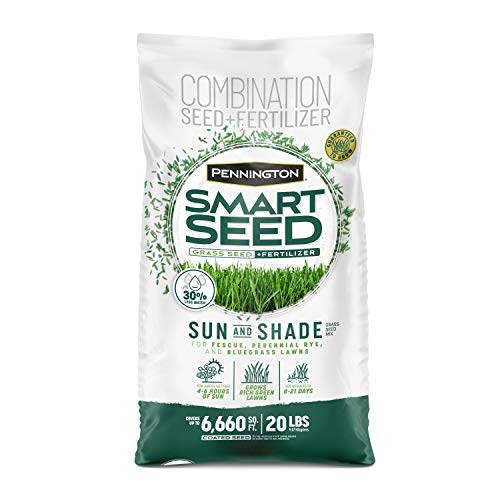
Pennington Smart Seed Sun and Shade Mix North, 20 lb
$57.21A sun and shade mix for lawns with both conditions, seeded at 5 to 6 pounds per 1,000 square feet for a new lawn.
Best for: yards with mature trees and open areas
Check price on Amazon
Scotts Turf Builder Grass Seed Bermudagrass, 4 lb
$34.97Bermudagrass seeds at just 1 to 2 pounds per 1,000 square feet, so a 4 pound bag covers about 2,700 square feet of new lawn.
Best for: southern lawns seeded once soil passes 65 F
Check price on Amazon
Scotts Turf Builder EdgeGuard DLX Broadcast Spreader
$94.97A broadcast spreader with an edge guard that keeps seed out of beds and off the drive, at the right size for typical suburban lawns.
Best for: lawns up to about half an acre
Check price on Amazon
EarthWay 2150 Commercial 50 lb Broadcast Spreader
$279.99A commercial 50 pound broadcast spreader with larger wheels that tracks over uneven ground and holds a whole bag at once.
Best for: large or rough lawns
Check price on AmazonHow we chose
We did not test these products in person. Picks are researched from manufacturer specifications and owner manuals, engine and safety certifications where they apply, warranty terms, public recall records, and the recurring themes in verified owner reviews. We favor established brands with large review counts and parts support, match each pick to a real yard size or task, and place it in the tier where its price and capability actually belong.
Frequently asked questions
How much grass seed do I need for 5,000 square feet?
About 35 pounds of tall fescue, 12.5 pounds of Kentucky bluegrass, 30 pounds of perennial ryegrass or 7.5 pounds of bermudagrass for a new lawn. To overseed the same 5,000 square feet, use roughly half of each: about 17.5 pounds of tall fescue or 6 pounds of bluegrass. Always check the bag label, which governs.
Why does Kentucky bluegrass need so much less seed?
Seed size. Kentucky bluegrass has far more seeds per pound than tall fescue, so 2 to 3 pounds per 1,000 square feet puts down a similar number of seeds as 6 to 8 pounds of fescue. Bluegrass also spreads by rhizomes and fills in gaps over time, while tall fescue is a bunch grass that must be seeded thickly enough to look full.
Can I put down too much grass seed?
Yes. Seedlings crowded shoulder to shoulder compete for light, water and nutrients, which produces thin, weak plants that are more prone to damping off disease and to dying back in the first heat or drought. Doubling the rate does not double the lawn. Stay in the range on the label and spend the extra effort on seed-to-soil contact instead.
How much seed do I need for an acre?
An acre is 43,560 square feet, so at the midpoint rates you need roughly 305 pounds of tall fescue, 261 pounds of perennial ryegrass, 109 pounds of Kentucky bluegrass or 65 pounds of bermudagrass for a new lawn. At that scale a tow-behind broadcast spreader behind a lawn tractor is the only practical way to spread evenly.
Is overseeding worth it every year?
For tall fescue and perennial ryegrass, yes, because they are bunch grasses that do not spread to fill thin areas. An annual overseeding at 3 to 4 pounds per 1,000 square feet in late summer to early fall keeps density up and crowds out weeds. Kentucky bluegrass spreads on its own and usually needs overseeding only after damage.
Researched, not professional advice. This page is compiled from published specifications, manuals, labels and owner-review consensus, not hands-on testing. Follow the manufacturer's instructions and product label, and consult a qualified professional where safety, chemicals, fuel or structures are involved. As an Amazon Associate we earn from qualifying purchases.