Landscaping
Paver Calculator: How Many Pavers, Base Gravel and Sand You Need
Quick answer
Divide patio area by the face area of one paver and add 5 percent waste, or 10 to 15 percent for herringbone and curves. A 12 by 16 foot patio of 4 by 8 inch pavers needs about 908 pavers, plus about 2.7 cubic yards of 4 inch compacted base, 0.6 cubic yards of bedding sand and 56 feet of edge restraint.
A paver patio is mostly what you cannot see: several inches of compacted crushed stone, an inch of bedding sand, edge restraints and joint sand that locks everything together. Enter your patio size, paver size and pattern, and the calculator counts pavers with waste, and works out base gravel, bedding sand, polymeric sand and edging so you can order everything at once. For a gravel path or pad instead of pavers, use the gravel calculator.
Paver calculator
Pavers needed
Tools and materials for the base and joints
Top matches update when you calculate.

Bully Tools Steel Hand Tamper
$71.99A made-in-USA all-steel tamper with a 3/8 in. thick plate and 49 in. handle for compacting gravel base under pavers.
Best for: compacting paver base and post-hole backfill
Check price on Amazon
Alliance Gator Supersand G2 Polymeric Sand (50 lb)
$79.98A polymeric sand for paver joints up to 2 in. that the maker lists as rainfast in 15 minutes, with no dust, no haze and no blower needed.
Best for: standard concrete paver patios and walkways
Check price on Amazon
DOMINATOR Polymeric Sand (40 lb)
$89.00Ceramic Flex polymeric sand rated for joint widths from 1/8 to 4 in. at a minimum 1 in. depth, with a published coverage calculator.
Best for: wide-joint flagstone and paver patios
Check price on Amazon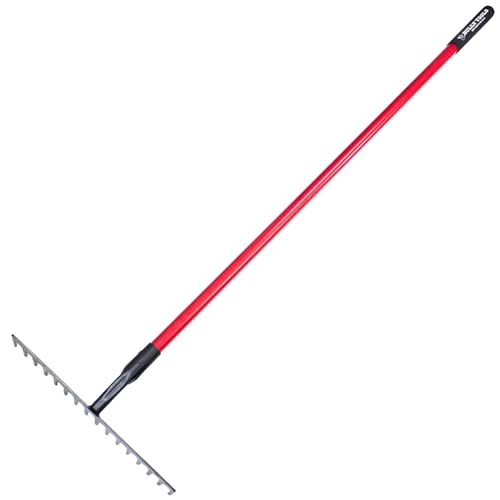
Bully Tools 7-Gauge 16-Tine Stone Rake
$69.29A made-in-USA 7-gauge steel head, thicker than standard 10-gauge rakes, on a 66 in. fiberglass handle for spreading gravel and stone.
Best for: leveling gravel pads and paver base
Check price on Amazon
Jackson MP1010 10 cu ft Poly 2-Wheel Wheelbarrow
$689.94A contractor-size 10 cu ft poly tray on an all-steel undercarriage with two 16 inch pneumatic wheels, stable enough for big loads of mulch or leaves.
Best for: heavy, frequent loads
Check price on Amazon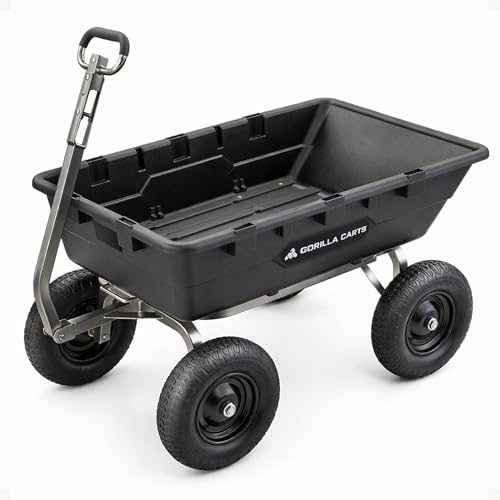
Gorilla Carts Poly Dump Cart, 1,500 lb, 10 cu ft
$389.99A 10 cu ft, 1,500 lb poly cart whose handle converts to a hitch for a lawn tractor or ATV, with 16 inch pneumatic tires and quick-release dump.
Best for: hand-pull or tow hauling on mid-size properties
Check price on Amazon
DeWitt Pro-5 Weed Barrier Fabric (6 x 250 ft.)
$156.99A 5 oz commercial woven fabric that passes air and water, resists tears during install and has alignment stripes every 12 in.
Best for: large beds and gravel paths that need long-term weed control
Check price on Amazon
Edge Right Hammer-In COR-TEN Steel Edging (5 x 48 in.)
$130.00Five 48 in. strips of 16-gauge COR-TEN steel with a rounded top and 6 in. depth that weathers to a rust patina and shrugs off string trimmers.
Best for: crisp permanent edges between lawn and gravel
Check price on Amazon
EasyFlex Heavy Duty No-Dig Edging Kit (100 ft.)
$44.37A 100 ft coil of 1.7 in. tall recycled plastic edging with 40 anchoring spikes that forms curves and tree rings without trenching.
Best for: quick curved bed borders without digging
Check price on AmazonOn this page
How many pavers do I need per square foot?
| Paver | Per sq ft | 100 sq ft, 5 percent waste | 200 sq ft, 10 percent waste |
|---|---|---|---|
| 4 x 8 in brick paver | 4.5 | 473 | 991 |
| 6 x 6 in square | 4 | 420 | 881 |
| 6 x 9 in rectangle | 2.67 | 281 | 587 |
| 12 x 12 in square | 1 | 105 | 221 |
| 16 x 16 in slab | 0.56 | 60 | 124 |
| 24 x 24 in slab | 0.25 | 27 | 56 |
How deep should the paver base be?
| Use | Compacted base | Bedding sand | Notes |
|---|---|---|---|
| Walkway or patio, foot traffic | 4 in | 1 in | Compacted in 2 lifts |
| Patio on clay or poorly drained soil | 6 in | 1 in | Add geotextile fabric under the base |
| Hot tub or heavy grill station pad | 6 in | 1 in | Follow the equipment maker's pad requirements |
| Residential driveway | 8 to 12 in | 1 in | Use pavers rated for vehicles; consider a contractor |
How much base gravel and sand does a patio need?
| Patio area | Crushed base, with compaction | Bedding sand | Polymeric sand, 50 lb bags |
|---|---|---|---|
| 100 sq ft | 1.42 yd (2.1 t) | 0.31 yd (17 bags) | 2 bags |
| 200 sq ft | 2.84 yd (4.3 t) | 0.62 yd (34 bags) | 3 bags |
| 300 sq ft | 4.26 yd (6.4 t) | 0.93 yd (50 bags) | 4 bags |
| 400 sq ft | 5.68 yd (8.5 t) | 1.23 yd (67 bags) | 5 bags |
| 600 sq ft | 8.52 yd (12.8 t) | 1.85 yd (100 bags) | 8 bags |
How is the paver calculation done?
- Pavers = area in sq ft / paver face area in sq ft x (1 + waste), with 5 percent for straight running bond, 10 percent for basket weave or herringbone, and 15 percent for curves and many cuts
- Base gravel = area x base depth in inches / 324 x 1.15 for compaction, in cubic yards
- Bedding sand = area x 1 inch / 324, in cubic yards; half cubic foot bags = cubic feet / 0.5
- Edge restraint = the perimeter, minus any side against a house slab or existing hardscape
Excavation depth is the base plus sand plus paver thickness, typically about 7 to 8 inches for a patio with 2 3/8 inch pavers, and the finished surface should slope away from the house about 1/8 to 1/4 inch per foot for drainage. For pricing the whole job with labor, a contractor cost estimator such as HouseProjectCalc helps.
What tools do I need to lay pavers?
Beyond a shovel and a level, the jobs that matter are compaction, screeding and joint sand. Rent a plate compactor for the base; a steel hand tamper such as the Bully Tools Steel Hand Tamper handles edges and small walkways. A heavy stone rake like the Bully Tools 7-Gauge 16-Tine Stone Rake spreads base gravel evenly, and moving 3 tons of stone goes far faster in a two-wheel barrow such as the Jackson MP1010 10 cu ft Poly 2-Wheel Wheelbarrow than in a single-wheel one. Lock joints with polymeric sand such as Alliance Gator Supersand G2 Polymeric Sand (50 lb) or DOMINATOR Polymeric Sand (40 lb), following the bag's watering instructions exactly. On soft or clay soil, a woven geotextile like the DeWitt Pro-5 Weed Barrier Fabric (6 x 250 ft.) under the base reduces settling.
Frequently asked questions
How many 4x8 pavers are in a square foot?
A 4 by 8 inch paver has a face area of 32 square inches, so 144 divided by 32 gives 4.5 pavers per square foot. For 100 square feet you need 450 pavers before waste, about 473 with 5 percent extra, or around 495 to 518 with 10 to 15 percent for herringbone patterns and cuts.
How much base do I need for a 12x12 paver patio?
A 12 by 12 foot patio is 144 square feet. With a 4 inch compacted base, you need about 1.8 cubic yards before compaction, roughly 2 cubic yards or 3 tons with a compaction allowance, plus about 0.44 cubic yards of bedding sand. On clay or poorly drained soil, a 6 inch base needs about 3 cubic yards of crushed stone.
Can I lay pavers directly on dirt?
Not if you want them to stay flat. Pavers laid on soil shift, settle and grow weeds between joints within a season or two, especially where soil freezes or drains poorly. A compacted crushed stone base and a thin sand bed spread loads and drain water. Stepping stones set into a lawn are the exception, since small uneven movement matters less there.
How much polymeric sand do I need?
Coverage depends on paver size and joint width. For standard pavers with narrow joints, a 50 pound bag often covers roughly 60 to 100 square feet, while small pavers, tumbled edges and wide joints can use two or three times as much. Check the coverage chart on the bag for your joint width and buy an extra bag, since running short mid-job causes uneven curing.
What waste factor should I use for pavers?
Use about 5 percent extra for simple running bond or stack patterns with straight edges, 10 percent for herringbone or basket weave, and 15 percent for curved edges, circles or many obstacles. Extra pavers from the same production run are also worth keeping for future repairs, since colors vary between batches.
Researched, not professional advice. This page is compiled from published specifications, manuals, labels and owner-review consensus, not hands-on testing. Follow the manufacturer's instructions and product label, and consult a qualified professional where safety, chemicals, fuel or structures are involved. As an Amazon Associate we earn from qualifying purchases.