Outdoor Kitchens
Built-In vs Freestanding Grill: Which Belongs on Your Patio?
Quick answer
A freestanding cart grill is the right buy for most homes: no construction, it moves when you remodel, and a Weber Genesis E-435 already includes a side burner and prep table. A built-in grill head like the Blaze Prelude LBM 32 makes sense only when you are building a permanent island with counters, storage and ideally a gas line.

Blaze Prelude LBM 32 in. Built-In Grill (Propane)
$1,749.00A 32 inch stainless grill head that drops into an island cutout.
Best for: first outdoor kitchen islands
Check price on Amazon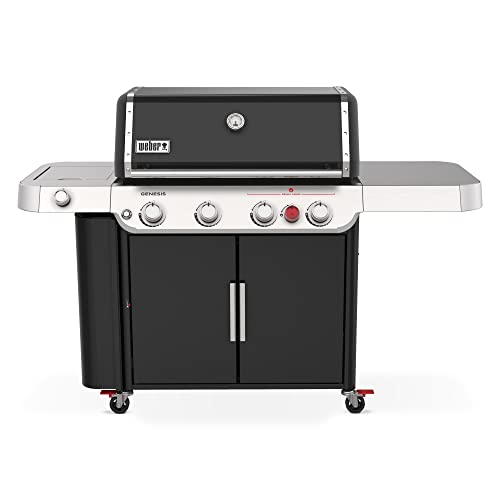
Weber Genesis E-435 Gas Grill with Side Burner (Propane)
$1,499.00A complete cart grill with side burner and prep table.
Best for: hosts who cook sides and mains outside
Check price on AmazonA built-in grill is a grill head without a cart, designed to drop into a cutout in an outdoor kitchen island. A freestanding grill is a complete grill on its own cart or cabinet. The cooking physics are the same: burners, grates, a lid. What differs is everything around the cookbox, including cost, construction, permits, fuel and whether the grill leaves with you when you sell the house.
The Blaze Prelude LBM 32 in. Built-In Grill (Propane) is $1,749.00 for the head alone; the Weber Genesis E-435 Gas Grill with Side Burner (Propane) is $1,499.00 complete. The built-in number grows fast once you add an island, side burner, doors and a fridge. Plan the whole space first with our outdoor kitchen planning guide and the grill size calculator.
On this page
- What is the difference between a built-in and a freestanding grill?
- Which should you choose, built-in or freestanding?
- How much does a built-in grill setup really cost?
- What does an outdoor kitchen island need for a built-in grill?
- Does a built-in grill cook better than a freestanding grill?
- Is there a middle ground between built-in and freestanding?
- Which built-in and freestanding options are worth considering?
What is the difference between a built-in and a freestanding grill?
| Factor | Built-in grill head | Freestanding grill |
|---|---|---|
| Example | Blaze Prelude LBM 32, $1,749.00 | Weber Genesis E-435, $1,499.00 |
| What you get | Grill head only | Complete grill with cart, shelves, side burner and tank storage |
| Needs | Island with a 30 5/8 by 21 1/4 by 8 1/2 in. cutout (Blaze listing) | A level patio spot with manual clearances |
| Burners and BTU | 4 stainless tube burners, 14,000 BTU each, 56,000 total | 4 burners plus side burner; BTU not published |
| Construction | Island framing; insulated jacket if framing is combustible, per the manual | Assembly only |
| Fuel | Propane tank in a vented island bay, or hard-piped natural gas | Propane tank in the cabinet, or a factory natural gas model |
| Trades involved | Often a licensed gas fitter and electrician | Usually none for propane |
| Mobility | Permanent; stays with the house | Rolls to reposition; moves with you |
| Materials | 304 stainless construction (Blaze listing) | Painted and porcelain-enameled steel with cast-iron grates |
| Warranty on listing | Lifetime residential, 3-year commercial (Blaze) | Not stated on the Genesis listing |
| Add-ons | Bought separately: Blaze side burner $479.00, doors, fridge | Side burner and prep table included |
Island construction costs vary widely by materials and region and are not included. For contractor estimates, see houseprojectcalc.com.
Which should you choose, built-in or freestanding?
Choose a built-in grill if
- You are already building a patio or island with counters, storage and lighting.
- You plan to stay in the home for many years.
- You have or will run a natural gas line to the island.
- You want 304 stainless construction and a long printed warranty, as with the Blaze Prelude LBM 32 in. Built-In Grill (Propane).
Choose a freestanding grill if
- You want to cook this weekend, not after a construction project.
- You rent, may move, or may redesign the patio.
- You want side burner, prep space and storage in one purchase, as with the Weber Genesis E-435 Gas Grill with Side Burner (Propane).
- You want the most grill for the money; island work can cost more than the grill.
How much does a built-in grill setup really cost?
The grill head is only the start. From our catalog, a Blaze Prelude LBM 32 in. Built-In Grill (Propane) ($1,749.00) plus a Blaze 12,000 BTU Drop-In Single Side Burner (Propane) ($479.00) and a 24 inch Whynter BOR-53024-SSW 24 in. Built-in Outdoor Beverage Fridge ($1,112.99) already totals well over $3,000 before any island, access doors, countertop, gas line or electrical work. A bundle such as the Bullet by Bull Outdoor Kitchen Set with 4-Burner Grill (Propane) ($1,697.00) packages a grill, side burner and door. A complete stainless island like the KoolMore Reserve Outdoor Kitchen Island with 6-Burner Grill, Sink and Refrigerator ($4,799.00) delivers grill, sink and fridge as one unit.
Masonry, stone and countertop work is where budgets move the most, and it depends heavily on region and materials, so we do not quote it. HouseProjectCalc covers contractor cost estimates. A cart grill avoids all of it.
What does an outdoor kitchen island need for a built-in grill?
Four things decide whether a built-in install is safe and passes inspection:
- The exact cutout. Build to the manufacturer's spec sheet, with the grill or its drawings on hand before framing. Blaze lists 30 5/8 by 21 1/4 by 8 1/2 inches for its 32 inch heads.
- Combustible framing protection. Most makers require an insulated jacket when the island is framed with wood or other combustible material. Follow the installation manual exactly.
- Ventilation. Enclosed island bays holding a propane tank or gas connections need vent panels so leaked gas cannot collect.
- Licensed trades. A licensed plumber or gas fitter should run and pressure-test gas lines, and a licensed electrician should install GFCI outlets for lights, fridges and rotisseries. Call 811 before trenching for any line.
Keep the island the manual's clearance from the house and never under a low roof unless the installation instructions and local code allow it with proper ventilation.
Does a built-in grill cook better than a freestanding grill?
Not by itself. A built-in head uses the same combination of burners, heat spreaders and grates as a cart grill, and cooking results depend on those parts and the lid, not on the island around them. Built-in heads tend to be heavier stainless construction with longer warranties because they are expected to last as long as the island. A premium cart grill can match that performance: the Napoleon Prestige 500 RSIB Gas Grill (Propane) and Broil King Regal S 690 Pro IR Gas Grill (Propane) both add infrared and rotisserie features found on high-end built-ins. Buy built-in for the kitchen, not for better food.
Is there a middle ground between built-in and freestanding?
Yes, and for many homes it is the smartest path. The Domi 5-Piece Modular Aluminum Outdoor Kitchen with Sink ($1,199.99) is a set of powder-coated aluminum modules with a sink that arrange around an existing grill without masonry. A Keter Unity XL Outdoor Prep Table and Storage Cart adds a stainless prep top and 78 gallons of storage next to any cart grill for $237.99. A Sunjoy 7 x 9 ft. 2-Tier Hardtop Grill Gazebo puts a vented roof over the cooking station. You get most of the outdoor kitchen experience, and everything can move later. The best outdoor kitchen islands roundup covers more options.
Which built-in and freestanding options are worth considering?
A cart grill, a built-in head and two ways to build a kitchen around them.
Weber Genesis E-435 Gas Grill with Side Burner (Propane)
$1,499.00Four burners, a side burner, an expandable second-level grate, a grillware locker and an extra-large prep table: a compact outdoor kitchen on wheels.
Best for: most homes that want to cook full meals outside
Check price on Amazon Blaze Prelude LBM 32 in. Built-In Grill (Propane)
$1,749.00Four 14,000 BTU stainless tube burners with heat zone separators, a published cutout and a lifetime residential warranty.
Best for: a first outdoor kitchen island
Check price on Amazon
Domi 5-Piece Modular Aluminum Outdoor Kitchen with Sink
$1,199.99Aluminum modules with a stainless sink and faucet, corner bar cabinet and leveling feet that recombine to fit a patio around an existing grill.
Best for: an outdoor kitchen without construction
Check price on Amazon
Bullet by Bull Outdoor Kitchen Set with 4-Burner Grill (Propane)
$1,697.00A matched stainless set with a four-burner built-in grill, side burner and access door in one order.
Best for: buying island components together
Check price on AmazonHow we chose
We did not test these products in person. Picks are researched from manufacturer specifications and owner manuals, engine and safety certifications where they apply, warranty terms, public recall records, and the recurring themes in verified owner reviews. We favor established brands with large review counts and parts support, match each pick to a real yard size or task, and place it in the tier where its price and capability actually belong.
Frequently asked questions
Is a built-in grill worth it?
A built-in grill is worth it when you are building a permanent outdoor kitchen and plan to stay in the home, because it integrates with counters, storage and a gas line. It is not worth it just to get a better grill, since cooking performance comes from burners and grates, not the island. For most households, a complete cart grill like the Weber Genesis E-435 delivers more for the money.
Can you put a freestanding grill in an outdoor kitchen island?
Only in a way its manual allows. Cart grills are not designed to be enclosed by counters, and wrapping one in combustible framing can trap heat and gas. Many islands leave an open bay with the clearances the grill manual lists, so the cart rolls in and out. If you want the grill set into the counter, buy a built-in grill head designed for a cutout.
Do built-in grills need an insulated jacket?
Most manufacturers require an insulated jacket when the grill goes into an island framed with wood or other combustible materials, and some do not require one for fully non-combustible masonry or steel islands. The requirement is in the installation manual for your specific grill head, and it is not optional. Skipping it risks fire inside the island and can void the warranty.
How long do built-in grills last?
Well-built stainless grill heads commonly last many years because they are made to stay put in an island exposed to weather. Blaze backs the Prelude LBM 32 with a lifetime residential warranty on its listing. Lifespan still depends on care: clean burners and grease trays, cover the head when not in use and replace igniters and heat tents as they wear.
Can I put a built-in grill under a covered patio?
Only if the grill's installation manual and your local code allow it, which usually requires specific overhead clearance and often a vent hood rated for outdoor grills. Heat and grease vapor can scorch ceilings and build up under a roof, and gas combustion produces carbon monoxide. Never install a grill on an enclosed or screened porch. Have a licensed contractor review the plan.
Researched, not professional advice. This page is compiled from published specifications, manuals, labels and owner-review consensus, not hands-on testing. Follow the manufacturer's instructions and product label, and consult a qualified professional where safety, chemicals, fuel or structures are involved. As an Amazon Associate we earn from qualifying purchases.