Landscaping
Wheelbarrow vs Yard Cart: Which Hauls Easier? (Gorilla Cart Too)
Quick answer
Choose a wheelbarrow for loose, heavy material you dump in exact spots, like gravel, soil and mulch on narrow paths: the True Temper 6 cu ft is the classic. Choose a yard cart for bags, tools, firewood and anyone who wants the wheels to carry the weight: the Gorilla Carts 6 cu ft is easier on backs.
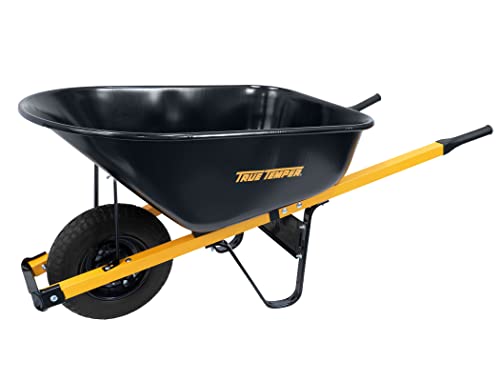
True Temper 6 cu ft Steel Wheelbarrow with Never Flat Tire
$229.00Single flat-free wheel, steel tray, dumps exactly where you point it.
Best for: general yard hauling
Check price on Amazon
Gorilla Carts Poly Dump Cart, 1,200 lb, 6 cu ft
$199.99Four wheels carry the load, with a quick-release dump bed.
Best for: hauling bags of seed and fertilizer
Check price on AmazonA wheelbarrow puts the load over one wheel and your arms: you lift the handles, balance the tray and push. A yard cart, or dump cart, rolls on four wheels and you pull it by a handle, so the wheels carry the full load and you only supply rolling effort. Both examples here hold 6 cu ft and cost about the same: $229.00 for the True Temper 6 cu ft Steel Wheelbarrow with Never Flat Tire and $199.99 for the Gorilla Carts Poly Dump Cart, 1,200 lb, 6 cu ft.
The right one depends on what you haul and how your back feels about it. Many homeowners with a real landscaping project end up owning both. Estimate your loads first with the mulch calculator or gravel calculator.
On this page
- How does a wheelbarrow compare with a yard cart?
- Which should you choose, a wheelbarrow or a yard cart?
- How much can a wheelbarrow or yard cart really carry?
- Is a wheelbarrow or yard cart easier on your back?
- What is the difference between a yard cart and a tow-behind dump cart?
- Which wheelbarrows and yard carts are worth buying?
How does a wheelbarrow compare with a yard cart?
| Factor | Wheelbarrow | Yard or dump cart |
|---|---|---|
| Example | True Temper 6 cu ft steel, $229.00 | Gorilla Carts 1,200 lb 6 cu ft, $199.99 |
| Capacity | 6 cu ft; no weight rating listed | 6 cu ft; rated to 1,200 lb |
| Wheels | One 4 x 8 in. flat-free tire | Four wheels; size not listed |
| Who carries the weight | Wheel plus your arms and back | The wheels; you pull |
| Balance | You balance the load side to side | Stable on flat ground |
| Dumping | Tip forward precisely where you aim | Quick-release bed tips at the cart |
| Narrow spaces | Fits gates, planks and paths between beds | Wider 40 by 25.6 in. bed |
| Slopes | Can tip sideways on cross slopes | Can push you downhill when loaded |
| Tray | Seamless steel | Rust-proof poly bed |
| Best loads | Gravel, soil, concrete, spreading mulch | Bags, tools, firewood, plants, bulky loads |
| Bigger version | Jackson MP1010 10 cu ft two-wheel, $689.94 | Gorilla Carts 1,500 lb 10 cu ft, converts to tow, $389.99 |
Specifications from the Amazon listings.
Which should you choose, a wheelbarrow or a yard cart?
Choose a wheelbarrow if
- You move loose material and want to dump it exactly on a bed, in a hole or along a path.
- You work on narrow paths, through gates or up a plank.
- You mix concrete or mortar in the tray.
- You are comfortable lifting and balancing a load.
Choose a yard cart if
- You haul bags of soil, seed and fertilizer, tools or firewood.
- Your back, shoulders or balance make lifting handles hard.
- Your yard is mostly flat and open.
- You own a riding mower and may want to tow: the Gorilla Carts Poly Dump Cart, 1,500 lb, 10 cu ft handle converts to a hitch.
How much can a wheelbarrow or yard cart really carry?
Volume fills up long before a sensible weight limit. Gravel weighs roughly 100 lb per cubic foot, so a 6 cu ft tray heaped with gravel is around 600 lb, which nobody should push. Moist topsoil runs roughly 75 to 100 lb per cubic foot, and mulch roughly 15 to 30. In practice, fill a wheelbarrow about a third to half full with stone or soil, and fill it to the top only with mulch or leaves. The 1,200 lb rating on the Gorilla Carts Poly Dump Cart, 1,200 lb, 6 cu ft describes what the cart can hold, not what a person can safely pull up a grade. See the gravel weight chart for material weights.
Is a wheelbarrow or yard cart easier on your back?
A four-wheel cart, for most people. With a single-wheel barrow you lift a share of the load at the handles and use your core to keep it upright, and a shifting load can twist you as it tips. A cart puts all the weight on its wheels; you pull, and on flat ground a loaded cart takes modest effort. That is why carts are popular with older homeowners and anyone with a back injury. The trade-off is maneuverability and dumping precision. A two-wheel wheelbarrow such as the Jackson MP1010 10 cu ft Poly 2-Wheel Wheelbarrow is a middle ground: it will not tip sideways and still dumps forward, though you still lift the handles.
What is the difference between a yard cart and a tow-behind dump cart?
A yard cart like the Gorilla is designed to be pulled by hand, and some convert to tow. A tow-behind dump cart is built for a lawn tractor or zero-turn and is too heavy to pull by hand when loaded. The Agri-Fab 12 cu ft Tow-Behind Poly Swivel Dump Cart, 700 lb holds 12 cu ft and 700 lb with an 80 degree swivel dump, and the Ohio Steel 4048P-HYB 15 cu ft Poly Swivel Hybrid Dump Cart holds 15 cu ft and 1,250 lb with a foot-pedal swivel dump across 100 degrees. If you have acreage and a riding mower, a tow cart saves the most walking; check your mower manual's towing limits first. The best yard carts and wheelbarrows roundup compares more models.
Which wheelbarrows and yard carts are worth buying?
A classic barrow, a hand cart, a stable two-wheel barrow and a cart that tows.
True Temper 6 cu ft Steel Wheelbarrow with Never Flat Tire
$229.00A seamless steel tray with a sloped front for dumping, steel handles and a flat-free tire, shipped in one box.
Best for: mulch, soil and stone on narrow paths
Check price on Amazon Gorilla Carts Poly Dump Cart, 1,200 lb, 6 cu ft
$199.99A rust-proof poly bed rated to 1,200 lb in a 40 by 25.6 inch bed with a patented quick-release dump.
Best for: bags, tools and flat yards
Check price on Amazon
Jackson MP1010 10 cu ft Poly 2-Wheel Wheelbarrow
$689.94A contractor-size 10 cu ft poly tray on an all-steel undercarriage with two 16 inch pneumatic wheels that will not tip sideways.
Best for: big, frequent loads
Check price on Amazon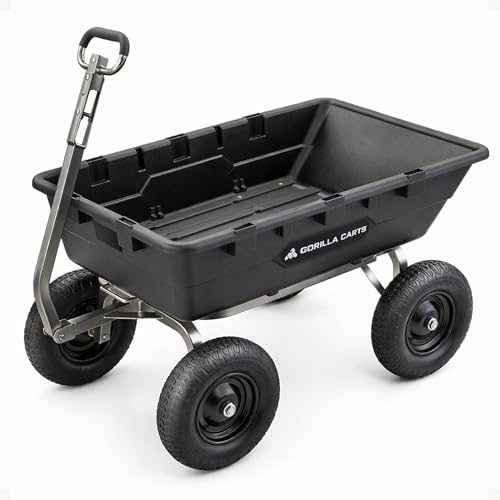
Gorilla Carts Poly Dump Cart, 1,500 lb, 10 cu ft
$389.99A 10 cu ft, 1,500 lb poly cart whose handle converts to a hitch, with 16 inch pneumatic tires and a quick-release dump.
Best for: mid-size properties with a riding mower
Check price on AmazonHow we chose
We did not test these products in person. Picks are researched from manufacturer specifications and owner manuals, engine and safety certifications where they apply, warranty terms, public recall records, and the recurring themes in verified owner reviews. We favor established brands with large review counts and parts support, match each pick to a real yard size or task, and place it in the tier where its price and capability actually belong.
Frequently asked questions
Is a wheelbarrow or a garden cart better?
A wheelbarrow is better for loose, heavy material you dump in precise spots and for narrow paths. A garden or dump cart is better for bags, tools and firewood, and for anyone who does not want to lift and balance a load, because four wheels carry the weight. The True Temper 6 cu ft and Gorilla Carts 6 cu ft cost about the same.
Is a Gorilla Cart worth it?
For hauling bags, tools, firewood and plants across a mostly flat yard, yes. The Gorilla Carts poly dump cart carries the load on four wheels, resists rust and dumps with a quick-release bed. It is less useful for placing gravel or soil precisely, on narrow paths, or on steep yards where a loaded cart is hard to control going downhill. Many owners keep a wheelbarrow too.
How much weight can a wheelbarrow hold?
More than you should push. A 6 cu ft wheelbarrow heaped with gravel holds roughly 600 lb, since gravel weighs about 100 lb per cubic foot. A practical load for most people is a tray a third to half full of stone or soil, or full of mulch and leaves. Two-wheel barrows are more stable with heavy loads, but the limit is still your control on the ground.
What is the difference between a yard cart and a dump cart?
The terms overlap. A yard cart is any wheeled cart for hauling around the yard, and a dump cart is one whose bed tips to unload. Hand-pull poly carts like Gorilla Carts are both. Tow-behind dump carts such as the Agri-Fab 12 cu ft swivel cart are built to hitch to a lawn tractor and are too heavy to pull by hand when loaded.
Can I tow a Gorilla Cart with a riding mower?
Some models, yes. The Gorilla Carts 1,500 lb 10 cu ft has a handle that converts to a hitch for a lawn tractor or ATV. Check your mower's manual for towing capacity, hitch type and slope limits before towing, keep speed low, and never exceed the lower of the cart and mower ratings. The smaller 6 cu ft cart is designed to be pulled by hand.
Researched, not professional advice. This page is compiled from published specifications, manuals, labels and owner-review consensus, not hands-on testing. Follow the manufacturer's instructions and product label, and consult a qualified professional where safety, chemicals, fuel or structures are involved. As an Amazon Associate we earn from qualifying purchases.