Chainsaws and Wood
How to Split Firewood: Maul vs Splitter, Tonnage and Drying
Quick answer
Cut rounds about 3 inches shorter than your firebox (16 inches suits most stoves), split them soon after cutting, and dry them to 20 percent moisture, which EPA says takes at least 6 months. A 6 to 8 lb maul handles rounds under 12 inches; 20 inch seasoned hardwood needs about 20 tons, like the BILT HARD 22-Ton.
Splitting firewood means driving a wedge along the grain of a sawn log round so it breaks into pieces small enough to dry quickly and fit your stove. Split wood dries far faster than whole rounds because the bark, which slows moisture loss, only covers one face of each piece. The two decisions that shape the job are how you split (a maul, a manual hydraulic splitter, an electric or a gas splitter) and how long you let the wood dry before burning.
Start by sizing the splitter to your largest common rounds in the log splitter tonnage calculator. For most homeowners burning a few cords of mixed hardwood, a 20 to 22 ton gas splitter such as the SuperHandy 20-Ton Gas Log Splitter ($869.00) or the BILT HARD 22-Ton Gas Log Splitter is the sweet spot, while a 5 to 7 ton electric suits a patio fire pit supply of small rounds.
On this page
- How long should firewood rounds be?
- How dry does firewood need to be before burning?
- Should I use a maul or a log splitter?
- How many tons of log splitter do I need?
- Does cycle time matter on a log splitter?
- How do I read the grain to split wood easier?
- What size should split firewood pieces be?
- How should I stack firewood so it dries?
- How do I split firewood step by step?
- Which log splitter or saw should I buy for firewood?
How long should firewood rounds be?
Cut rounds about 3 inches shorter than the front-to-back depth of your firebox, or no longer than the maximum log length printed in your stove or insert manual. That leaves room to load pieces at an angle and keeps wood off the glass and door gasket. Sixteen inches is the most common length for wood stoves and the standard assumption when firewood is sold by the face cord; small inserts and fire pits often take 12 to 14 inches, and large fireplaces and outdoor fire pits can take 18 to 20.
Check your splitter too. Electric splitters such as the Sun Joe LJ602E 5-Ton Electric Log Splitter and BILT HARD 6.5-Ton Electric Log Splitter accept logs up to 20.5 inches long, and the Sun Joe LJ10M 10-Ton Manual Hydraulic Log Splitter manual splitter takes 18 inches. Cut consistently: a measuring stick laid on the log or a paint mark every 16 inches before you start bucking saves fitting problems later. Choose a chainsaw bar about 2 inches longer than the log diameter, as the chainsaw bar length calculator explains, and wear full protective gear while bucking (see the chainsaw safety guide).
How dry does firewood need to be before burning?
EPA's Burn Wise program says firewood should have a moisture content of 20 percent or less, and recommends splitting, stacking, covering and storing it for at least 6 months. Wet wood wastes heat boiling off water, produces more smoke and fine particle pollution, and builds creosote in the chimney, which is a fire risk. Freshly cut green wood is commonly well above that level, often double or more.
- Test with a moisture meter on a freshly split face, not the end grain or bark side, which dry first and read low. A basic firewood moisture meter costs less than a single face cord.
- Signs of dry wood: cracks (checks) radiating across the ends, lighter weight, bark that loosens, and a hollow knock when two pieces strike each other.
- Signs of wet wood: hissing or bubbling from the ends in the fire, heavy weight, and a fire that smolders instead of flaming.
Dense hardwoods like oak are commonly given 1 to 2 years to season, while softwoods and lighter hardwoods such as pine, poplar and ash often reach 20 percent in 6 to 12 months in a sunny, breezy stack. Your climate matters as much as species: wood dries fast in hot dry summers and slowly in humid, shaded yards.
Should I use a maul or a log splitter?
A splitting maul is a heavy wedge-shaped head, commonly 6 to 8 pounds, on a long handle, designed to burst wood apart rather than cut it. A splitting axe is lighter, commonly 3 to 6 pounds, with a sharper profile that suits smaller rounds. A log splitter uses a hydraulic ram to push the log into a wedge (or the wedge into the log) with a rated force in tons.
- Maul or axe: no fuel, no noise and the lowest cost, such as a Fiskars X27 splitting axe or an 8 lb splitting maul. It suits straight-grained rounds under about 12 inches and a cord or less a year for a fit person. Knotty, stringy or large rounds turn it into hours of hard work.
- Manual hydraulic: the Sun Joe LJ10M 10-Ton Manual Hydraulic Log Splitter gives 10 tons from a hand pump with no fuel or cord, but only takes rounds up to 8 inches across and is slow.
- Electric (5 to 7 tons): the PowerSmart 7-Ton Electric Log Splitter and BILT HARD 6.5-Ton Electric Log Splitter run from a household outlet with an 18 to 20 second cycle and no exhaust, for rounds up to about 10 inches.
- Gas (20 tons and up): the SuperHandy 20-Ton Gas Log Splitter, BILT HARD 22-Ton Gas Log Splitter and Full Boar 28-Ton Gas Log Splitter handle big hardwood rounds with faster cycles, for anyone splitting several cords a year.
The electric vs gas trade-offs are covered in electric vs gas log splitters.
How many tons of log splitter do I need?
Required force rises steeply with diameter. The figures below are common guidance for straight-grained, seasoned wood, the same table the site's calculator uses. Tough, stringy species such as elm and sweetgum need about 35 percent more, and green wood about 25 percent more.
| Log diameter | Seasoned softwood (tons) | Seasoned hardwood (tons) | Elm, sweetgum and stringy wood (tons) | Splitter class that fits |
|---|---|---|---|---|
| 6 in | 3 | 4 | 5.4 | Any, including 5 ton electric |
| 8 in | 4 | 5 | 6.8 | 6.5 ton or 7 ton electric |
| 10 in | 4 | 6 | 8.1 | 7 ton electric at its 10 in. limit, or 8 ton gas |
| 12 in | 5 | 8 | 10.8 | 8 ton gas for hardwood, 20 ton for stringy wood |
| 16 in | 10 | 14 | 18.9 | 20 ton gas |
| 20 in | 14 | 20 | 27 | 22 ton to 28 ton gas |
| 24 in | 18 | 27 | 36.5 | 28 ton gas, or noodle and slab the round first |
Common guidance for straight-grained seasoned wood; knots, crotches and frozen or green wood change the numbers. Check each splitter's maximum log diameter as well as its tonnage.
Does cycle time matter on a log splitter?
For big piles, cycle time matters as much as tonnage. Cycle time is how long the ram takes to extend and return. A 7 second cycle, like the BILT HARD 22-Ton Gas Log Splitter, splits roughly twice as many rounds per hour as a machine cycling in 15 to 20 seconds. The SuperHandy 20-Ton Gas Log Splitter lists 7.5 seconds and the Full Boar 28-Ton Gas Log Splitter 10.9 seconds, while the Champion 8-Ton Compact Horizontal Gas Log Splitter runs 20 seconds with auto-return (about 180 cycles per hour) and the electrics run 18 to 20 seconds.
If you split one cord a year for a fire pit, a slow electric is fine and quieter. If you heat a house with 4 to 6 cords, a fast gas splitter saves whole weekends. A cord is a stack 4 feet high, 4 feet wide and 8 feet long, or 128 cubic feet of stacked wood.
How do I read the grain to split wood easier?
Wood splits along its fibers, and the end of every round tells you where it wants to break.
- Follow the checks. Cracks radiating from the center on the end of a drying round are the easiest line. Place the maul blade or splitter wedge along the longest check.
- Split from the edge on big rounds. Instead of striking a 20 inch round dead center, take slabs off the outside edge a few inches in, working around the round until the core is small enough to halve. Owners commonly report this works better than center blows with a maul and reduces stalls on a splitter.
- Avoid knots. Branch knots run across the grain. Orient the round so the split line runs through or beside a knot rather than across it, or set the knot-heavy piece aside for last.
- Crotches and stringy species are the hardest. Forked sections and elm or sweetgum tear rather than pop apart; they often need a splitter or can be cut into slabs with a saw (called noodling, cutting along the length of the round) by an experienced operator.
- Split the top of the tree first, meaning set rounds with the end that faced the crown up when using a maul, which many splitters find breaks more easily.
- Frozen wood often splits more readily with a maul, one reason many people split in cold weather.
What size should split firewood pieces be?
For most wood stoves, pieces 3 to 6 inches across at the widest point burn well and dry evenly, with some smaller kindling split from dry, straight pieces. Rounds under about 6 inches can often dry unsplit in a good stack, but splitting them in half speeds drying. Larger pieces hold a fire longer overnight but take longer to season. Mix sizes: small pieces start a fire and bring the stove up to temperature quickly, and larger pieces sustain it.
How should I stack firewood so it dries?
Drying needs air movement and sun, and protection from ground moisture and rain:
- Get it off the ground on pallets, rails, cinder blocks or a firewood rack, so the bottom row does not wick moisture and rot.
- Stack in single rows with the ends facing the prevailing wind and gaps between rows, in the sunniest open spot you have.
- Cover the top only. A roof, board or tarp over the top keeps rain off, but wrapping the sides traps moisture. Leave sides open.
- Bark side up on the top layer sheds water.
- Stack loosely, and cross-stack the ends of each row (or use end braces) so it does not topple.
Keep large stacks away from the house. Firewood against siding invites termites, carpenter ants and rodents, and in wildfire-prone areas Firewise USA guidance is to keep firewood at least 30 feet from structures. Buy or cut firewood locally: many states restrict moving firewood because it spreads invasive insects such as the emerald ash borer. A dump cart or wheelbarrow such as the Gorilla Carts Poly Dump Cart, 1,200 lb, 6 cu ft makes moving split wood to the stack far easier.
How do I split firewood step by step?
- Gear up. Wear safety glasses, gloves, boots with toe protection and hearing protection around gas engines. Remove rings and loose clothing that can catch.
- Set up on level ground. Place the splitter or chopping block on firm, level ground with room to work. Run gas splitters outdoors only, well away from doors, windows and garages.
- Sort the rounds. Stage rounds by size and set knotty, forked or stringy pieces aside. Check each round is no longer than the splitter's rated log length.
- Read the end grain. Find the longest check and plan to split along it, or plan to slab off the edges of large rounds first.
- Position the round. On a splitter, set the round square against the end plate and wedge with flat ends. With a maul, set it on a sturdy chopping block, not on the ground, so the head does not bury in dirt or glance toward your feet.
- Split with hands clear. Operate the splitter control with your hands away from the log and wedge, one operator only. With a maul, clear the swing arc, keep feet apart and let the head's weight do the work.
- Resize and repeat. Halve and quarter pieces until they are 3 to 6 inches across. Stop the engine before clearing jammed pieces.
- Stack to dry. Move the splits to a raised, top-covered stack in sun and wind, and check moisture after 6 months on a fresh split face.
Which log splitter or saw should I buy for firewood?
Match the splitter to your largest common rounds and yearly volume, then pick a saw that bucks those rounds comfortably. The full ranking with tiers is on the best log splitters.
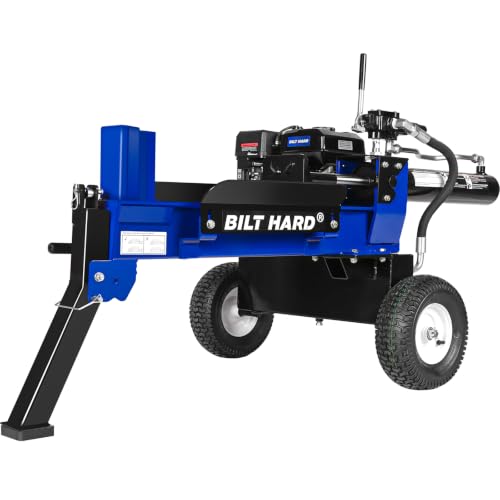
BILT HARD 22-Ton Gas Log Splitter
$1,099.99A 209cc engine with a 14 GPM 2-stage pump, 22 tons, a 7 second cycle and a 21 in. log capacity, towable at up to 25 MPH to wherever the wood is.
Best for: mixed hardwood, 2 to 6 cords a year
Check price on Amazon
Full Boar 28-Ton Gas Log Splitter
$1,399.00A 212cc OHV engine producing 28 tons with a 10.9 second cycle, adjustable auto-return valve and a heavy H beam for large, knotty or stringy rounds.
Best for: rounds over 20 in. and elm or sweetgum
Check price on Amazon
SuperHandy 20-Ton Gas Log Splitter
$869.00A 7 HP engine with a 2-stage Bucher gear pump and a 7.5 second cycle for logs up to 20 in. long and 16 in. across.
Best for: seasoned rounds up to 16 in.
Check price on Amazon
PowerSmart 7-Ton Electric Log Splitter
$379.99A 15 amp induction motor with 7 tons of force and a 20 second cycle for logs up to 20 in. long and 10 in. across, with no fuel or exhaust.
Best for: fire pit and small stove wood
Check price on Amazon
Husqvarna 450 Rancher 20 in. Gas Chainsaw
$354.99A 50.2cc, 3.2 HP X-Torq engine with Smart Start and LowVib on a 20 in. bar, sized for bucking 16 to 18 in. firewood rounds.
Best for: cutting several cords a year
Check price on Amazon
EGO Power+ CS1815 18 in. Chainsaw Kit with 6.0Ah Battery
$399.00An 18 in. brushless saw that EGO rates as a 50cc gas equivalent, with no fuel mixing or pull starting for firewood up to about 16 in.
Best for: occasional firewood and storm cleanup
Check price on AmazonHow we chose
We did not test these products in person. Picks are researched from manufacturer specifications and owner manuals, engine and safety certifications where they apply, warranty terms, public recall records, and the recurring themes in verified owner reviews. We favor established brands with large review counts and parts support, match each pick to a real yard size or task, and place it in the tier where its price and capability actually belong.
Frequently asked questions
What size log splitter do I need for oak?
Seasoned oak up to 12 inches splits with about 8 tons, 16 inch rounds need about 14 tons and 20 inch rounds about 20 tons, by common guidance. Green oak and knotty or forked pieces need more. A 20 to 22 ton gas splitter such as the BILT HARD 22-Ton Gas Log Splitter covers most homeowner oak, while a 28 ton machine like the Full Boar 28-Ton Gas Log Splitter adds margin for large, gnarly rounds.
Is it easier to split wood green or seasoned?
It depends on species. Many straight-grained hardwoods such as oak and ash split readily when fresh, and splitting early speeds drying, since split wood dries much faster than whole rounds. Stringy species like elm often split more easily after they dry and check. Frozen wood tends to pop apart with a maul. For drying, the practical rule is to split soon after bucking, then stack and cover the top.
How long does firewood take to dry?
EPA's Burn Wise guidance is at least 6 months of splitting, stacking and covering, with a target moisture content of 20 percent or less. Softwoods and lighter hardwoods often dry in 6 to 12 months in a sunny, breezy stack, while dense oak commonly takes 1 to 2 years. Check with a moisture meter on a freshly split face, since ends and outer surfaces dry first and read low.
Can an electric log splitter handle firewood for a wood stove?
For small rounds, yes. Electric splitters like the PowerSmart 7-Ton Electric Log Splitter and Sun Joe LJ602E 5-Ton Electric Log Splitter take logs up to about 10 inches across and 20 inches long, which suits softwood and small hardwood. They are slow, cycling in 18 to 20 seconds, and stall on large, knotty or stringy rounds. Anyone heating a house with several cords of hardwood is usually better served by a 20 ton or larger gas splitter.
What is the best length to cut firewood?
Cut rounds about 3 inches shorter than the front-to-back depth of your firebox, and never longer than the maximum log length in your stove manual. Sixteen inches is the most common length for wood stoves. Small inserts and fire pits often need 12 to 14 inches. Consistent lengths stack neatly, load easily and fit the 18 to 21 inch log capacity of most splitters.
Should I cover my firewood pile?
Cover the top and leave the sides open. A roof, board or tarp over the top sheds rain and snow, while open sides let wind carry moisture away. Wrapping the whole stack in a tarp traps humidity and slows drying, and can grow mold. Stack wood off the ground on pallets or a rack, in single rows in sun and wind, and away from the house.
Researched, not professional advice. This page is compiled from published specifications, manuals, labels and owner-review consensus, not hands-on testing. Follow the manufacturer's instructions and product label, and consult a qualified professional where safety, chemicals, fuel or structures are involved. As an Amazon Associate we earn from qualifying purchases.