Seasonal Lawn Care
Zone 4 Summer Lawn Care Calendar: What to Do and When
Quick answer
Zone 4 summers are warm enough to stress a lawn but short enough that full dormancy is uncommon. Raise the mower to 3.5 inches, water 1 to 1.25 inches per week including rain, check for grubs once soil passes 70 F, and open the aeration and overseeding window as soil falls back through 65 F.
A zone 4 summer sits between two climates. Early and late summer stay in the 60 to 75 F air range that cool-season grass likes, while the middle stretch can push soil past 75 F, where root growth slows and the lawn coasts on what it stored in spring. Mow high and water deeply through that middle stretch and the lawn comes out the other side without thinning.
Use the quiet weeks to plan the renovation. Check watering with the sprinkler zone calculator, size seed with the grass seed calculator, and see what a full cut costs in time with the mowing time calculator.
On this page
What should I do to my lawn in zone 4 in summer?
The first half of this list is maintenance. The last two rows are the renovation window, which opens in late summer while the weather still feels like summer.
| Task | Trigger | Timing cue in zone 4 | Notes |
|---|---|---|---|
| Raise mowing height to 3.5 in | Air consistently above 80 F | Early summer | Taller leaf shades soil, cools roots and blocks light from crabgrass seed. |
| Water 1 to 1.25 in per week | Footprints stay visible, color dulls | Through the dry middle of summer | One or two deep soakings, early morning. Never water in the evening. |
| Post-emergent crabgrass control | Crabgrass at 1 to 4 leaves, air below 85 F | Early summer | The BASF Drive XLR8 Crabgrass Killer Concentrate, 64 oz is a quinclorac product, rainfast in under an hour. |
| Nutsedge control | Sedge outgrowing turf between mows | Mid summer | The Ortho Nutsedge Killer for Lawns Ready-to-Spray, 32 oz is a hose-end option covering 5,000 sq ft. |
| Grub watch | Soil above 70 F, then turf that lifts like carpet | Mid to late summer | Preventive products must precede egg hatch; curative products treat visible damage. |
| Hold nitrogen | Air above 85 F | Peak summer | If the lawn is pale, use slow release such as the Milorganite Slow-Release Nitrogen 6-4-0 Fertilizer, 5 lb Bag (4-Pack). |
| Core aerate and overseed | Soil back down through 65 F | Late summer | Allow 45 days of growing weather before the first hard freeze. |
Herbicide and grub timing follow product labels and extension guidance. Soil temperature is read at 2 inches deep.
How often should I water a lawn in zone 4?
Once or twice a week, totalling 1 to 1.25 inches including rain, rather than a little every day. Deep soakings pull roots down; daily sprinkling keeps them at the surface where the next hot week kills them. Water between dawn and mid morning so blades dry before night, which is the simplest disease control there is.
Measure the output once and reuse the number. Put straight-sided cans in the spray pattern, run the sprinkler 20 minutes, and multiply up to half an inch. The Gilmour Metal Sled Base Oscillating Sprinkler, 3,600 sq ft sits heavier than plastic bases when dragged around, the Orbit 58308Z Brass Impact Sprinkler on Tripod throws over tall growth, and a Flexzilla Garden Hose, 3/4 in x 100 ft carries more flow to a distant sprinkler than a 5/8 inch hose. Automation options are in the best smart sprinkler controllers, and Rachio vs Orbit B-hyve compares the two common timers.
How high should I mow in a zone 4 summer?
Higher than spring, on every grass. The one-third rule still applies, so a taller cut also means mowing before the grass gets away from you.
| Grass | Summer height | Mow before it reaches | Summer note |
|---|---|---|---|
| Kentucky bluegrass | 3 to 3.5 in | 5 in | Goes dormant in drought and recovers from rhizomes |
| Tall fescue | 3.5 to 4 in | 6 in | Deepest roots, stays green longest in a dry spell |
| Fine fescue | 3 to 4 in | 5.5 in | Best in shade; dislikes heavy water and nitrogen |
| Perennial ryegrass | 2.5 to 3.5 in | 5 in | Fast growth, poorest heat and drought tolerance |
Heights match the mowing height chart. Leave clippings on the lawn: they return nitrogen and do not cause thatch.
What summer problems hit zone 4 lawns?
Grubs are the big one. Annual white grub eggs hatch as soil reaches roughly 70 to 75 F, and larvae feed on roots into late summer, leaving irregular brown patches that peel back like carpet, often with skunks or birds digging. Confirm before treating: cut a square foot of turf on three sides, fold it back, and count. More than about 5 to 10 grubs per square foot is generally treatable on a home lawn, and preventive products only work if they precede egg hatch.
Dollar spot shows as small straw-colored patches on lawns running low on nitrogen, and it often signals the lawn is hungry rather than sick. Brown patch appears in humid stretches when nights stay above about 65 F, mostly on tall fescue, and it is worse where evening watering keeps blades wet. Mow high, water in the morning, and keep heavy nitrogen for fall. Chemical handling is in the weed killer safety guide.
What gear does a zone 4 summer need?
Watering that runs itself, a mower that holds a tall cut, and spot treatments. More in the best lawn sprinklers.
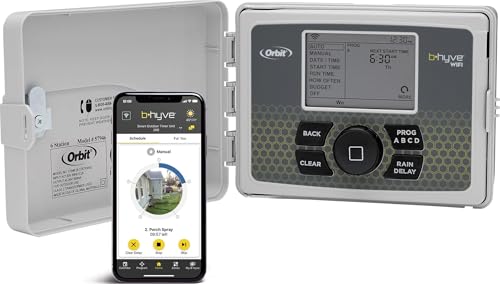
Orbit B-hyve Smart Indoor/Outdoor Sprinkler Controller, 12 Zone
$138.00A 12 zone app-controlled sprinkler controller in a weatherproof case for garage or exterior mounting, at a lower price than most smart controllers with the same zone count.
Best for: automating an existing in-ground system
Check price on Amazon
Gilmour Metal Sled Base Oscillating Sprinkler, 3,600 sq ft
$53.71A metal sled-base oscillating sprinkler rated for 3,600 square feet that stays put on the lawn better than all-plastic designs when it is dragged from spot to spot.
Best for: rectangular lawns watered by hose
Check price on Amazon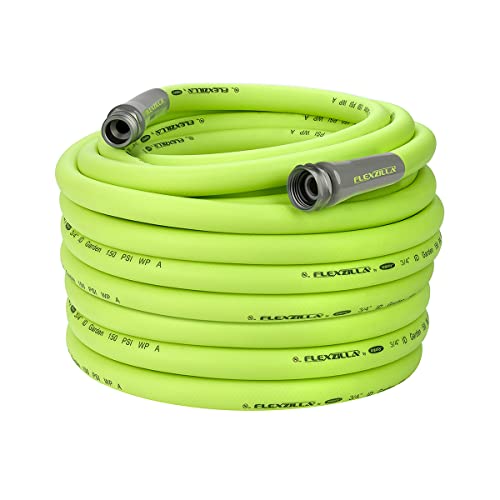
Flexzilla Garden Hose, 3/4 in x 100 ft
$89.00A lightweight hybrid polymer hose in a 3/4 inch bore, which delivers more flow over 100 feet to impact and traveling sprinklers than a 5/8 inch hose can.
Best for: running a sprinkler far from the spigot
Check price on Amazon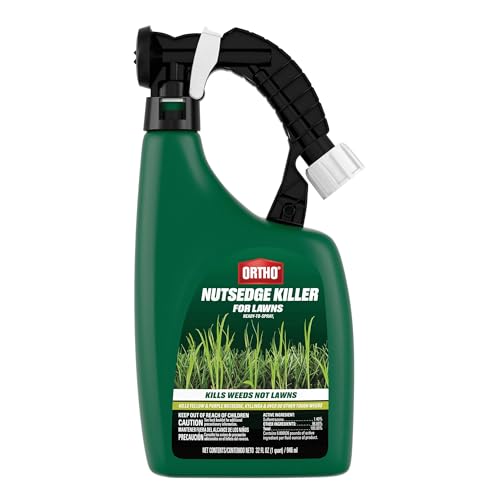
Ortho Nutsedge Killer for Lawns Ready-to-Spray, 32 oz
$21.99A hose-end bottle labeled for nutsedge, kyllinga, wild violet and dollarweed on established turf, covering 5,000 square feet with nothing to measure.
Best for: sedge patches without a sprayer
Check price on AmazonHow we chose
We did not test these products in person. Picks are researched from manufacturer specifications and owner manuals, engine and safety certifications where they apply, warranty terms, public recall records, and the recurring themes in verified owner reviews. We favor established brands with large review counts and parts support, match each pick to a real yard size or task, and place it in the tier where its price and capability actually belong.
Frequently asked questions
Should I water a dormant lawn in zone 4?
Pick one strategy and hold it. Either water 1 to 1.25 inches a week to keep the lawn green, or let it go dormant and give it about half an inch every two to three weeks, which keeps crowns alive without waking the plant. Repeatedly greening a lawn up and letting it brown off again drains its reserves and is what actually thins turf in a dry summer.
When should I apply grub control in zone 4?
Preventive products containing chlorantraniliprole or imidacloprid go down before eggs hatch, which is when soil is climbing through about 70 F in early to mid summer, and they must be watered in as the label directs. Curative products with trichlorfon are for damage you can already see in late summer. Confirm grub numbers first rather than treating on schedule.
Is it too late to control crabgrass in a zone 4 summer?
Not if it is young. Post-emergent products work best on crabgrass at the 1 to 4 leaf stage, before it tillers into a wide clump, and quinclorac products stay effective longer than most. Once plants are large and setting seed, control gets unreliable and the better plan is to mow high, thicken the lawn by overseeding in fall, and use pre-emergent next spring.
Researched, not professional advice. This page is compiled from published specifications, manuals, labels and owner-review consensus, not hands-on testing. Follow the manufacturer's instructions and product label, and consult a qualified professional where safety, chemicals, fuel or structures are involved. As an Amazon Associate we earn from qualifying purchases.