Lawn Care
Best Lawn Fertilizers: Ratios for Spring, Summer and Fall (2026)
Quick answer
The best lawn fertilizer for most established lawns is a high-nitrogen, low-phosphorus granular such as The Andersons Core 24-6-12, applied at about 1 lb of nitrogen per 1,000 sq ft per feeding. Feed cool-season grass mainly in fall; feed warm-season grass from late spring through summer. Test soil first.
The best fertilizer is the one that matches what your soil lacks and what your grass uses. Nearly every lawn uses more nitrogen than anything else, so most lawn fertilizers lead with a big first number. Phosphorus (the middle number) is only needed when a soil test shows it is low or when you are seeding, and a number of states restrict phosphorus on established lawns for water quality.
Our top pick is The Andersons Core 24-6-12 ($89.88): super-fine granules with quick and slow release nitrogen, iron and micronutrients, labeled for all turf types. For big cool-season lots, Lesco 32-0-3 delivers more nitrogen per dollar. Run your numbers through the fertilizer calculator, and remember that a bag is only as even as the spreader it goes through; see the best lawn spreaders.
On this page
- What do the three numbers on a fertilizer bag mean?
- How many pounds of nitrogen per 1,000 sq ft does my lawn need per year?
- What is the best lawn fertilizer ratio for fall, spring and summer?
- Beginner picks: simple all-grass feedings and burn-resistant organics
- Intermediate picks: maintenance nitrogen, organic fall feeding and liquids
- Expert picks: professional granular nitrogen for large lawns
- How do the fertilizer picks compare?
- What is the best fertilizer to use on a lawn: granular or liquid?
- Should I test my soil before fertilizing?
What do the three numbers on a fertilizer bag mean?
N-P-K is the guaranteed analysis by weight: percent nitrogen (N), percent phosphate (P2O5) and percent potash (K2O). A 50 lb bag of 32-0-3 contains 16 lb of nitrogen, no phosphate and 1.5 lb of potash; the rest is carrier and other ingredients. Nitrogen drives color and growth, phosphorus supports root development in new grass, and potassium helps with stress tolerance when soil is deficient.
To find pounds of product for 1 lb of nitrogen per 1,000 sq ft, divide 100 by the nitrogen percentage. A 32-0-4 needs 3.1 lb; a 24-6-12 needs 4.2 lb; an 8-0-5 organic needs 12.5 lb. That number is the dose to compare against the label rate, not a replacement for it. The how to read a fertilizer label guide explains slow-release nitrogen, iron and the fine print.
How many pounds of nitrogen per 1,000 sq ft does my lawn need per year?
Annual nitrogen depends on grass type, and more is not better. Extension services recommend splitting the yearly total into feedings of about 1 lb of nitrogen per 1,000 sq ft or less, with lower totals for unirrigated lawns, shade and grass clippings left on the lawn (clippings return nitrogen).
| Grass type | Season | Lb N per year | Main feeding window |
|---|---|---|---|
| Tall fescue | Cool | 2 to 4 | Early fall and late fall, light spring |
| Kentucky bluegrass | Cool | 3 to 4 | Early fall and late fall, light spring |
| Perennial ryegrass | Cool | 2 to 4 | Fall, light spring |
| Fine fescue | Cool | 1 to 2 | Fall only |
| Bermudagrass | Warm | 2 to 5 | Late spring through summer |
| Zoysiagrass | Warm | 1 to 3 | Late spring through summer |
| St. Augustinegrass | Warm | 2 to 4 | Late spring through summer |
| Centipedegrass | Warm | 1 to 2 | Late spring and early summer |
University extension consensus ranges. Use the low end for shade, sandy soil without irrigation, or lawns where clippings are returned.
What is the best lawn fertilizer ratio for fall, spring and summer?
For cool-season lawns, fall is the main event: two feedings of mostly nitrogen, roughly 1 lb N per 1,000 sq ft each, in early fall and again late fall while the grass is still green. A fall product with extra potassium, such as Espoma Turf-Tone 8-0-5, is fine where a soil test shows low potassium. Spring feeding should be light, because heavy spring nitrogen pushes top growth that suffers in summer heat. Summer feeding of cool-season grass is mostly a mistake unless you use a slow-release, low-salt product like Milorganite.
For warm-season lawns, the calendar flips. Start after full green-up in late spring, then feed every six to eight weeks through summer with a high-nitrogen product; Lesco 32-0-3 lists bermuda in summer as a target use. Stop about six weeks before the first expected frost. Our zone 6 fall lawn care calendar and zone 8 summer calendar show region-specific timing.
| Season | Cool-season lawns | Warm-season lawns |
|---|---|---|
| Early spring | Skip or very light; pre-emergent instead | Skip until full green-up |
| Late spring | Light N, slow release (for example 29-0-3) | First feeding, high N (for example 32-0-3 or 24-6-12) |
| Summer | Avoid, or low-salt organic like 6-4-0 | High N every 6 to 8 weeks |
| Early fall | Main feeding, high N | Last light feeding, then stop |
| Late fall | Second feeding, N with K if soil test is low | None, grass is going dormant |
| Seeding any time | Starter with phosphorus (for example 24-25-4) | Starter with phosphorus |
Beginner picks: simple all-grass feedings and burn-resistant organics
These are forgiving products with coverage printed plainly on the bag, sold for any grass type.
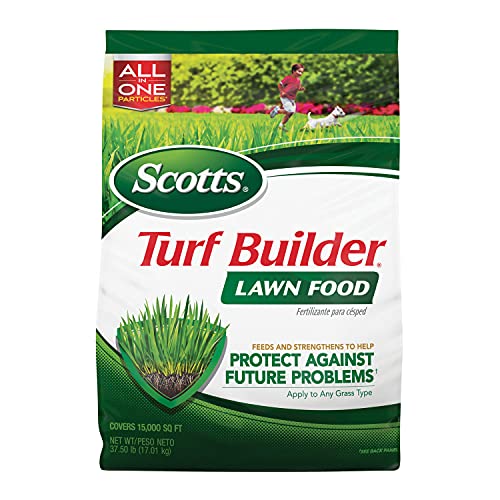
Scotts Turf Builder Lawn Food, 37.5 lb
$47.96A pesticide-free feeding labeled for any grass type, applied to a wet or dry lawn in spring, summer or fall, with a 37.5 lb bag covering 15,000 sq ft. Scotts prints spreader settings for its own spreaders.
Best for: a basic feeding schedule
Check price on Amazon
Milorganite Slow-Release Nitrogen 6-4-0 Fertilizer, 5 lb Bag (4-Pack)
$40.99A low-salt, slow-release nitrogen with non-staining iron that the maker says feeds for 8 to 10 weeks without watering in. At 6 percent nitrogen it takes about 16.7 lb for 1 lb N per 1,000 sq ft, so it is pricey for big lawns.
Best for: hot, dry stretches and small lawns
Check price on Amazon
Scotts Turf Builder Starter Food for New Grass, 15 lb
$34.97A 24-25-4 starter for any time new seed, sod, sprigs or plugs go down, covering 5,000 sq ft per bag. Phosphorus is what new roots need, which is why starter fertilizers are the exception to low-P programs.
Best for: seeding and sodding
Check price on AmazonIntermediate picks: maintenance nitrogen, organic fall feeding and liquids
For owners who follow a schedule and want a specific product for each part of the year.

Jonathan Green Green-Up Lawn Food 29-0-3, 15,000 sq ft
$73.27A made-in-USA 29-0-3 sized for 15,000 sq ft with no phosphorus, a good fit for established lawns where a soil test shows adequate P. It pairs with a Jonathan Green seed program.
Best for: established northern lawns
Check price on Amazon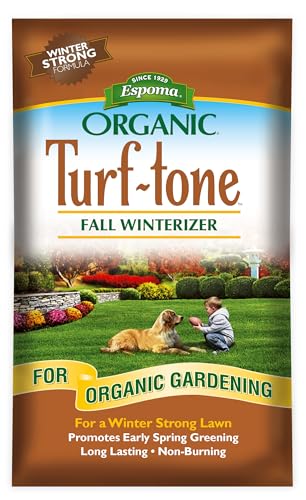
Espoma Turf-Tone Fall Winterizer 8-0-5, 30 lb
$55.29A natural and organic 8-0-5 with extra potassium, labeled not to burn or leach and listed for fescues, bluegrass, ryegrass, St. Augustine and zoysia. A 30 lb bag covers only 5,000 sq ft.
Best for: organic programs on smaller lawns
Check price on Amazon
Simple Lawn Solutions Advanced 16-4-8 Liquid Lawn Fertilizer, 1 gal
$59.77A 16-4-8 liquid with fish and seaweed that the maker positions as a monthly add-on to a regular program, covering 12,800 sq ft per gallon. It needs a hose-end or tank sprayer.
Best for: spray-applied extra feeding
Check price on AmazonExpert picks: professional granular nitrogen for large lawns
Pro-grade bags for owners with a calibrated spreader, a soil test, and a lot of square feet.
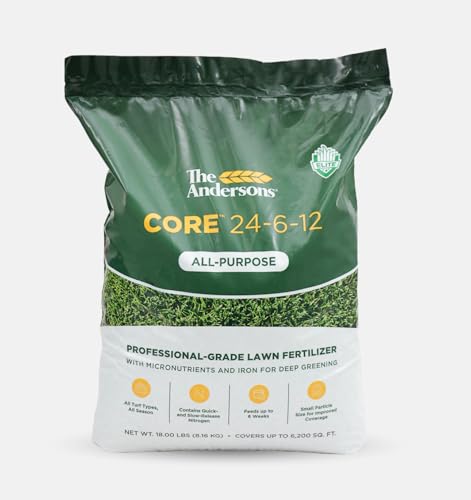
The Andersons Core 24-6-12 Professional Lawn Fertilizer, 45 lb
$89.88Super-fine granules with quick and slow release nitrogen for up to 6 weeks, plus iron and micronutrients, labeled for all turf types in spring, summer and fall at 15,500 sq ft per 45 lb bag. The label coverage works out to about 2.9 lb per 1,000 sq ft, roughly 0.7 lb of nitrogen.
Best for: even spreading on any turf type
Check price on Amazon
Lesco Basic Nutrition 32-0-3 Stabilized Nitrogen Fertilizer, 50 lb
$84.99Stabilized 32-0-3 in a 50 lb bag covering 16,000 sq ft, listed for bermuda in summer and tall fescue in fall. At its label coverage it supplies about 1 lb of nitrogen per 1,000 sq ft; the seller marks it non-returnable.
Best for: large bermuda or tall fescue lawns
Check price on AmazonWho should not buy this tier: Skip pro 45 to 50 lb bags if your lawn is under about 5,000 sq ft (they go stale and cake in a humid garage), if you do not own a spreader you have calibrated, or if you have not soil tested. Skip high-nitrogen summer feedings on cool-season grass, and skip any fertilizer containing phosphorus on an established lawn if your state restricts it or your soil test shows enough.
How do the fertilizer picks compare?
| Model | Price | N-P-K | Bag size | Coverage | Type |
|---|---|---|---|---|---|
| The Andersons Core 24-6-12 Professional Lawn Fertilizer, 45 lb | $89.88 | 24 6 12 | 45 lb | 15,500 sq ft | granular |
| Lesco Basic Nutrition 32-0-3 Stabilized Nitrogen Fertilizer, 50 lb | $84.99 | 32 0 3 | 50 lb | 16,000 sq ft | granular |
| Jonathan Green Green-Up Lawn Food 29-0-3, 15,000 sq ft | $73.27 | 29 0 3 | - | 15,000 sq ft | granular |
| Espoma Turf-Tone Fall Winterizer 8-0-5, 30 lb | $55.29 | 8 0 5 | 30 lb | 5,000 sq ft | winterizer |
| Simple Lawn Solutions Advanced 16-4-8 Liquid Lawn Fertilizer, 1 gal | $59.77 | 16 4 8 | - | 12,800 sq ft | liquid concentrate |
| Scotts Turf Builder Lawn Food, 37.5 lb | $47.96 | - | 37.5 lb | 15,000 sq ft | granular |
| Milorganite Slow-Release Nitrogen 6-4-0 Fertilizer, 5 lb Bag (4-Pack) | $40.99 | 6 4 0 | 20 lb | - | slow release organic nitrogen |
| Scotts Turf Builder Starter Food for New Grass, 15 lb | $34.97 | 24 25 4 | 15 lb | 5,000 sq ft | starter |
What is the best fertilizer to use on a lawn: granular or liquid?
Granular fertilizer is the better base for most homeowners. It is cheaper per pound of nitrogen, slow-release versions feed for weeks, and a spreader makes the rate easy to control. Liquid fertilizer greens up faster and suits spot feeding or small lawns, but it usually needs more frequent applications. The hose-end Scotts Turf Builder Liquid Lawn Food (29-0-3) is the lowest-effort way to feed a small yard with no spreader at all.
If you already own a tank or backpack sprayer for weed control, a liquid supplement can ride along, as long as both labels allow the mix. See liquid vs granular fertilizer and the best lawn sprayers.
Should I test my soil before fertilizing?
Yes. A soil test tells you whether you need phosphorus or potassium at all, and whether low pH is locking nutrients up. Jonathan Green notes lawns do best between pH 6.2 and 7.0, and fertilizer is wasted when pH is far outside that. A university extension lab test is the gold standard for accuracy; a mail-in kit like MySoil is a convenient alternative. If your soil is acidic, lime before you spend money on fertilizer; the lime calculator and best soil test kits page cover the next steps.
How we chose
We did not test these products in person. Picks are researched from manufacturer specifications and owner manuals, engine and safety certifications where they apply, warranty terms, public recall records, and the recurring themes in verified owner reviews. We favor established brands with large review counts and parts support, match each pick to a real yard size or task, and place it in the tier where its price and capability actually belong.
Frequently asked questions
What is the best fertilizer to use on a lawn?
For most established lawns, a high-nitrogen granular with little or no phosphorus is the best base, applied at about 1 lb of nitrogen per 1,000 sq ft per feeding. The Andersons Core 24-6-12 and Lesco 32-0-3 are strong choices for larger lawns; Scotts Turf Builder Lawn Food is the simple option. Test your soil first so you only add phosphorus, potassium or lime if the results call for it.
What is the best lawn fertilizer ratio for fall?
For cool-season grasses, the best fall fertilizer is mostly nitrogen, such as 32-0-3 or 29-0-3, applied in early fall and again in late fall at about 1 lb of nitrogen per 1,000 sq ft each. Add potassium, as in an 8-0-5 winterizer, only if a soil test shows it is low. Warm-season lawns should get their last feeding about six weeks before the first frost.
What is the best lawn fertilizer ratio for spring?
Spring feeding for cool-season lawns should be light and slow release, since heavy spring nitrogen pushes growth that struggles in summer heat. Many owners put down a pre-emergent in early spring and a modest feeding later. Warm-season lawns get their first high-nitrogen feeding only after they have fully greened up in late spring. Use a starter with phosphorus if you are seeding.
How many pounds of nitrogen per 1,000 square feet?
Extension services generally recommend no more than about 1 lb of nitrogen per 1,000 sq ft per feeding. Annual totals range from 1 to 2 lb for fine fescue and centipede to 3 to 4 lb for Kentucky bluegrass and up to 5 lb for heavily used bermudagrass. To convert to product, divide 100 by the nitrogen percentage: a 32-0-4 bag needs 3.1 lb per 1,000 sq ft.
Can I fertilize my lawn in summer?
Warm-season lawns such as bermuda, zoysia and St. Augustine are fed through summer, typically every six to eight weeks. Cool-season lawns such as tall fescue and bluegrass generally should not get high-nitrogen fertilizer in summer heat, because it can stress the grass and feed disease. If a cool-season lawn needs color, a low-salt slow-release product like Milorganite, at the label rate, is the safer option.
Is organic lawn fertilizer better?
Organic fertilizers such as Milorganite 6-4-0 and Espoma Turf-Tone 8-0-5 release nitrogen slowly and carry little burn risk, which makes them forgiving in hot weather. The trade-off is cost and volume: at 6 to 8 percent nitrogen you need 12 to 17 lb of product for 1 lb of nitrogen per 1,000 sq ft. Synthetic slow-release products deliver the same nitrogen far more cheaply on large lawns.
Researched, not professional advice. This page is compiled from published specifications, manuals, labels and owner-review consensus, not hands-on testing. Follow the manufacturer's instructions and product label, and consult a qualified professional where safety, chemicals, fuel or structures are involved. As an Amazon Associate we earn from qualifying purchases.