Lawn Care
Fertilizer Calculator: How Much Lawn Fertilizer Per 1,000 Sq Ft
Quick answer
Divide 100 by the first number on the bag, the nitrogen percentage, to get pounds of product per 1,000 square feet for 1 pound of nitrogen. A 32-0-3 fertilizer needs about 3.1 pounds per 1,000 square feet, so a 10,000 square foot lawn takes about 31 pounds per feeding at 1 pound of nitrogen, or 16 pounds at half a pound.
Lawn fertilizer is dosed by nitrogen, not by bag weight. The three numbers on every bag are the percentages of nitrogen, phosphate and potash by weight, so a 50 pound bag of 32-0-3 holds 16 pounds of nitrogen. Enter the analysis from your bag, your lawn area and the nitrogen rate you want, and the calculator returns pounds of product, bags and the phosphorus and potassium that come along with it. The product label rate always takes priority, and a soil test tells you whether you need phosphorus or potassium at all; see soil test kits.
Fertilizer calculator
Fertilizer needed
Fertilizers and spreaders that fit
Top matches update when you calculate.

Lesco Basic Nutrition 32-0-3 Stabilized Nitrogen Fertilizer, 50 lb
$84.99A pro-grade 50 lb bag of stabilized-nitrogen 32-0-3 covering 16,000 sq ft; the seller marks it non-returnable.
Best for: bermuda in summer or tall fescue in fall on bigger lots
Check price on Amazon
Jonathan Green Green-Up Lawn Food 29-0-3, 15,000 sq ft
$73.27A made-in-USA 29-0-3 maintenance feeding sized for 15,000 sq ft, pairing well with a Jonathan Green seed program.
Best for: established cool-season lawns
Check price on Amazon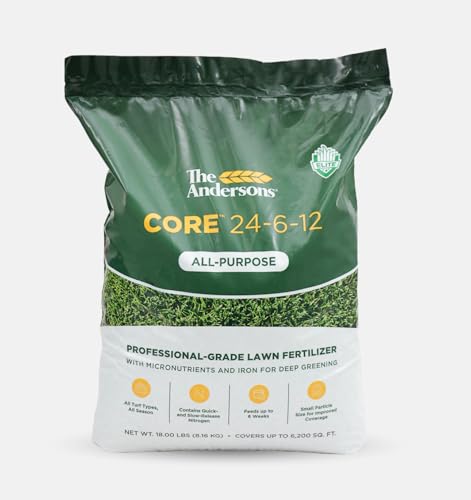
The Andersons Core 24-6-12 Professional Lawn Fertilizer, 45 lb
$89.88Super-fine granules with quick and slow release nitrogen plus iron and micronutrients, labeled for all turf types at 15,500 sq ft per bag.
Best for: DIYers who want pro-grade even spreading
Check price on Amazon
Scotts Turf Builder Starter Food for New Grass, 15 lb
$34.97A 24-25-4 starter formula for any time new seed, sod, sprigs or plugs go in, covering 5,000 sq ft per bag.
Best for: feeding new seed or sod
Check price on Amazon
Simple Lawn Solutions Advanced 16-4-8 Liquid Lawn Fertilizer, 1 gal
$59.77A balanced liquid 16-4-8 with fish and seaweed that the maker positions as a monthly add-on to a regular program, with the gallon covering 12,800 sq ft.
Best for: spray-applied supplemental feeding
Check price on Amazon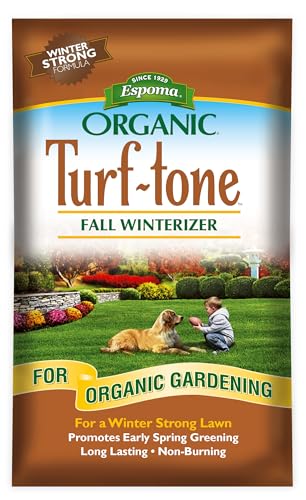
Espoma Turf-Tone Fall Winterizer 8-0-5, 30 lb
$55.29A natural and organic 8-0-5 with extra potassium for fall, labeled not to burn or leach, though 30 lb only covers 5,000 sq ft.
Best for: organic lawn programs
Check price on Amazon
Milorganite Slow-Release Nitrogen 6-4-0 Fertilizer, 5 lb Bag (4-Pack)
$40.99A low-salt slow-release nitrogen with non-staining iron that the maker says feeds for 8 to 10 weeks and does not need watering in; four 5 lb bags rather than one large sack.
Best for: burn-free feeding in hot, dry weather
Check price on Amazon
Scotts Turf Builder EdgeGuard DLX Broadcast Spreader
$94.97A pre-calibrated push broadcast spreader holding up to 15,000 sq ft of product, with an EdgeGuard shield that keeps granules off beds and driveways.
Best for: lawns up to about a third of an acre
Check price on Amazon
EarthWay 2150 Commercial 50 lb Broadcast Spreader
$279.99A commercial push spreader with 13 inch pneumatic tires, a slide-out grate, fully enclosed gearbox and a 3-hole drop with side-spread control for feathered edges.
Best for: rough or bumpy lawns
Check price on Amazon
Lesco 50 lb Commercial Push Spreader
$445.00The long-running landscaper standard with an enclosed gearbox and powder-coated carbon steel frame, and settings printed on many pro fertilizer bags.
Best for: pros and serious DIYers who spread weekly
Check price on Amazon
Agri-Fab 130 lb Tow-Behind Broadcast Spreader
$249.99A universal-hitch tow spreader with a 10 to 12 ft spread width, enclosed gears and a hopper rated to cover up to half an acre per fill.
Best for: half-acre to acre lawns with a riding mower
Check price on Amazon
Brinly BS361BH-A Deluxe 175 lb Tow-Behind Broadcast Spreader
$439.00A 175 lb tow spreader with stainless hardware, enclosed nylon gearbox, directional spread pattern control, an extended reach handle and a weatherproof cover, sized for 1 acre plus.
Best for: acreage owners who want even edges
Check price on AmazonOn this page
How much fertilizer do I need per 1,000 square feet?
Pounds of product per 1,000 square feet by nitrogen percentage and target rate.
| Nitrogen on the bag | 0.5 lb N | 0.75 lb N | 1 lb N | 1 lb N over 10,000 sq ft |
|---|---|---|---|---|
| 6 percent (6-x-x) | 8.3 lb | 12.5 lb | 16.7 lb | 167 lb |
| 10 percent (10-x-x) | 5.0 lb | 7.5 lb | 10.0 lb | 100 lb |
| 16 percent (16-x-x) | 3.1 lb | 4.7 lb | 6.3 lb | 63 lb |
| 24 percent (24-x-x) | 2.1 lb | 3.1 lb | 4.2 lb | 42 lb |
| 29 percent (29-x-x) | 1.7 lb | 2.6 lb | 3.4 lb | 35 lb |
| 32 percent (32-x-x) | 1.6 lb | 2.3 lb | 3.1 lb | 32 lb |
| 46 percent (46-x-x) | 1.1 lb | 1.6 lb | 2.2 lb | 22 lb |
How much nitrogen does my lawn need per year?
| Grass | Type | Pounds N per 1,000 sq ft per year | Main feeding time |
|---|---|---|---|
| Tall fescue | Cool-season | 2 to 4 lb | Most in fall, lighter in spring |
| Kentucky bluegrass | Cool-season | 3 to 4 lb | Mostly fall, some late spring |
| Perennial ryegrass | Cool-season | 2 to 4 lb | Mostly fall |
| Fine fescue | Cool-season | 1 to 2 lb | Fall; low needs |
| Bermudagrass | Warm-season | 2 to 5 lb | Late spring through summer |
| Zoysiagrass | Warm-season | 1 to 3 lb | Late spring and summer |
| St. Augustinegrass | Warm-season | 2 to 4 lb | Late spring through summer |
| Centipedegrass | Warm-season | 1 to 2 lb | Early summer; excess nitrogen harms it |
| Bahiagrass | Warm-season | 1 to 2 lb | Late spring and summer |
How do you read the N-P-K numbers on a fertilizer bag?
The three numbers are the guaranteed analysis: percent nitrogen (N), percent phosphate (P2O5) and percent potash (K2O) by weight. On a 45 pound bag of 24-6-12, 24 percent of 45 pounds, about 10.8 pounds, is nitrogen, 2.7 pounds is phosphate and 5.4 pounds is potash. Nitrogen drives green color and leaf growth, phosphate supports roots and is most useful when seeding, and potash supports stress tolerance. Many established lawns need little or no phosphate, which is why common maintenance products such as the Lesco Basic Nutrition 32-0-3 Stabilized Nitrogen Fertilizer, 50 lb and the Jonathan Green Green-Up Lawn Food 29-0-3, 15,000 sq ft carry zero. Starter fertilizers such as the Scotts Turf Builder Starter Food for New Grass, 15 lb (24-25-4) are high in phosphate for new seed. The label also lists how much nitrogen is slow release; see how to read a fertilizer label.
How is the fertilizer calculation done?
- Product per 1,000 sq ft = target pounds of N x 100 / N percent
- Total product = product per 1,000 sq ft x lawn square feet / 1,000
- Bags = total product / bag weight, rounded up
- Phosphate and potash applied = total product x P percent / 100 and x K percent / 100
For a 7,500 square foot lawn fed 0.75 pounds of nitrogen with a 29-0-3 fertilizer: 0.75 x 100 / 29 = 2.6 pounds per 1,000 square feet, times 7.5 = 19.4 pounds of product, a little over one 15,000 square foot bag's worth at half its label coverage. Low-analysis organic products need much more product for the same nitrogen: the Milorganite Slow-Release Nitrogen 6-4-0 Fertilizer, 5 lb Bag (4-Pack) at 6 percent needs about 16.7 pounds per 1,000 square feet for 1 pound of nitrogen, which is why organic programs usually apply less nitrogen more often.
Is slow release or quick release fertilizer better?
For most homeowners, a product with a good share of slow-release nitrogen is the safer choice. Quick-release nitrogen greens the lawn within days but can surge growth, burn grass if overapplied in heat and wash out faster. Slow-release forms feed over several weeks. Stabilized nitrogen products such as the Lesco Basic Nutrition 32-0-3 Stabilized Nitrogen Fertilizer, 50 lb reduce losses to the air, and balanced professional blends such as the The Andersons Core 24-6-12 Professional Lawn Fertilizer, 45 lb combine forms. Liquid products like the Simple Lawn Solutions Advanced 16-4-8 Liquid Lawn Fertilizer, 1 gal act quickly and are easy to spot-apply, but must be reapplied more often; the trade-offs are in liquid vs granular fertilizer.
How do I spread fertilizer evenly?
Use a broadcast or drop spreader set to the label setting, fill it on a driveway or tarp so spills can be swept up, and apply half the rate in two perpendicular passes. A push broadcast spreader such as the Scotts Turf Builder EdgeGuard DLX Broadcast Spreader covers typical suburban lawns, the EarthWay 2150 Commercial 50 lb Broadcast Spreader handles rough ground, and a tow-behind unit such as the Agri-Fab 130 lb Tow-Behind Broadcast Spreader is the practical choice past half an acre. Sweep or blow any granules off driveways, walks and streets back onto the lawn. See the best lawn spreaders and drop vs broadcast spreaders.
Frequently asked questions
How much 32-0-4 fertilizer do I need per 1,000 square feet?
For 1 pound of nitrogen per 1,000 square feet, you need about 3.1 pounds of a 32-0-4 fertilizer, because 100 divided by 32 is 3.125. For a lighter 0.75 pound application use about 2.3 pounds, and for half a pound about 1.6 pounds. A 10,000 square foot lawn therefore takes roughly 16 to 31 pounds per feeding, depending on the rate you choose.
How many bags of fertilizer do I need for an acre?
An acre is 43,560 square feet. At 1 pound of nitrogen per 1,000 square feet with a 32 percent nitrogen product, you need about 136 pounds of product, or three 50 pound bags. Bags labeled for 15,000 square feet of coverage need three bags per acre as well. A tow-behind spreader behind a lawn tractor makes acre-sized applications practical.
What do the three numbers on fertilizer mean?
They are the percentages by weight of nitrogen, phosphate and potash, always in that order. A bag marked 24-6-12 is 24 percent nitrogen, 6 percent phosphate and 12 percent potash, so a 45 pound bag contains about 10.8 pounds of nitrogen. The remaining weight is carrier material and other nutrients. Nitrogen is the number used to set lawn application rates.
Can I put down too much fertilizer?
Yes. Too much quick-release nitrogen can burn grass, especially in hot, dry weather, and it produces surge growth that needs more mowing and is more prone to disease. Excess fertilizer also washes into storm drains and waterways. Stay at or below the label rate, keep single applications at or under about 1 pound of nitrogen per 1,000 square feet, and water in if the label says to.
When should I fertilize my lawn?
Feed cool-season grasses such as tall fescue and Kentucky bluegrass mainly in late summer and fall, with a lighter feeding in spring, because fall feeding builds roots. Feed warm-season grasses such as bermuda, zoysia and St. Augustine from late spring, once they have fully greened up, through summer. Avoid fertilizing dormant or drought-stressed lawns. Local timing by zone is in our lawn care calendar.
Researched, not professional advice. This page is compiled from published specifications, manuals, labels and owner-review consensus, not hands-on testing. Follow the manufacturer's instructions and product label, and consult a qualified professional where safety, chemicals, fuel or structures are involved. As an Amazon Associate we earn from qualifying purchases.