Outdoor Power Tools
String Trimmer Line Size Chart: Diameter by Job
Quick answer
Use .065 to .080 inch line for light battery and electric trimmers and normal lawn edges, .080 to .095 for most residential gas and high-voltage battery trimmers, and .095 to .105 for heavy weeds. Never exceed the diameter your manual lists.
Trimmer line is sold by diameter in thousandths of an inch and by cross-section shape. Diameter has to match what the head and motor were designed for: too thin and it snaps constantly, too thick and it will not feed, strains the motor and can overheat the head.
The manual is the authority for your tool. Use this chart to understand the trade-offs, then buy the size it lists. Our top pick is the EGO ST1623T at $299.00, whose auto-feeding head removes most line problems in the first place.
On this page
What size trimmer line do I need?
| Line diameter | Typical tool | Job | Trade-off |
|---|---|---|---|
| .065 in | Light electric and low-voltage battery trimmers | Grass edges, light trimming around beds | Breaks quickly against fences and concrete |
| .080 in | Mid-size battery and small gas trimmers | General residential trimming and edging | The common all-round residential size |
| .095 in | Higher-voltage battery and most residential gas trimmers | Thicker grass, weeds and rougher edges | Lasts longer, needs more power to spin |
| .105 in | Larger gas trimmers, light commercial | Heavy weeds and dense growth | Only where the manual allows it |
| .130 in and up | Commercial gas trimmers and brushcutters | Brush, heavy weeds, ditch and fence lines | Requires a commercial head and engine |
Never fit line thicker than the maximum diameter in your operator manual. Oversized line will not feed properly, strains the motor or clutch and can overheat the head.
Which line shape should I use?
| Shape | Cutting | Durability | Noise | Best for |
|---|---|---|---|---|
| Round | Tears rather than slices | Highest, resists breaking | Quiet | General trimming and hard edges like fences and walls |
| Twisted | Cleaner than round | High | Quieter than square | All-round residential use |
| Square or multi-sided | Sharp edges slice cleanly | Lower, corners chip | Louder | Thick weeds and heavy growth |
| Star or serrated | Aggressive cutting | Lower | Louder | Dense weeds where speed matters |
| Co-polymer and reinforced | Varies by design | Highest for the diameter | Varies | Anyone tired of refilling the spool |
Shape matters less than diameter and line quality. Round line survives contact with hard objects best, which is what most residential line hits.
What line do current trimmers take?
| Trimmer | Cutting swath (in) | Line | Power |
|---|---|---|---|
| EGO ST1500SF | 15 | .095 in | 56V battery |
| EGO ST1623T | 16 | Auto-feeding head | 56V battery |
| Greenworks 80V 16 in Gen 2 | 16 | Per the manual | 80V battery |
| RYOBI 40V attachment capable | 13 to 15 adjustable | Per the manual | 40V battery |
| DEWALT DCST972X1 | 15 to 17 adjustable | .080 in, also takes .095 | 60V battery |
| Milwaukee M18 FUEL 2825-20ST | 14 to 16 | .080 or .095 in | 18V battery |
| Husqvarna 128C | 17 | Per the manual | 28cc gas |
| Husqvarna 130L | 18 | Per the manual | 28cc gas |
| ECHO SRM-2620T | Speed-Feed head | Per the manual | 25.4cc gas |
Line diameters are listed where the manufacturer publishes them. Where they are not, the operator manual is the only reliable source, so check it rather than guessing.
Can I use thicker trimmer line?
Only up to the maximum your manual lists. Thicker line has more mass, so it takes more power to spin at cutting speed. On an undersized tool it bogs the motor or engine, drains a battery much faster, overheats the head and can wear the clutch on a gas trimmer. It also may not fit through the eyelets or feed from the spool at all.
Where a tool lists a range, such as a trimmer that accepts .080 or .095 inch, the thicker option makes sense for heavy weeds and the thinner one for runtime and cleaner cuts on ordinary grass. The Oregon Gatorline .080 in at $22.99 and the MaxPower .095 in twisted line at $12.10 cover the two common residential sizes.
Why does my trimmer line keep breaking?
- It is too thin for the job. Light .065 in line disintegrates against chain-link fence, brick and concrete edges. Step up within what the manual allows.
- The line is old and dry. Nylon line loses moisture in storage and becomes brittle. Soaking a spool in water for a day before use is a long-standing fix, and buying smaller spools more often helps.
- You are cutting with the wrong part. The tip does the cutting. Burying the whole line in growth snaps it and stalls the head.
- Too much line is out. Line longer than the guard cutter whips and breaks, and it slows the head.
- Hard contact. Trimming right against concrete or metal will always cost line. Round line survives it best.
If edging along a hard surface is the main job, a dedicated edger with a steel blade does it better and consumes no line at all. See string trimmer vs edger and the best lawn edgers.
Which trimmers and line should I buy?
Cutting swath matters as much as line size for how long trimming takes. Full picks are in the best string trimmers.

EGO Power+ ST1623T 16 in. String Trimmer Kit with 4.0Ah Battery
$299.00A 16 inch swath with an auto-feeding line head and powered winding, which removes both bump feeding and hand rewinding, with a 4.0Ah battery included.
Best for: large suburban lots
Check price on Amazon
Oregon Platinum Gatorline .080 in. Trimmer Line, 414 ft
$22.99A 414 foot spool of .080 in line, the common residential size for mid-size battery and small gas trimmers.
Best for: general trimming and edging
Check price on Amazon
MaxPower 338814 .095 in. Premium Twisted Trimmer Line, 200 ft
$12.10Two hundred feet of .095 in twisted line, which cuts cleaner than round and lasts longer than thinner line in weeds.
Best for: thicker grass and rough edges
Check price on Amazon
Husqvarna 130L 28cc Straight Shaft Gas String Trimmer
$279.00A 28cc straight shaft engine with an 18 inch cutting width, which reaches under shrubs and along fence lines beyond battery range.
Best for: rural lots and ditches
Check price on Amazon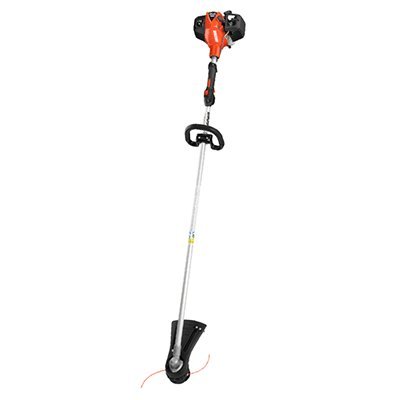
ECHO SRM-2620T 25.4cc High Torque Gas String Trimmer
$479.99A commercial high torque 25.4cc trimmer with a Speed-Feed head, built for dense growth and daily use.
Best for: acreage and heavy brush
Check price on Amazon
EGO Power+ ME0820 8 in. Edger with Multi-Head Power Head (tool only)
$219.00An 8 inch steel edger blade cutting up to 3 inches deep gives a cleaner edge along walks and drives, and uses no line.
Best for: crisp edges along hard surfaces
Check price on AmazonHow we chose
We did not test these products in person. Picks are researched from manufacturer specifications and owner manuals, engine and safety certifications where they apply, warranty terms, public recall records, and the recurring themes in verified owner reviews. We favor established brands with large review counts and parts support, match each pick to a real yard size or task, and place it in the tier where its price and capability actually belong.
Frequently asked questions
What size trimmer line should I use?
Use the size your operator manual lists. As a general guide, .065 inch suits light electric and low-voltage battery trimmers, .080 inch is the common residential all-rounder, .095 inch suits higher-voltage battery and most residential gas trimmers, and .105 inch and above belongs on larger gas and commercial machines. Going thicker than the manual allows causes feeding and motor problems.
Can I put thicker line in my trimmer?
Only within the range the manual allows. Thicker line has more mass and takes more power to spin, so on an undersized tool it bogs the motor, drains the battery faster, overheats the head and can wear a gas clutch. It may also fail to feed through the eyelets. If the manual gives a range, use the thicker option only for heavy weeds.
Is square or round trimmer line better?
Round line is more durable and better where the line hits fences, walls and concrete, because it has no corners to chip. Square and multi-sided line has cutting edges that slice thick weeds faster but wears out sooner and is louder. For most residential trimming, twisted or round line in the right diameter is the better balance.
Why does my trimmer line keep breaking?
Usually the line is too thin for what you are cutting, it has dried out in storage and gone brittle, or you are burying the whole line in growth instead of cutting with the tip. Hard contact with concrete and chain-link is also unavoidable line wear. Soaking a dry spool in water for a day and stepping up one diameter within the manual range both help.
How long does a spool of trimmer line last?
It depends far more on what you trim than on hours of use. Trimming soft grass edges can take a season on a spool, while edging against concrete or clearing fence lines can burn through the same spool in a few sessions. Buying a larger spool such as a 414 foot roll of .080 inch line is far cheaper per foot than replacement cartridges.
Researched, not professional advice. This page is compiled from published specifications, manuals, labels and owner-review consensus, not hands-on testing. Follow the manufacturer's instructions and product label, and consult a qualified professional where safety, chemicals, fuel or structures are involved. As an Amazon Associate we earn from qualifying purchases.