Weed Control
Henbit: How to Identify and Control It in a Lawn
Quick answer
Henbit is a winter annual mint that germinates in cool fall soil, so the control that works is a pre-emergent applied in late summer to early fall, not in spring. Spray small plants in late fall or early spring with a three-way broadleaf product. Thick fall turf is the real fix.
The purple haze across lawns and fields in early spring is usually henbit, and by the time it is that visible the useful control window has closed. Henbit is a winter annual: seed germinates as soil cools in fall, plants sit small through winter, then bolt, flower and set seed in early spring before dying out as heat arrives.
That means henbit is a fall problem you notice in spring. It exploits lawns that are thin going into winter, including dormant warm-season turf that offers bare ground for months. Size the fall overseeding that closes that gap with the grass seed calculator.
On this page
How do I identify henbit?
| Trait | Henbit |
|---|---|
| Weed type | Broadleaf, in the mint family |
| Life cycle | Winter annual; germinates in fall, dies out in early summer |
| Season | Cool season; small through winter, flowering in early spring |
| How it spreads | Seed only, in large quantities |
| Stem | Square in cross-section, upright to sprawling, often reddish at the base |
| Leaf | Rounded with scalloped edges, in opposite pairs. Upper leaves clasp the stem directly with no stalk, which is the key check |
| Flower | Pink to purple tubular flowers in whorls at the upper leaf joints |
| Roots | Shallow and fibrous, so plants pull easily |
| What it says about the lawn | Thin turf going into winter, bare soil, or dormant warm-season grass with nothing covering the ground |
Purple deadnettle is the common mix-up. Its upper leaves are triangular, distinctly stalked and often purple-tinged, while henbit upper leaves wrap the stem without a stalk.
Why does henbit take over in early spring?
It does not take over in spring. It germinated the previous fall and spent winter as a small plant nobody notices, then grows fast when temperatures rise and flowers before the lawn has broken dormancy. The lawn looks empty and purple because the turf is still waking up while the henbit is finishing its life.
Warm-season lawns get hit hardest for exactly this reason. Dormant bermudagrass or centipedegrass is brown and open all winter, which is a standing invitation to winter annuals. Cool-season lawns suffer where fall left them thin. Either way, the durable answer is fall density, discussed in how to overseed a lawn.
What kills henbit in a lawn?
Henbit is easy to kill and easy to be too late for. The whole question is whether you act in the fall germination window or wait for the spring flower show.
| Method | When | What it involves |
|---|---|---|
| Pre-emergent herbicide | Late summer to early fall, as soil cools | Prodiamine or dithiopyr, watered in per the label. This is the control that actually prevents the spring display. |
| Overseed and feed | Late summer to early fall | Dense turf leaves no bare cool soil for seed. This conflicts with pre-emergent timing, so choose one per season. |
| Post-emergent on small plants | Late fall, or early spring before flowering | Three-way products with 2,4-D, dicamba and mecoprop work well while plants are young. |
| Post-emergent on flowering plants | Spring | Still kills the plant, but seed for next fall is usually already set. Cosmetic rather than preventive. |
| Atrazine on southern lawns | Per label, southern turf only | Used on some St. Augustine and centipede lawns for winter annuals. Not for northern lawns, and restricted in some states. |
| Hand pulling | Any time, small areas | Shallow fibrous roots lift easily. Practical in beds and along edges. |
| Mowing | Spring | Removes flowers and slows seed set but does not control the plant. Bag the clippings if seed has formed. |
Henbit dies on its own as summer heat arrives, so a late spring herbicide application is usually spending money on a plant that had weeks left.
Which products work on henbit?
For prevention, Lesco 0-0-7 with 0.43% Stonewall Pre-Emergent, 50 lb is a granular pre-emergent covering 12,500 sq ft with no added nitrogen, and Quali-Pro Prodiamine 65 WDG Pre-Emergent Herbicide, 5 lb is the sprayable generic prodiamine that handles both the fall and spring windows from one bottle. Dithiopyr is the other common active.
For plants already up, Ortho WeedClear Weed Killer for Lawns Concentrate, 1 gal and Spectracide Large Plot Weed Stop for Lawns Concentrate, 1 gal are three-way broadleaf concentrates that control henbit when it is small. Southern lawns have an extra option in atrazine, which is used on some St. Augustine and centipede turf for winter annuals, is not appropriate for northern lawns, and is restricted in some states. Always confirm your grass appears on the label's turf list.
What gear helps with henbit?
A spreader for the fall pre-emergent or the fall seeding, whichever you choose, and seed to close the ground. Spreader types are compared in drop vs broadcast spreaders.

Scotts Turf Builder EdgeGuard DLX Broadcast Spreader
$94.97A pre-calibrated push broadcast spreader holding up to 15,000 sq ft of product with an edge shield that keeps granules off beds and pavement.
Best for: lawns up to about a third of an acre
Check price on Amazon
Jonathan Green Black Beauty Ultra Grass Seed, 7 lb
$43.99A dark-green tall fescue, bluegrass and ryegrass mix rated for 1,400 sq ft new or 2,800 sq ft overseeded.
Best for: thickening cool-season turf before winter
Check price on Amazon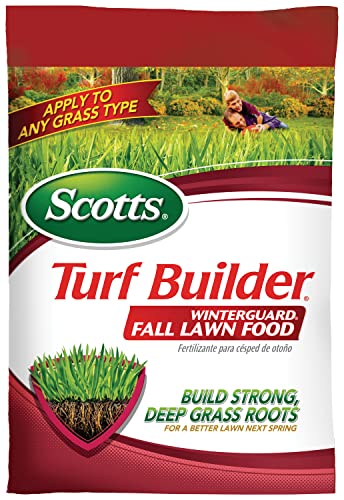
Scotts Turf Builder WinterGuard Fall Lawn Food, 32.3 lb
$46.98A fall feeding aimed at root building before winter, labeled for any grass type at 12,000 sq ft per bag.
Best for: building density that crowds out winter annuals
Check price on AmazonHow we chose
We did not test these products in person. Picks are researched from manufacturer specifications and owner manuals, engine and safety certifications where they apply, warranty terms, public recall records, and the recurring themes in verified owner reviews. We favor established brands with large review counts and parts support, match each pick to a real yard size or task, and place it in the tier where its price and capability actually belong.
Frequently asked questions
Is henbit the same as purple deadnettle?
No, though they are close relatives that appear together and respond to the same treatment. Henbit has rounded upper leaves that clasp the square stem directly with no stalk. Purple deadnettle has triangular upper leaves on distinct stalks, usually tinged purple and angled downward. Both are winter annual mints that germinate in fall, flower in early spring and die in summer heat.
When should I spray for henbit?
Late fall or very early spring, while plants are still small and well before flowering. By the time a lawn is visibly purple, the plant is near the end of its life and has usually set seed for the next fall germination. Better still, prevent it with a pre-emergent applied in late summer to early fall, which is months earlier than a crabgrass application.
Does henbit hurt my lawn?
Not directly, and it dies out on its own in early summer heat. The real problem is what it reveals: bare or thin ground through winter that the turf is not covering. Henbit also competes for moisture and nutrients as the lawn breaks dormancy in spring, and a heavy stand can leave visibly thin patches behind when it collapses in the heat.
Researched, not professional advice. This page is compiled from published specifications, manuals, labels and owner-review consensus, not hands-on testing. Follow the manufacturer's instructions and product label, and consult a qualified professional where safety, chemicals, fuel or structures are involved. As an Amazon Associate we earn from qualifying purchases.