Lawn Care
Bermudagrass: Mowing Height, Seed Rate and Lawn Care
Quick answer
Bermudagrass is a warm-season grass for USDA zones 7 to 10 that spreads by stolons and rhizomes. Mow common bermuda at 1 to 2 inches, seed hulled seed at 1 to 2 pounds per 1,000 square feet once soil holds 65 F, and feed 3 to 6 pounds of nitrogen a year. Hybrid bermuda is sprigged or sodded.
Bermudagrass is the sun-loving workhorse of southern lawns: a fine to medium bladed warm-season grass that spreads by both above-ground stolons and below-ground rhizomes, which is why it heals traffic damage faster than any other lawn grass. It greens up as soil warms in spring and goes tan and dormant after the first hard frost. That dormancy is normal, not death.
There are two kinds on the market. Common bermuda grows from seed and is what most homeowners plant. Hybrid bermudas such as Tifway and TifTuf produce little viable seed, so they are established from bermuda sod or bermuda sprigs instead. Size the job first with the grass seed calculator, set feeding rates with the fertilizer calculator, and use the lime calculator only if a soil test comes back below pH 6.0.
On this page
What are the key numbers for a bermudagrass lawn?
| Trait | Bermudagrass |
|---|---|
| Season type | Warm-season; grows hardest in summer heat, dormant and tan after frost |
| USDA zones and region | Zones 7 to 10; the Southeast, Gulf Coast, Texas, Oklahoma and the irrigated Southwest |
| Mowing height | 1 to 2 in for common bermuda; 0.5 to 1.5 in for hybrids |
| Seeding rate | 1 to 2 lb per 1,000 sq ft new; 0.5 to 1 lb overseeding (hulled seed). Hybrids: sprigs or sod only |
| Germination | 7 to 21 days once soil holds 65 to 70 F |
| Shade tolerance | Poor; needs at least 7 hours of direct sun and thins badly under trees |
| Drought tolerance | Excellent; deep roots and fast recovery after dormancy |
| Wear and traffic | Excellent, the best of the lawn grasses, and it repairs itself |
| Nitrogen per year | 3 to 6 lb N per 1,000 sq ft, applied in the warm months only |
| Soil pH | 6.0 to 7.0 |
| Spreading habit | Stolons and rhizomes; aggressive |
| Main drawback | It invades beds and neighboring lawns, and it builds thatch under heavy feeding |
Ranges reflect common southern extension guidance for home lawns. Your seed bag label and a soil test take priority.
How low should Bermuda grass be mowed?
Mow common bermudagrass at 1 to 2 inches and hybrid bermuda at 0.5 to 1.5 inches. Bermuda is one of the few lawn grasses that gets better as you cut it lower, because low mowing thickens the stand and keeps the canopy from growing leggy. The catch is frequency: at 1 inch the one-third rule means mowing before the lawn passes about 1.5 inches, which is two cuts a week in summer.
If you cannot mow that often, hold 2 inches and accept a slightly looser lawn. Most walk-behinds bottom out around 1.25 to 1.5 inches. The Honda HRX-BE 21 in. Battery Self-Propelled Mower goes down to 0.75 inches and the BILT HARD 21 in. 3-in-1 Gas Push Mower, 144cc covers 1 to 3 inches. Lawns cut under 1 inch are usually kept with a reel mower, which the catalog does not carry. Heights for every grass sit side by side in the mowing height chart.
How much bermudagrass seed do I need?
At the extension rate of 1 to 2 pounds of hulled seed per 1,000 square feet, a 5,000 square foot lawn takes 5 to 10 pounds from bare soil, and a full acre needs about 65 pounds at the 1.5 pound midpoint. Bermuda seed is small and the seedlings spread aggressively, so heavier seeding wastes money rather than speeding up cover.
Bag coverage runs lighter than the raw rate because coated products carry fertilizer and mulch weight. The Scotts Turf Builder Grass Seed Bermudagrass, 4 lb is labeled for 1,330 square feet of new lawn from a 4 pound bag. Spread it in two perpendicular passes with a broadcast spreader such as the Scotts Turf Builder EdgeGuard DLX Broadcast Spreader, whose edge shield keeps seed out of beds. Hybrid lawns skip seed entirely and start from sod or sprigs. More seed options are in the best grass seed.
When should I plant bermudagrass?
Bermuda is planted late, not early. Seed germinates when soil holds 65 to 70 F, which is well after the last frost, and seedlings need the whole summer to root before their first dormancy. This timeline runs on soil temperature so it works from zone 7 to zone 10.
| Season | Soil temperature cue | Main tasks |
|---|---|---|
| Early spring | Soil 50 to 55 F, lawn still tan | Pre-emergent before soil holds 55 F; scalp the dormant lawn one notch low and bag the clippings; no nitrogen yet |
| Late spring | Soil 65 F and rising, lawn 50 percent green | Green-up feeding of about 1 lb N; seed or sprig new areas; start regular low mowing |
| Summer | Soil 75 F and above | Peak growth: mow twice a week, feed every 4 to 6 weeks, water about 1 in a week, dethatch or aerate if needed |
| Late summer to early fall | Soil cooling through 70 F | Last nitrogen feeding roughly 4 to 6 weeks before the first expected frost; a potassium feeding helps winter hardiness |
| Fall | Soil below 65 F | Stop nitrogen; fall pre-emergent for winter weeds; overseed with ryegrass only if you want winter color |
| Winter | Lawn dormant and tan | Keep traffic light on frozen dormant turf; service the mower and sharpen blades |
Measure soil temperature 2 to 4 inches deep in the morning. Late nitrogen pushes tender growth into frost and invites winterkill, so stop feeding well before the first frost.
How much fertilizer does bermudagrass need?
Plan on 3 to 6 pounds of nitrogen per 1,000 square feet per year, split into feedings of no more than 1 pound each during the warm months. Bermuda is the hungriest common lawn grass, and an unfed bermuda lawn thins and lets weeds in. Irrigated hybrid lawns sit at the top of the range, while an unwatered common bermuda lawn does fine near 3 pounds.
A 32-0-3 product such as the Lesco Basic Nutrition 32-0-3 Stabilized Nitrogen Fertilizer, 50 lb delivers 1 pound of nitrogen from about 3.1 pounds of product per 1,000 square feet. In midsummer heat a slow-release like the Milorganite Slow-Release Nitrogen 6-4-0 Fertilizer, 5 lb Bag (4-Pack) reduces burn risk. Read the bag before you spread: how to read a fertilizer label explains the three numbers, and the best lawn fertilizers compares programs.
Does Bermuda grass grow in shade?
Not well. Bermuda is the least shade-tolerant common lawn grass and wants seven or more hours of direct sun. Under tree canopies it stretches, thins and gives way to weeds and moss, and no fertilizer program fixes a light problem. Your realistic options are to limb up trees for more light, switch the shaded strip to St. Augustinegrass or zoysiagrass, which both take more shade, or give up on turf there and mulch the bed.
Thin, weak bermuda in shade is also where weeds start. Summer grassy invaders such as crabgrass, goosegrass and dallisgrass take the openings first, and prevention beats rescue: see when to apply pre-emergent.
What gear helps a bermudagrass lawn?
A mower that goes low, a spreader for frequent feedings, thatch control and steady summer water. Bigger lawns should size up in the best lawn spreaders.

Honda HRX-BE 21 in. Battery Self-Propelled Mower
$999.00A battery self-propelled mower with a 0.75 to 4 inch height range and a twin-blade MicroCut deck, one of the few walk-behinds that reaches true bermuda heights.
Best for: common or hybrid bermuda up to about a third of an acre
Check price on Amazon
Scotts Turf Builder EdgeGuard DLX Broadcast Spreader
$94.97A pre-calibrated push broadcast spreader holding up to 15,000 sq ft of product, with an edge shield that keeps granules off drives and beds.
Best for: the four to six feedings bermuda wants
Check price on Amazon
Greenworks 40V 15 in 2-in-1 Dethatcher and Scarifier Kit
$279.00A cordless 15 inch machine with swappable dethatching and scarifying reels and five depth settings, battery and charger included.
Best for: bermuda thatch that builds under heavy feeding
Check price on Amazon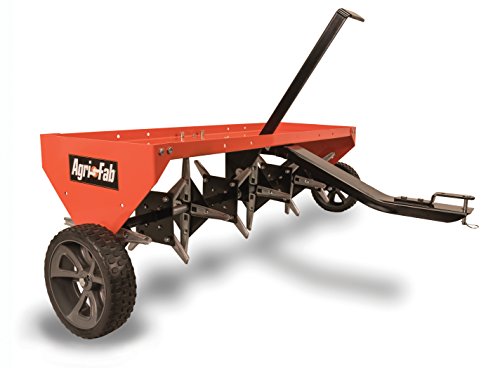
Agri-Fab 48 in Tow-Behind Plug Aerator
$319.98Thirty-two self-sharpening knives pull plugs up to 3 inches deep across 48 inches, with a weight tray and flat-free tires.
Best for: core-aerating a large bermuda lawn behind a tractor
Check price on Amazon
Melnor XT Oscillating Sprinkler, 4,500 sq ft
$32.99Twenty nozzles with width and range controls water a rectangle up to 4,500 sq ft, enough for about an inch a week on a mid-size lawn.
Best for: lawns without in-ground irrigation
Check price on AmazonHow we chose
We did not test these products in person. Picks are researched from manufacturer specifications and owner manuals, engine and safety certifications where they apply, warranty terms, public recall records, and the recurring themes in verified owner reviews. We favor established brands with large review counts and parts support, match each pick to a real yard size or task, and place it in the tier where its price and capability actually belong.
Frequently asked questions
Why is my Bermuda grass turning brown in winter?
Bermudagrass is warm-season turf, so it goes dormant and turns tan after the first hard frost and stays that way until soil warms back through about 65 F in spring. This is normal and the lawn is alive underground. Brown patches that appear during the growing season are a different problem, usually drought, grubs, disease or scalping from mowing too low in one pass.
How do I get rid of bermudagrass that is invading my beds?
Bermuda spreads by stolons above ground and rhizomes below, so pulling the runners leaves rhizomes that resprout. Edging deeply and keeping a mulch gap slows it. Chemical control means a non-selective or grass-specific herbicide applied while the bermuda is actively growing in warm weather, usually over repeat treatments. Read the label for what it can be sprayed near, since it will also kill desirable plants.
Can you overseed bermudagrass for winter color?
Yes. In the lower South, dormant bermuda is often overseeded with ryegrass in fall as soil cools, which gives green turf through winter. The trade-off is spring transition: the ryegrass competes with bermuda just as it tries to green up, which can weaken the bermuda. Skip overseeding on a lawn that is already thin or recently established.
How often should bermudagrass be watered?
About 1 inch of water a week in summer from rain and irrigation combined, delivered in one or two deep early-morning soakings rather than a daily sprinkle. Deep, infrequent watering pushes roots down, which is how bermuda earns its drought reputation. Established common bermuda can also be left unwatered through a dry spell, where it browns down and recovers when rain returns.
Researched, not professional advice. This page is compiled from published specifications, manuals, labels and owner-review consensus, not hands-on testing. Follow the manufacturer's instructions and product label, and consult a qualified professional where safety, chemicals, fuel or structures are involved. As an Amazon Associate we earn from qualifying purchases.