Outdoor Entertainment
Best Outdoor Projector for Daylight (2026): What Actually Works
Quick answer
No backyard projector works in real daylight. The brightest here, the AuKing at a claimed 4,800 ANSI lumens, still needs dusk. For watching before dark, buy an outdoor TV instead. For dusk starts, the HAPPRUN 3,000 ANSI is the sensible pick.
Let us deal with the search term honestly, because most pages covering it will not. A projector throws a fixed amount of light at a surface, and daylight adds far more. Even 4,800 lumens across a 100 in. screen cannot compete with an open sky. There is no consumer projector, at any price on this site, that gives you a watchable picture on a sunny afternoon in the yard.
What brightness actually buys you is earlier start times and tolerance for ambient light. A 600 lumen projector needs full darkness and a proper screen. A 3,000 lumen projector will hold a decent picture at dusk, with porch lights on, or under a covered patio with the string lights running. That is a real and worthwhile difference, and it is what this page is ranking.
If you genuinely need to watch a game at 4pm, stop here and read best outdoor TVs or outdoor TV vs projector. If you want a 120 in. image for film nights after sunset for a few hundred dollars, a projector is unbeatable value and this page will get you the right one.
A note on the numbers: ANSI lumens is a measured standard, and the inflated figures some listings quote are not. Where a maker publishes a real ANSI or ISO figure we use it; where they publish nothing, we say so rather than guess. TheaterCalc goes deeper on projector optics and screen materials at their outdoor projector guide and outdoor projector screen guide; this page stays on the backyard question of light, placement and weather.
On this page
- How bright does an outdoor projector need to be?
- What is the best outdoor projector for daylight?
- Beginner picks: occasional movie nights after dark
- Intermediate picks: dusk starts and better sound
- Expert picks: the brightest backyard projectors here
- How do the projector picks compare on brightness?
- What else does a backyard projector need?
How bright does an outdoor projector need to be?
Brightness requirements rise sharply with ambient light and with image size. The guidance below is a planning convention based on published ANSI figures and typical 100 in. images, not a manufacturer standard.
| When you want to watch | Light level | ANSI lumens needed | Realistic outcome |
|---|---|---|---|
| Full dark, no yard lights | None | 500 to 1,000 | Excellent picture on a proper screen |
| After dark, porch and string lights on | Low ambient | 1,000 to 2,000 | Good, colors slightly washed |
| Dusk, roughly 30 minutes after sunset | Falling ambient | 2,000 to 3,000 | Watchable, improves as it darkens |
| Covered patio, daytime, lights off | Indirect daylight | 3,000 to 5,000 | Marginal, small image only |
| Open yard, daytime | Direct daylight | Not achievable | Buy an outdoor TV instead |
Assumes roughly a 100 in. diagonal image on a dedicated screen. A larger image spreads the same light thinner, so going from 100 to 150 in. costs you well over half the apparent brightness. A white wall performs worse than a real screen.
What is the best outdoor projector for daylight?
Ranked by published brightness, with the caveat that the highest claims are the least verifiable.
- Best overall for dusk: HAPPRUN 3,000 ANSI at under $500. A real published figure in the class that matters.
- Brightest claim: AuKing at under $500. Note the listing contradicts itself, saying 5000ANSI in the title and 4,800 ANSI in the detail.
- Most honest specification: TOPTRO X9 Pro at under $1,000, which quotes 920 lumens to the ISO standard and says plainly that many rivals inflate theirs.
- Best for parties: ZCGIOBN 2,300 ANSI at under $1,000, which ships with two wireless microphones.
- Best budget brightness: Alvar 2,500 ANSI at under $250.
- Best built-in sound: ONOAYO ONO5Pro at under $500, with dual 60W Dolby speakers.
Beginner picks: occasional movie nights after dark
If the projector comes out a few times a summer and always after sunset, spending more buys very little. These need darkness, and with it they produce a genuinely big picture.

HAPPRUN J7 Outdoor Smart Projector, 1,500 ANSI Lumens
Under $250A published 1,500 ANSI lumens with streaming apps built in, auto focus and Dolby Audio. Bright enough for a dark yard on a proper screen, and honest about not being more than that.
Best for: occasional movie nights after full dark
Check price on Amazon
Alvar Smart Projector, 2,500 ANSI Lumens
Under $250A claimed 2,500 ANSI with native 1080p, auto focus and keystone and Wi-Fi 6, for under $250. That is a lot of stated brightness for the money, so treat the figure as the maker's own rather than verified.
Best for: a big image on a budget once the sun is down
Check price on Amazon
WiMiUS P62 Pro Outdoor Projector, 600 ANSI Lumens
Under $250WiMiUS publishes a conservative real 600 ANSI instead of an inflated number, with dual HDMI including ARC and Wi-Fi 6. Modest output, but you know exactly what you are getting.
Best for: a fully dark yard and a dedicated screen
Check price on AmazonIntermediate picks: dusk starts and better sound
The step up buys either brightness that tolerates ambient light or speakers loud enough to work outdoors, where there are no walls to reflect sound and a projector's own audio usually vanishes.

ONOAYO ONO5Pro Outdoor Projector with 60W Dolby Audio
Under $500Dual 60W Dolby speakers, which is far beyond what projectors in this price class usually carry and removes the need to run separate audio. ONOAYO does not publish an ANSI lumens figure for it, so treat brightness as unknown.
Best for: movie nights without separate speakers
Check price on Amazon
ONOAYO ONO3Pro Outdoor 4K Projector with AI Auto Focus
Under $250Auto focus, auto keystone, obstacle avoidance and screen fit in about three seconds, which is the difference between setting up in a minute and fiddling for ten every time it comes out of the cupboard. No ANSI figure published.
Best for: a projector carried out and set up fresh each time
Check price on Amazon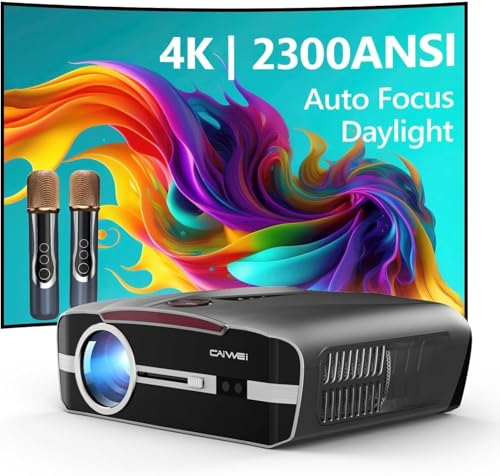
ZCGIOBN Daylight Projector, True 2,300 ANSI Lumens
Under $1,000A true 2,300 ANSI figure with a low-reflection lens, and two wireless microphones in the box. Karaoke in the yard is something no outdoor TV does, and it is the reason to pick this over a brighter rival.
Best for: yard parties and karaoke rather than film nights
Check price on AmazonExpert picks: the brightest backyard projectors here
These are the models that will start a film at dusk rather than waiting for full dark, and hold a picture under a covered patio with lights on. None of them works in open daylight.

HAPPRUN Outdoor Projector, 3,000 ANSI Lumens
Under $500A published 3,000 ANSI lumens with a 20,000 to 1 contrast ratio and HDR10, the point where a projector stops demanding a blacked-out yard. Auto focus and 6D keystone, and streaming built in.
Best for: starting a film at dusk instead of waiting for dark
Check price on Amazon
AuKing Outdoor Projector, 4,800 ANSI Lumens
Under $500The highest stated output here. Be aware the listing is internally inconsistent, quoting 5000ANSI in the title and 4,800 ANSI in the detail, so expect the lower figure and treat it as a manufacturer claim.
Best for: the largest image here, in a dark or dusk yard
Check price on Amazon
TOPTRO X9 Pro Outdoor Projector, 920 ISO Lumens
Under $1,000TOPTRO quotes 920 lumens to the ISO standard and openly criticizes rivals who inflate theirs. Lower on paper than the others in this tier, and probably closer to the truth. Dual 20W speakers and HDMI ARC.
Best for: buyers who want a comparable brightness figure and good sound
Check price on AmazonWho should not buy this tier: Do not buy any of these expecting daytime viewing, because that is not a thing a backyard projector does and no amount of money here changes it. Skip this tier if you only watch after full dark, where a 1,500 ANSI projector looks nearly as good for a third of the price. And skip projectors altogether if the main use is live sport in the afternoon, if there is nowhere to hang a screen, or if setup friction means it will never actually come out of the box. In all three cases the money belongs in an outdoor TV.
How do the projector picks compare on brightness?
Published figures only. Two models here have no manufacturer ANSI rating at all, which is itself useful information when you are paying for brightness.
| Model | Budget | Brightness | Resolution |
|---|---|---|---|
| AuKing Outdoor Projector, 4,800 ANSI Lumens | Under $500 | 4,800 ANSI lumens | 4K support |
| HAPPRUN Outdoor Projector, 3,000 ANSI Lumens | Under $500 | 3,000 ANSI lumens | 4K decoding |
| Alvar Smart Projector, 2,500 ANSI Lumens | Under $250 | 2,500 ANSI lumens | native 1080p, 4K input support |
| ZCGIOBN Daylight Projector, True 2,300 ANSI Lumens | Under $1,000 | 2,300 ANSI lumens | native 1080p, 4K decoding |
| HAPPRUN J7 Outdoor Smart Projector, 1,500 ANSI Lumens | Under $250 | 1,500 ANSI lumens | native 1080p, 4K decoding |
| TOPTRO X9 Pro Outdoor Projector, 920 ISO Lumens | Under $1,000 | 920 ANSI lumens | native 1080p, 4K decoding |
| WiMiUS P62 Pro Outdoor Projector, 600 ANSI Lumens | Under $250 | 600 ANSI lumens | native 1080p, 4K support |
| ONOAYO ONO3Pro Outdoor 4K Projector with AI Auto Focus | Under $250 | - | 4K decoding |
| ONOAYO ONO5Pro Outdoor Projector with 60W Dolby Audio | Under $500 | - | 4K support |
What else does a backyard projector need?
A projector is never the whole purchase. Budget for three more things.
A screen. A white wall loses a great deal of the light you paid for and shows every texture in the render. A proper screen is the cheapest brightness upgrade available. TheaterCalc covers screen gain and materials in depth at their outdoor projector screen guide.
Sound. Outdoors there are no walls to reflect off, so a projector's small speakers sound thin at any volume. Either buy a model with real speakers like the ONO5Pro, or run a pair of Polk Atrium 4 wall speakers. See best outdoor speakers for a patio.
Power and weather protection. None of these projectors is weatherproof. They come out, they go back in. Plan a GFCI-protected outdoor outlet with an in-use cover, keep the unit off wet ground, and never leave one out overnight in dew.
How we chose
We did not test these products in person. Picks are researched from manufacturer specifications and owner manuals, engine and safety certifications where they apply, warranty terms, public recall records, and the recurring themes in verified owner reviews. We favor established brands with large review counts and parts support, match each pick to a real yard size or task, and place it in the tier where its price and capability actually belong.
Frequently asked questions
Can you use a projector outside during the day?
Not in open daylight. Even the brightest projector here, at a claimed 4,800 ANSI lumens, cannot compete with an open sky spreading light across a 100 in. image. Under a fully covered patio with a small image and a proper screen you may get something marginal. If you need to watch before sunset, an outdoor TV is the only product that genuinely does it.
How many lumens do you need for an outdoor projector?
For full darkness on a dedicated screen, 500 to 1,000 ANSI lumens is enough for a good picture. With porch and string lights on, plan for 1,000 to 2,000. To start a film at dusk, 2,000 to 3,000 is the useful class. Above that you are buying tolerance for ambient light rather than a brighter picture in the dark, and image size matters as much as the number.
Is ANSI lumens the same as the lumens in the product title?
Often not. ANSI lumens is a measured standard, while many listings quote much larger figures using undefined methods. TOPTRO publishes an ISO figure of 920 and points out that rivals inflate theirs, while AuKing lists 5000ANSI in its title and 4,800 ANSI in its detail. Compare ANSI or ISO numbers only, and treat any figure without one of those labels as marketing.
Do I need a screen or can I project onto a wall?
A wall works, but it costs you a lot of the brightness you paid for and shows its own texture and color cast in the image. A dedicated screen reflects far more light back at the viewer and is the cheapest way to make any projector look brighter. For a fixed setup outdoors, a screen is a better investment than upgrading to the next projector up.
Can I leave an outdoor projector outside?
No. None of these projectors is weatherproof or rated for permanent outdoor installation. They are portable units that come out for the evening and go back indoors. Dew alone is enough to cause problems overnight, and the vents that keep them cool also let moisture in. If you want permanently installed outdoor entertainment, that is what an outdoor TV is for.
Researched, not professional advice. This page is compiled from published specifications, manuals, labels and owner-review consensus, not hands-on testing. Follow the manufacturer's instructions and product label, and consult a qualified professional where safety, chemicals, fuel or structures are involved.