Outdoor Entertainment
Outdoor TV Brightness Calculator: How Many Nits Do You Need?
Quick answer
Plan about 700 nits for a fully covered patio, 1,000 nits where the screen catches indirect glare, and 1,500 to 2,000 nits or more for a wall in direct sun at the hours you watch. A typical indoor TV is only 250 to 400 nits, which is why it looks washed out the moment you carry it outside.
Brightness is the number that decides whether an outdoor TV is worth owning. Weatherproofing keeps the set alive; nits decide whether you can see it. Buy too few and the screen is a mirror every afternoon. Buy too many and you have spent well over a thousand dollars more than the spot needed.
Enter where the screen will hang, how much sun reaches it and when you actually watch, and this calculator gives the nit figure to shop for, the sun class that matches it, and the screens in our catalog that meet it. Then read partial sun vs full sun outdoor TV for what that class really changes, and best outdoor TVs for the picks.
Outdoor TV brightness calculator
Screen brightness to shop for
Outdoor TVs that meet your brightness target
Top matches update when you calculate.
Ranked by how closely each screen's published brightness meets your result without overshooting it.

SYLVOX 43 in. Patio Series Outdoor TV (700 nits)
Under $1,000The lowest-cost purpose-built outdoor TV in this catalog: a 700-nit 4K panel, an IP56 weatherproof body and an IP66 remote, with Google TV built in and dual 10W waterproof speakers.
Best for: covered patios, porches and other fully shaded spots
Check price on Amazon
SYLVOX 43 in. Deck Pro 3.0 Outdoor TV (1,000 nits)
Under $1,000A 1,000-nit Deck Pro panel in a full metal casing with Dolby Atmos and HDR10, which buys roughly 40 percent more brightness than the Patio Series for a small step up in price.
Best for: small decks that catch some direct sun during the day
Check price on Amazon
SYLVOX 50 in. Patio Series Outdoor TV (700 nits)
Under $2,500The same 700-nit shade-rated panel and IP56 build as the 43 in. Patio Series in a 50 in. size, which is the smallest screen most people find comfortable across a patio table.
Best for: covered patios where the viewing distance is 10 ft or more
Check price on Amazon
Westinghouse 55 in. Smart Outdoor TV (700 nits, Partial Sun)
Under $2,500The cheapest 55 in. outdoor TV here, with anti-glare tempered glass, a 178 degree viewing angle and an IP55 rating. Westinghouse rates it for partial sun at 700 nits, which is the low end of that class.
Best for: a 55 in. screen on a shaded or lightly shaded patio on a budget
Check price on Amazon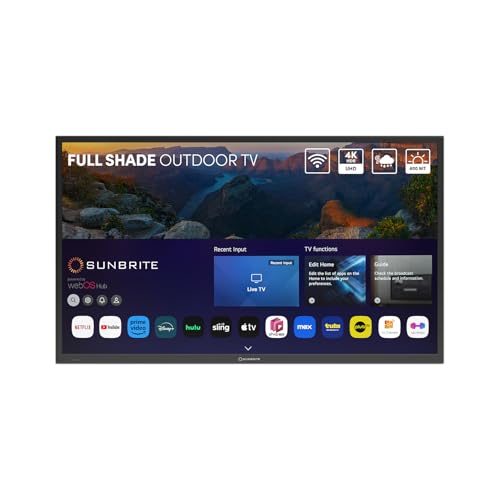
SunBriteTV 49 in. Veranda 4 Full Shade Outdoor TV (600 nits)
Under $2,500SunBrite rates the Veranda 4 at 600 nits of sustained full-screen brightness, which is a stricter measure than the peak figures most brands quote, and uses Eco Bright RGB-W subpixels to run cooler in outdoor heat.
Best for: a fully covered porch or outdoor room, never direct sun
Check price on Amazon SunBriteTV 55 in. Veranda 4 Full Shade Outdoor TV (600 nits)
Under $2,500The 55 in. Veranda 4, built for full shade with an anti-glare screen and a longer display life in high outdoor temperatures thanks to lower heat generation.
Best for: covered patios where picture quality matters more than raw brightness
Check price on Amazon
Furrion Aurora Partial-Sun 2 55 in. Outdoor TV (750 nits)
Under $2,500Furrion pairs a 750-nit screen with IK09 impact-resistant tempered glass, an IP55 rating and RangeXtend external Wi-Fi antennas, which is the feature most owners of far-from-the-router patios end up wanting.
Best for: a partly shaded patio a long way from the household router
Check price on Amazon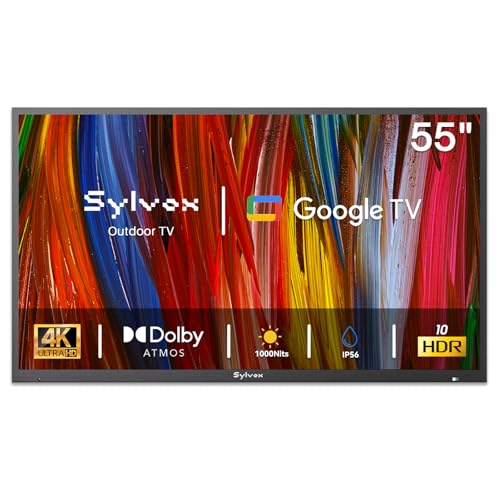
SYLVOX 55 in. Deck Pro 3.0 Outdoor TV (1,000 nits)
Under $2,500The Deck Pro version of the 55 in. 1,000-nit screen, which adds a published IP56 rating and a full metal casing built for wall, stand or ceiling mounting in a gazebo.
Best for: an exposed deck that needs a published IP rating as well as brightness
Check price on Amazon
SYLVOX 55 in. Outdoor TV, 1,000 Nits Ultra Bright
Under $2,500A 1,000-nit 55 in. panel with 4K, Dolby Atmos and HDR10 and a voice remote. Sylvox describes it as about three times brighter than a standard indoor TV, which is the practical partial-sun threshold.
Best for: patios that get morning or late-afternoon sun rather than all-day sun
Check price on Amazon
SYLVOX 65 in. Outdoor TV, 1,000 Nits Ultra Bright
Under $2,500The 65 in. version of the 1,000-nit Sylvox panel, for seating areas deep enough that a 55 in. screen looks small from the far chairs.
Best for: large patios with a 14 ft or greater viewing distance
Check price on Amazon
Furrion Aurora Sun 55 in. Full Sun Outdoor TV (1,500 nits)
Under $2,500Furrion's true full-sun model: a 1,500-nit anti-glare screen with IK08 impact-resistant glass that the maker specifically rates for an exposed deck, patio or yard.
Best for: an unshaded patio or poolside wall in direct sun
Check price on Amazon
SYLVOX 55 in. Full Sun Outdoor TV, 2,000 Nits
Under $2,500The brightest screen per dollar in this catalog at a published 2,000 nits, which Sylvox rates for genuinely unshaded installations and also sells into bars and restaurants.
Best for: a wall or pool deck in direct sun for most of the afternoon
Check price on Amazon
SunBrite 55 in. Solis Full-Sun Outdoor TV (1,500 nits)
$2,500+A 1,500-nit direct-lit anti-glare screen in an industrial-grade IP55 aluminum housing rated for rain, snow, dust, salt and heat, with a weatherproof media bay carrying 110V AC and USB power behind the screen.
Best for: coastal or poolside installations in direct sun
Check price on Amazon
SunBrite 65 in. Solis Full-Sun Outdoor TV (1,500 nits)
$2,500+The ceiling of this catalog: a 65 in. full-sun screen in a salt-rated aluminum body with an integrated media bay and down-firing speakers, priced accordingly.
Best for: a large, fully exposed poolside or coastal patio
Check price on AmazonOn this page
How many nits does an outdoor TV need?
| Where the screen hangs | Light on the screen | Baseline nits |
|---|---|---|
| Covered porch, roofed patio, enclosed gazebo | No direct sun at any hour | 700 |
| Deep overhang or dense pergola | Brief edge-of-day sun only | 850 |
| Open patio with a tree or umbrella | Indirect glare for part of the day | 1,000 |
| Open deck, sun on the wall morning or late | Direct sun, but not at viewing time | 1,500 |
| Poolside or unshaded wall | Direct sun at viewing time | 2,000 |
Which outdoor TVs meet each brightness level?
What size outdoor TV should you buy?
| Distance to farthest seat | Screen size | Notes |
|---|---|---|
| Up to 8 ft | 43 in | A 55 in screen this close fills too much of the view |
| 8 to 10 ft | 43 to 50 in | The common small-patio distance |
| 10 to 14 ft | 55 in | The most common outdoor size for good reason |
| 14 to 18 ft | 65 in | Where the jump to 65 in starts paying for itself |
| Over 18 ft | 65 in or larger | Check the viewing angle if chairs sit well off to the sides |
How is outdoor TV brightness calculated here?
- Nits needed = baseline for the location x viewing-time factor x glare factor, rounded to the nearest 50
- Viewing-time factor is 0.75 for evenings only, 1.0 for mixed use and 1.15 for mostly daytime viewing
- Glare factor is 1.15 where the screen faces into low sun, or sits above water, pale paving or light render that bounces light back at it
The baselines come from how makers class their own screens, as set out above. The two factors are ours. The logic behind them is simple: a screen used only after dark barely needs the daytime rating at all, while low sun straight into the panel at 6pm is the single worst case and defeats screens that cope fine at noon. Glare from a pool or pale patio is real and commonly underestimated.
One thing the calculator deliberately will not do is tell you a specific screen will be readable in your specific yard, because that depends on the angle of your wall, the reflectivity of your surroundings and the time of year. It gives you the class to shop in. If your result sits on a boundary, buy the brighter class: nobody regrets a screen that is too easy to see.
Why not just buy the brightest screen?
Money, mostly. The step from a 1,000-nit SYLVOX Deck Pro 55 at under $2,500 to a 2,000-nit full-sun panel at under $2,500 is a large sum for the same screen size, and under a roof you would not see the difference.
There is also a picture-quality argument. SunBrite rates the Veranda 4 at 600 nits of sustained full-screen brightness, a stricter measure than the peak figures most brands quote, and tunes it with an anti-glare screen for shade. In a covered space it will look better than a full-sun panel pushed hard. Brightness is a tool for beating daylight, not a measure of quality.
Frequently asked questions
How many nits is bright enough for an outdoor TV?
It depends entirely on light reaching the screen. Around 700 nits is comfortable under a solid roof, 1,000 handles a patio with indirect glare, and a wall in direct sun at viewing time wants 1,500 to 2,000 or more. For comparison, a typical indoor television produces roughly 250 to 400 nits, which is why an indoor set looks washed out outdoors even in shade.
Is 1,000 nits enough for an outdoor TV?
For most patios, yes. A 1,000-nit screen is roughly three times an indoor TV and handles shade, dappled light and indirect glare comfortably. It is not enough for a wall in direct sunlight at the time you are watching, where reflections off the glass beat the panel regardless of its output. In that case step up to a full-sun model of 1,500 nits or more.
Can I use a regular TV outdoors if I make it bright enough?
No. Indoor televisions top out well below outdoor requirements, and turning the backlight up does not close a gap of four to eight times. Brightness is only half the problem anyway: indoor sets are not sealed against humidity, insects or condensation, and most warranties exclude outdoor use. A hard enclosure protects an indoor TV from weather but does nothing about readability in sun.
Does screen size change how many nits I need?
Not directly. Nits measure brightness per unit of area, so a larger screen at the same rating is equally readable rather than dimmer. Size is driven by viewing distance instead. What does change the requirement is where the screen faces: a bigger panel is often mounted on a more exposed wall, and it is the exposure, not the size, that raises the nit target.
What is the difference between peak and sustained brightness?
Peak brightness is the highest figure a panel can hit, often on a small bright area of the picture for a short time. Sustained full-screen brightness is what it holds across the whole panel continuously, and it is the lower, more honest number. SunBrite publishes a sustained figure for the Veranda 4, so its 600 nits is not directly comparable with a peak rating quoted elsewhere.
Researched, not professional advice. This page is compiled from published specifications, manuals, labels and owner-review consensus, not hands-on testing. Follow the manufacturer's instructions and product label, and consult a qualified professional where safety, chemicals, fuel or structures are involved.