Lawn Care
How to Read a Fertilizer Label: N-P-K, Slow-Release Nitrogen and Bag Math
Quick answer
The three numbers on a fertilizer bag are N-P-K: the percent by weight of nitrogen, phosphate and potash. A 50 lb bag of 32-0-3 holds 16 lb of nitrogen. To apply 1 lb of nitrogen per 1,000 sq ft, divide 100 by the nitrogen percent: about 3.1 lb of a 32-0-3 product.
A fertilizer label is a legal document regulated by state agriculture departments, and every bag sold for lawns carries the same core information: the grade (the three N-P-K numbers), a guaranteed analysis that breaks those nutrients down by form, a "derived from" list of the raw materials, directions with coverage and spreader settings, and any required cautions. Once you can read it, you can compare any two bags on cost per pound of nitrogen, predict whether a product will burn in summer heat and apply exactly what your lawn needs.
This guide goes line by line through a typical label, then works the bag math on real catalog products such as Lesco Basic Nutrition 32-0-3 Stabilized Nitrogen Fertilizer, 50 lb ($84.99) and The Andersons Core 24-6-12 Professional Lawn Fertilizer, 45 lb ($89.88). To skip the arithmetic, enter any analysis into the fertilizer calculator.
On this page
- What do the three numbers on a fertilizer bag mean?
- What is the guaranteed analysis on a fertilizer label?
- What does slow-release nitrogen mean on a fertilizer label?
- How much nitrogen should a single fertilizer application put down?
- How do I calculate how much fertilizer to apply?
- How do I compare fertilizer prices using the label?
- What do coverage and spreader settings on a fertilizer label mean?
- Which states restrict phosphorus in lawn fertilizer?
- Is liquid or granular fertilizer better, and are their labels different?
- Which lawn fertilizers have the clearest labels and best value?
- What spreader do I need to apply fertilizer at the label rate?
What do the three numbers on a fertilizer bag mean?
The three numbers, called the grade or N-P-K ratio, are percentages by weight, always in the same order:
- N, nitrogen: drives green color and leaf growth. It is the nutrient lawns use most.
- P, phosphate (P2O5): supports root development, which matters most for new seed and sod.
- K, potash (K2O): helps with drought, cold and wear tolerance.
So a 50 lb bag of 32-0-3 contains 16 lb of nitrogen (50 x 0.32), no phosphate and 1.5 lb of potash. The remaining weight is other nutrients, coatings and carrier material that helps the granules spread evenly. It is not wasted filler; it is what lets you spread 16 lb of nitrogen over 16,000 sq ft without burning the grass.
One technical detail: labels express phosphorus as phosphate (P2O5) and potassium as potash (K2O) for historical reasons. Actual elemental phosphorus is about 44 percent of the phosphate number, and elemental potassium about 83 percent of the potash number. Soil test reports sometimes use elemental values, so check which one yours uses before comparing.
What is the guaranteed analysis on a fertilizer label?
The guaranteed analysis is the manufacturer's legally binding statement of the minimum nutrient content. It expands the N-P-K grade into forms, and those forms tell you how the product will behave. A typical lawn fertilizer label lists:
- Total Nitrogen (N), then its forms: ammoniacal nitrogen and nitrate nitrogen (immediately available), urea nitrogen (quickly available after it converts in soil), and water insoluble nitrogen or slowly available nitrogen (released over weeks).
- Available Phosphate (P2O5).
- Soluble Potash (K2O).
- Secondary and micronutrients such as sulfur (S) and iron (Fe), which only appear when guaranteed. Iron gives fast dark-green color without extra growth.
- Derived from: the source materials, discussed below.
- Sometimes a chlorine maximum when potassium chloride is used.
Bags that also contain a weed killer or crabgrass preventer, such as Lesco 0-0-7 with Stonewall or Scotts Turf Builder Weed and Feed5, add a separate pesticide section with active ingredients, an EPA registration number, a signal word (CAUTION, WARNING or DANGER), required protective equipment and grass types the product must not be used on. That part of the label is enforceable under federal pesticide law.
What does slow-release nitrogen mean on a fertilizer label?
Slow-release (or controlled-release) nitrogen feeds the lawn gradually over weeks instead of all at once. It gives more even growth, less burn risk in heat and less nitrogen lost to leaching. To find the slow-release share, divide the slowly available or water insoluble nitrogen by the total nitrogen. For example, a label showing 32 percent total nitrogen of which 8 percent is slowly available is 25 percent slow-release. The table shows the common nitrogen sources you will see in the derived-from list.
| Source on label | Typical N content | Release speed | Notes |
|---|---|---|---|
| Urea | 46% | Quick | Inexpensive; can lose nitrogen to the air if left on the surface without rain or irrigation |
| Ammonium sulfate | 21% | Quick | Adds sulfur and slowly acidifies soil; higher burn potential |
| Stabilized urea (with urease or nitrification inhibitors) | About 46% before blending | Quick, with reduced loss | Used in products such as Lesco 32-0-3 Stabilized Nitrogen |
| Polymer-coated urea | About 40 to 44% | Slow, controlled by coating | Listed as slowly available nitrogen |
| Sulfur-coated urea | About 30 to 40% | Slow, variable | Coating cracks release nitrogen unevenly |
| Methylene urea | About 38 to 40% | Slow, by soil microbes | Water insoluble nitrogen on many labels |
| Biosolids and natural organics | About 4 to 8% | Slow, by soil microbes | Low burn risk, e.g. Milorganite 6-4-0; slower in cold soil |
Nitrogen contents are typical industry values for the raw materials; the finished blend on your label is what counts.
How much nitrogen should a single fertilizer application put down?
Many university extension services suggest no more than about 1 lb of nitrogen per 1,000 sq ft in a single application for established lawns, and less, often around half that, when most of the nitrogen is quick-release and temperatures are high. Products with half or more of their nitrogen in slow-release form can be applied at the full 1 lb rate with less risk of burn and surge growth. Annual totals depend on grass type: many cool-season lawns get roughly 2 to 4 lb of nitrogen per 1,000 sq ft per year, with most of it in the fall, while low-input grasses such as centipedegrass need much less.
Label rates are often lower than 1 lb. That is not a trick; it spreads the product over more feedings. The Andersons Core 24-6-12 label coverage of 15,500 sq ft per 45 lb bag works out to about 0.7 lb of nitrogen per 1,000 sq ft. The fertilizer rate chart lists yearly nitrogen targets by grass type, and the lawn care calendar shows when to apply in each zone.
How do I calculate how much fertilizer to apply?
Use one rule: pounds of product for 1 lb of nitrogen per 1,000 sq ft = 100 divided by the nitrogen percent. Multiply by your target nitrogen rate and by your lawn size in thousands of square feet. For a 32-0-3 at 1 lb N on a 6,000 sq ft lawn: 100 / 32 = 3.1 lb per 1,000 sq ft, times 6 = about 19 lb of product. The table applies the rule to catalog products and compares it with each bag's printed coverage.
| Product | N-P-K | Bag (lb) | Product for 1 lb N per 1,000 sq ft (lb) | Sq ft per bag at 1 lb N | Label coverage (sq ft) | N at label coverage (lb per 1,000 sq ft) |
|---|---|---|---|---|---|---|
| Lesco 32-0-3 Stabilized Nitrogen | 32-0-3 | 50 | 3.1 | 16,000 | 16,000 | 1.0 |
| Andersons Core 24-6-12 | 24-6-12 | 45 | 4.2 | 10,800 | 15,500 | 0.70 |
| Scotts Turf Builder Starter | 24-25-4 | 15 | 4.2 | 3,600 | 5,000 | 0.72 |
| Espoma Turf-Tone Fall Winterizer | 8-0-5 | 30 | 12.5 | 2,400 | 5,000 | 0.48 |
| Milorganite 6-4-0 (four 5 lb bags) | 6-4-0 | 20 | 16.7 | 1,200 | See bag | See bag |
| Jonathan Green Green-Up | 29-0-3 | Sized for 15,000 sq ft | 3.4 | Depends on bag weight | 15,000 | See bag |
Rule: lb of product for 1 lb N = 100 / N percent. Sq ft per bag at 1 lb N = bag lb / product lb x 1,000. N at label coverage = bag lb x N percent / label sq ft x 1,000. Coverage figures are from catalog listings.
How do I compare fertilizer prices using the label?
Compare cost per pound of nitrogen, not cost per bag. Multiply bag weight by the nitrogen percent to get pounds of nitrogen, then divide the price by it. A 50 lb bag of 32-0-3 holds 16 lb of nitrogen; a 30 lb bag of 8-0-5 holds 2.4 lb. Even when the bags cost similar amounts, the high-analysis bag delivers several times as much nitrogen per dollar. Organic and slow-release products usually cost more per pound of nitrogen, and what you are paying for is the release behavior, lower burn risk and, for products like Espoma Turf-Tone, organic certification.
Also check the other nutrients you are paying for. If a soil test shows phosphorus and potassium are already adequate, a 24-6-12 buys nutrients your lawn does not need, and a 32-0-3 or 29-0-3 is the better value. If potassium is low, the extra potash in the Andersons blend earns its price. Test before you buy; see how to test soil pH and the best soil test kits.
What do coverage and spreader settings on a fertilizer label mean?
Coverage is how many square feet one bag treats at the label's intended rate. Spreader settings are the gate openings the maker says deliver that rate on specific spreader models. Settings are printed for the brand's own spreaders and a handful of common others; Scotts prints settings for Scotts spreaders such as the EdgeGuard DLX, and the Lesco commercial spreader has settings on many professional bags.
If your spreader is not listed, calibrate it rather than guessing:
- Measure a 1,000 sq ft area, such as 20 by 50 ft, on a driveway covered with a tarp or on the lawn.
- Weigh the product needed for 1,000 sq ft (from the table above or the label) into the hopper plus a known extra amount.
- Spread the area at your normal walking speed, then weigh what is left.
- Adjust the gate and repeat until the amount used matches the target within about 10 percent.
Apply half the rate in one direction and half at a right angle to avoid stripes. Particle size and density change how a product flows, so recheck when you switch products. Spreader types are compared in drop vs broadcast spreader.
Which states restrict phosphorus in lawn fertilizer?
Several states restrict phosphorus in lawn fertilizer to protect lakes and streams from algae blooms, including Minnesota, Wisconsin, Michigan, New York, New Jersey and Maryland, and many counties and cities have their own ordinances. Most of these laws allow phosphorus when establishing a new lawn or when a soil test shows a deficiency. That is why most maintenance lawn fertilizers now carry a 0 as the middle number, and why starter products like the 24-25-4 Scotts Starter label their use for new seedings.
Some jurisdictions go further, with seasonal blackout periods, bans on application to frozen ground, required buffers from water and rules that require sweeping granules off paved surfaces. Florida has many county and city ordinances with rainy-season restrictions. Check your state department of agriculture and local government before buying. The rules for weed control products are in the weed killer safety guide.
Is liquid or granular fertilizer better, and are their labels different?
Both use the same N-P-K grade and guaranteed analysis by weight, but coverage is stated per volume on liquids. Liquids green up fast and are easy on small lawns; granulars, especially slow-release blends, feed longer with less effort per season. The Scotts Turf Builder Liquid Lawn Food is a 29-0-3 in a hose-end bottle, and the Simple Lawn Solutions 16-4-8 gallon covers 12,800 sq ft and is positioned as a monthly supplement to a regular program. Because a gallon of liquid concentrate holds far less nitrogen than a 50 lb bag of granular, liquids usually cost more per pound of nitrogen. The full comparison is in liquid vs granular fertilizer.
Which lawn fertilizers have the clearest labels and best value?
These catalog fertilizers cover the main jobs: a high-nitrogen maintenance feed, a balanced pro blend, a starter and a low-burn organic. The full ranking is in best lawn fertilizers.

Lesco Basic Nutrition 32-0-3 Stabilized Nitrogen Fertilizer, 50 lb
$84.99A 50 lb bag of 32-0-3 with stabilized nitrogen that delivers 16 lb of nitrogen across 16,000 sq ft at exactly 1 lb N per 1,000 sq ft.
Best for: bigger lawns where soil P and K are adequate
Check price on Amazon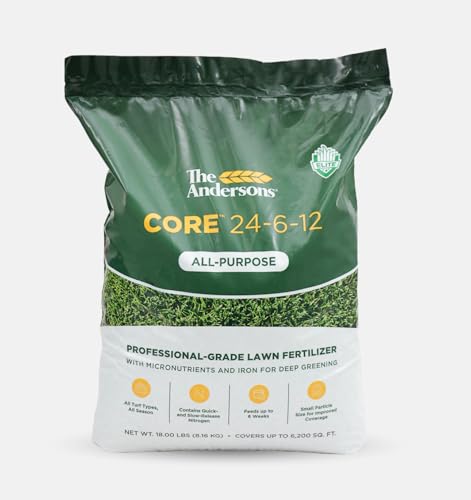
The Andersons Core 24-6-12 Professional Lawn Fertilizer, 45 lb
$89.88Super-fine granules with quick and slow release nitrogen plus iron and micronutrients, labeled for all turf types at 15,500 sq ft per bag.
Best for: even spreading with extra potash
Check price on Amazon
Scotts Turf Builder Starter Food for New Grass, 15 lb
$34.97A 24-25-4 formula for new seed, sod, sprigs and plugs, covering 5,000 sq ft per bag.
Best for: overseeding and new lawns
Check price on Amazon
Milorganite Slow-Release Nitrogen 6-4-0 Fertilizer, 5 lb Bag (4-Pack)
$40.99A slow-release organic nitrogen with non-staining iron that the maker says feeds for 8 to 10 weeks and does not need watering in.
Best for: feeding in hot, dry weather
Check price on AmazonWhat spreader do I need to apply fertilizer at the label rate?
An even spread matters as much as the right product. Match hopper size to lawn size; details are in best lawn spreaders.

Scotts Turf Builder EdgeGuard DLX Broadcast Spreader
$94.97Pre-calibrated with settings on Scotts bags, holds up to 15,000 sq ft of product and has an edge shield for beds and driveways.
Best for: lawns up to about a third of an acre
Check price on Amazon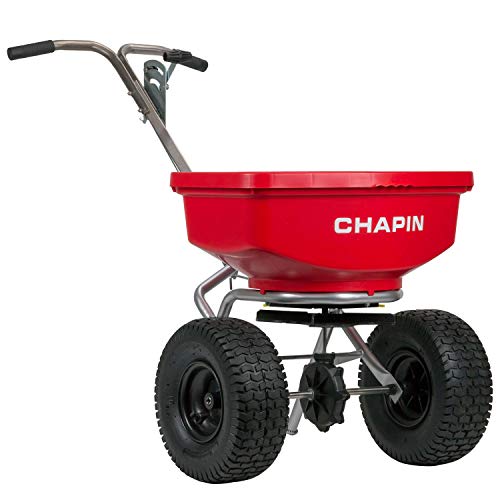
Chapin 8401C 80 lb Professional SureSpread Turf Spreader
$360.33An 80 lb hopper on a stainless frame with 14 inch pneumatic tires and an enclosed gearbox; Chapin says it is not for lime or rock salt.
Best for: acre-sized lawns spread on foot
Check price on Amazon
Brinly BS361BH-A Deluxe 175 lb Tow-Behind Broadcast Spreader
$439.00A 175 lb tow-behind with stainless hardware and directional spread pattern control that keeps granules off beds and edges.
Best for: lawns of 1 acre or more
Check price on AmazonHow we chose
We did not test these products in person. Picks are researched from manufacturer specifications and owner manuals, engine and safety certifications where they apply, warranty terms, public recall records, and the recurring themes in verified owner reviews. We favor established brands with large review counts and parts support, match each pick to a real yard size or task, and place it in the tier where its price and capability actually belong.
Frequently asked questions
What does 10-10-10 mean on fertilizer?
A 10-10-10 fertilizer contains 10 percent nitrogen, 10 percent phosphate and 10 percent potash by weight. A 50 lb bag holds 5 lb of each. It is a balanced garden fertilizer, but for most established lawns it supplies more phosphorus than needed and is restricted in several states. Applying 1 lb of nitrogen per 1,000 sq ft takes 10 lb of product, since 100 divided by 10 equals 10.
How do I figure out how much fertilizer to use per 1,000 square feet?
Divide 100 by the first number on the bag to get pounds of product that deliver 1 lb of nitrogen per 1,000 sq ft. For 32-0-3, that is about 3.1 lb; for 24-6-12, about 4.2 lb; for 6-4-0, about 16.7 lb. Multiply by your target nitrogen rate, usually 0.5 to 1 lb, and by your lawn size in thousands of square feet.
Why do most lawn fertilizers have a zero in the middle?
The middle number is phosphate. Established lawns usually have enough phosphorus in the soil, and phosphorus that washes off lawns feeds algae in lakes and streams. Several states, including Minnesota, Wisconsin and New York, restrict phosphorus in lawn fertilizer except for new lawns or proven deficiencies, so manufacturers sell zero-phosphorus maintenance formulas such as 32-0-3 and 29-0-3.
Is slow-release fertilizer better for lawns?
For most lawns, a product with a good share of slow-release nitrogen is the safer choice. It feeds evenly for weeks, is less likely to burn grass in heat, causes less surge growth and loses less nitrogen to leaching. Quick-release nitrogen greens up faster and costs less. Many programs combine both, as blends like The Andersons Core 24-6-12 do with quick and slow release nitrogen.
What is the filler in fertilizer?
The weight that is not nitrogen, phosphate or potash includes the other elements in each compound, such as the oxygen and carbon in urea or the sulfur in ammonium sulfate, plus coatings, micronutrients and carrier granules. Carriers are useful: they let you spread a small amount of nutrient evenly over a large area. A 32-0-3 bag is not two-thirds waste; it is formulated to be spread accurately.
What does derived from mean on a fertilizer bag?
The derived from statement lists the raw materials that supply the nutrients, such as urea, polymer-coated urea, ammonium sulfate, monoammonium phosphate, potassium chloride, potassium sulfate, iron sulfate or biosolids. It tells you how quickly the nitrogen releases, whether the product adds sulfur or acidifies soil, and whether it is organic. Pair it with the guaranteed analysis to judge a product beyond the three numbers.
Researched, not professional advice. This page is compiled from published specifications, manuals, labels and owner-review consensus, not hands-on testing. Follow the manufacturer's instructions and product label, and consult a qualified professional where safety, chemicals, fuel or structures are involved. As an Amazon Associate we earn from qualifying purchases.