Outdoor Entertainment
Partial Sun vs Full Sun Outdoor TV: Which Nits Rating?
Quick answer
Partial sun means roughly 700 to 1,000 nits for a wall that is shaded at peak, like the Furrion Partial-Sun 2. Full sun means 1,500 nits or more for direct light at viewing time, like the Aurora Sun 55. Both are equally weatherproof; only the panel differs.

Furrion Aurora Partial-Sun 2 55 in. Outdoor TV (750 nits)
Under $2,500For a wall that is shaded when you actually watch.
Best for: a partly shaded patio a long way from the household router
Check price on Amazon
Furrion Aurora Sun 55 in. Full Sun Outdoor TV (1,500 nits)
Under $2,500For direct sunlight on the screen at viewing time.
Best for: an unshaded patio or poolside wall in direct sun
Check price on AmazonOutdoor TVs are sold in sun classes: full shade, partial sun and full sun. The labels are the manufacturers' own, and they cause a lot of confusion because they sound like weather ratings. They are not. A full-shade TV is exactly as waterproof as a full-sun one from the same maker. The class describes how much light the panel can fight, nothing else.
This matters because the class is the single biggest driver of price. Furrion's 55 in. Partial-Sun 2 is under $2,500 and its 55 in. Aurora Sun is under $2,500. Same size, same brand, same weatherproofing. The difference is 750 nits against 1,500, and under $2,500 minus the other.
Get this wrong in one direction and you have wasted a lot of money. Get it wrong in the other and the screen is unusable at exactly the times you wanted it.
What do the outdoor TV sun classes mean?
The nit ranges below are a planning convention drawn from how these makers rate their own products, not an industry standard. The class names, though, are the manufacturers' own wording.
| Class | Typical nits | Where it belongs | Example |
|---|---|---|---|
| Full shade | 600 to 700 | Solid roof overhead, no direct sun at any hour | SunBrite Veranda 4 at 600 nits sustained |
| Partial sun | 700 to 1,000 | Shaded when you watch, sunny at other times | Furrion Partial-Sun 2 at 750 nits |
| Partial sun, upper end | 1,000 | Indirect glare through much of the day | SYLVOX Deck Pro 55 at 1,000 nits |
| Full sun | 1,500 | Direct sunlight on the screen at viewing time | Furrion Aurora Sun at 1,500 nits |
| Full sun, upper end | 2,000 or more | Unshaded wall or poolside, sun most of the afternoon | SYLVOX Full Sun at 2,000 nits |
A typical indoor television is roughly 250 to 400 nits, which sits below every class here. That is the gap an outdoor TV is paying to close.
How do you judge your own wall?
Do not guess from memory, and do not judge by how pleasant the patio feels. Two specific tests settle it.
The timing test. Stand where the screen will hang at the hours you would actually watch, not at noon on a whim. A west-facing wall that bakes at 5pm is a full-sun problem if you watch in the early evening, and irrelevant if you only ever watch after dark. This is why the outdoor TV brightness calculator asks when you watch as well as where the screen goes.
The reflection test. Hold a switched-off phone or tablet flat against the mounting spot and look at it. If you see the sky and it is hard to make out the screen surface, that is what an outdoor TV will be fighting. Pale paving, light render and above all a swimming pool bounce a surprising amount of light back at a screen from below, and this is the factor people most often miss.
A few honest traps. A pergola with slatted timber is not shade; moving stripes of sun across a panel are arguably worse than steady light. A patio umbrella is not a roof, because it moves and the sun does not stay put. And deciduous trees shade beautifully in summer and not at all in early spring, which is precisely when people want to sit outside again.
Which class should you buy?
If your answer sits on a boundary, buy the brighter class. Nobody regrets a screen that is easy to see, and the failure mode of buying too dim is that the TV is useless exactly when you wanted it.
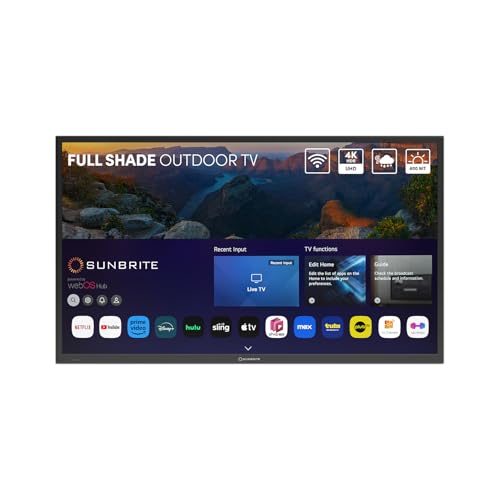
SunBriteTV 55 in. Veranda 4 Full Shade Outdoor TV (600 nits)
Under $2,500Rated at 600 nits of sustained full-screen brightness, a stricter measure than the peak figures most brands quote, with an anti-glare screen tuned for shade. Under a roof it will look better than a full-sun panel pushed hard.
Best for: a covered porch or roofed outdoor room
Check price on Amazon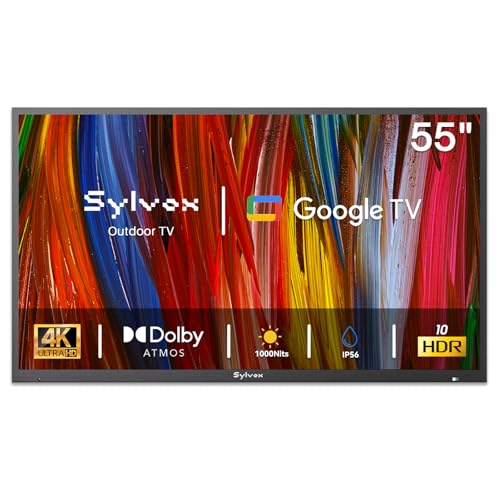
SYLVOX 55 in. Deck Pro 3.0 Outdoor TV (1,000 nits)
Under $2,500A 1,000-nit panel at the upper end of the partial-sun class with a published IP56 rating, which covers the patio most houses actually have without paying the full-sun premium.
Best for: the standard partly shaded patio
Check price on Amazon Furrion Aurora Sun 55 in. Full Sun Outdoor TV (1,500 nits)
Under $2,500A 1,500-nit anti-glare screen with IK08 impact-resistant glass that Furrion rates specifically for an exposed deck, patio or yard rather than leaving you to interpret a nit figure yourself.
Best for: an unshaded wall in direct sun at viewing time
Check price on Amazon
SYLVOX 55 in. Full Sun Outdoor TV, 2,000 Nits
Under $2,500A published 2,000 nits, the brightest screen here and cheaper than the 1,500-nit alternatives, which Sylvox also sells into bars and restaurants where screens run all day in daylight.
Best for: poolside and fully exposed installations
Check price on AmazonDoes a brighter screen mean a better picture?
No, and this is worth saying plainly because the specification sheet implies otherwise. Brightness is a tool for beating ambient light. In a space that has no ambient light problem, extra nits do nothing for you and can work against you.
SunBrite is the clearest example. The Veranda 4 is rated at 600 nits, lower than almost everything else here, and it is a more expensive television than several 1,000-nit screens. The money goes into an anti-glare panel, Eco Bright RGB-W subpixels that add white to raise light output while generating less heat, and a build tuned for picture quality in shade. In a covered outdoor room it will look better than a full-sun panel.
The other thing brightness does not tell you is durability. IP ratings and operating temperature ranges are separate specifications entirely, and they vary independently of the sun class. See best outdoor TVs for both sets of figures side by side.
How we chose
We did not test these products in person. Picks are researched from manufacturer specifications and owner manuals, engine and safety certifications where they apply, warranty terms, public recall records, and the recurring themes in verified owner reviews. We favor established brands with large review counts and parts support, match each pick to a real yard size or task, and place it in the tier where its price and capability actually belong.
Frequently asked questions
What is the difference between a partial sun and full sun TV?
It is a brightness class, not a weather rating. Partial-sun models run roughly 700 to 1,000 nits and suit a wall that is shaded at the hours you watch. Full-sun models run 1,500 nits or more with anti-glare treatment for direct light on the screen. Both are equally weatherproof from the same maker; only the panel and its cooling differ, and the price gap can exceed a thousand dollars.
How many nits do I need for a full sun patio?
Plan on at least 1,500 nits, and 2,000 is better if the wall is unshaded through the afternoon or sits above a pool or pale paving that bounces light upward. Below about 1,500 nits a screen in direct sunlight becomes a mirror at the times you most want to use it, and no picture setting closes that gap.
Can I use a partial sun TV in full sun?
It will survive perfectly well, because the weatherproofing is the same, but you will not be able to watch it comfortably when the sun is on the screen. The failure is readability rather than damage. If the wall only catches direct sun outside your normal viewing hours, a partial-sun screen is the sensible and much cheaper choice.
Is a full shade outdoor TV worth it over a brighter one?
Under a solid roof, often yes. Full-shade models such as the SunBrite Veranda 4 spend the budget on an anti-glare panel and picture quality rather than raw output, and in a covered space that looks better than a full-sun screen. Brightness only helps where there is ambient light to overcome, so paying for nits you cannot perceive is wasted money.
Does a pergola count as shade for an outdoor TV?
Usually not. Slatted timber lets moving bands of direct sun cross the screen, which is arguably worse than steady light because your eyes never adjust. Treat an open or slatted pergola as partial sun at minimum. A solid roof, a deep overhang or a fully covered patio is what counts as full shade, and umbrellas do not qualify because they move and the sun does not stay put.
Researched, not professional advice. This page is compiled from published specifications, manuals, labels and owner-review consensus, not hands-on testing. Follow the manufacturer's instructions and product label, and consult a qualified professional where safety, chemicals, fuel or structures are involved.