Lawn Care
Fertilizer Rate Chart: Pounds per 1,000 Sq Ft by Analysis
Quick answer
Divide 100 by the first number on the bag to get pounds of product per 1,000 square feet for 1 pound of nitrogen. A 32-0-3 needs 3.1 pounds, a 24-6-12 needs 4.2 pounds and a 6-4-0 organic needs 16.7 pounds to deliver the same nitrogen.
Lawn fertilizer is dosed by nitrogen, not by bag weight, which is why two products at the same price can need wildly different amounts. The three numbers on every bag are the percentages of nitrogen, phosphate and potash by weight, so a 50 pound bag of 32-0-3 holds 16 pounds of nitrogen.
Use the chart to convert any analysis into pounds per 1,000 square feet, then check it against the label rate, which always governs. The fertilizer calculator does the same math for your lawn size and bag weight. Our top pick for a maintenance program is the Lesco 32-0-3 at $84.99.
On this page
How much fertilizer do I need per 1,000 square feet?
Find the first number on your bag down the left. The columns are pounds of product, not pounds of nitrogen.
| Nitrogen on the bag | 0.5 lb N | 0.75 lb N | 1 lb N | 1 lb N over 10,000 sq ft | 1 lb N over 1 acre |
|---|---|---|---|---|---|
| 6 percent (6-4-0 type) | 8.3 lb | 12.5 lb | 16.7 lb | 167 lb | 726 lb |
| 10 percent | 5.0 lb | 7.5 lb | 10.0 lb | 100 lb | 436 lb |
| 16 percent (16-4-8 type) | 3.1 lb | 4.7 lb | 6.3 lb | 63 lb | 272 lb |
| 24 percent (24-6-12 type) | 2.1 lb | 3.1 lb | 4.2 lb | 42 lb | 182 lb |
| 29 percent (29-0-3 type) | 1.7 lb | 2.6 lb | 3.4 lb | 35 lb | 150 lb |
| 32 percent (32-0-3 type) | 1.6 lb | 2.3 lb | 3.1 lb | 32 lb | 136 lb |
| 46 percent (urea) | 1.1 lb | 1.6 lb | 2.2 lb | 22 lb | 95 lb |
Pounds of product = pounds of nitrogen wanted x 100 / nitrogen percentage. No single application should normally exceed 1 pound of quickly available nitrogen per 1,000 square feet.
How much nitrogen does my lawn need per year?
| Grass | Season type | Pounds N per year | Main feeding time |
|---|---|---|---|
| Tall fescue | Cool-season | 2 to 4 | Most in fall, lighter in spring |
| Kentucky bluegrass | Cool-season | 3 to 4 | Mostly fall, some late spring |
| Perennial ryegrass | Cool-season | 2 to 4 | Mostly fall |
| Fine fescue | Cool-season | 1 to 2 | Fall; low needs |
| Bermudagrass | Warm-season | 2 to 5 | Late spring through summer |
| Zoysiagrass | Warm-season | 1 to 3 | Late spring and summer |
| St. Augustinegrass | Warm-season | 2 to 4 | Late spring through summer |
| Centipedegrass | Warm-season | 1 to 2 | Early summer; excess nitrogen harms it |
| Bahiagrass | Warm-season | 1 to 2 | Late spring and summer |
Ranges reflect common university extension guidance. Irrigated, high-traffic lawns sit at the top; returning clippings supplies part of the need.
What do common bag analyses work out to?
| Product | Analysis | Product per 1,000 sq ft at 1 lb N | Notes |
|---|---|---|---|
| Lesco 32-0-3 | 32-0-3 | 3.1 lb | Stabilized nitrogen, no phosphate |
| Jonathan Green Green-Up | 29-0-3 | 3.4 lb | Maintenance feeding, no phosphate |
| The Andersons Core | 24-6-12 | 4.2 lb | Professional blend with potash |
| Simple Lawn Solutions 16-4-8 | 16-4-8 | 6.3 lb equivalent | Liquid, applied by its own label rate |
| Scotts Turf Builder Starter | 24-25-4 | 4.2 lb | High phosphate for new seed only |
| Espoma Turf-Tone | 8-0-5 | 12.5 lb | Organic winterizer, low analysis |
| Milorganite | 6-4-0 | 16.7 lb | Slow-release organic, hard to burn with |
Liquid products are dosed by volume on their own label and cannot be converted with the granular table.
How do you read the N-P-K numbers on a fertilizer bag?
The three numbers are the guaranteed analysis: percent nitrogen, percent phosphate and percent potash by weight, always in that order. On a 45 pound bag of 24-6-12, about 10.8 pounds is nitrogen, 2.7 pounds is phosphate and 5.4 pounds is potash. Nitrogen drives color and leaf growth, phosphate supports rooting and is most useful when seeding, and potash supports stress tolerance.
Many established lawns need little or no phosphate, which is why maintenance products such as the Jonathan Green Green-Up carry a zero in the middle. Several states restrict phosphorus lawn fertilizer unless a soil test shows a need. The label also states how much of the nitrogen is slow release; more on that in how to read a fertilizer label.
Can I put down too much fertilizer?
Yes, and it is the most common homeowner mistake. Too much quickly available nitrogen burns grass in hot, dry weather, produces surge growth that needs more mowing and is more prone to disease, and washes into storm drains and waterways. Doubling the rate does not double the color.
Stay at or below the label rate, keep single applications at or under about 1 pound of nitrogen per 1,000 square feet, and split the annual total across several feedings rather than one heavy one. Low-analysis organics such as Milorganite are much harder to burn with, which is part of why they are applied more often at lower nitrogen. Timing by climate zone is in the lawn care calendar.
Which fertilizers and spreaders match these rates?
A maintenance product, a starter, an organic and the spreaders that put them down evenly. Full picks are in the best lawn fertilizers.

Lesco Basic Nutrition 32-0-3 Stabilized Nitrogen Fertilizer, 50 lb
$84.99At 32 percent nitrogen this needs only 3.1 pounds per 1,000 square feet for a full feeding, so a 50 pound bag covers about 16,000 square feet.
Best for: established lawns on a regular program
Check price on Amazon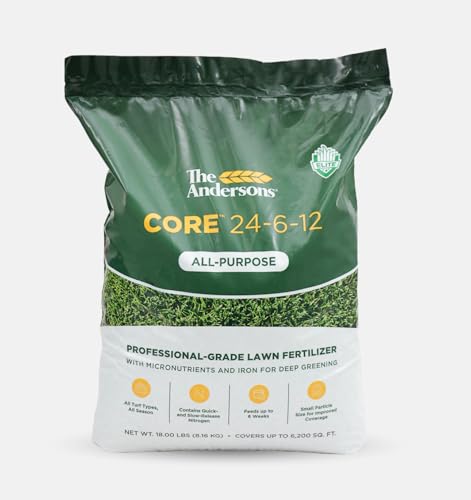
The Andersons Core 24-6-12 Professional Lawn Fertilizer, 45 lb
$89.88A 24-6-12 professional blend that brings potash along with the nitrogen, at 4.2 pounds per 1,000 square feet for 1 pound of nitrogen.
Best for: lawns whose soil test shows low potassium
Check price on Amazon
Scotts Turf Builder Starter Food for New Grass, 15 lb
$34.97A 24-25-4 starter analysis heavy in phosphate, which is what new seedlings use for root development. Not a maintenance product.
Best for: new lawns and overseeding
Check price on Amazon
Milorganite Slow-Release Nitrogen 6-4-0 Fertilizer, 5 lb Bag (4-Pack)
$40.99At 6 percent nitrogen it takes 16.7 pounds per 1,000 square feet for a full pound of nitrogen, which is why it is very difficult to burn a lawn with.
Best for: people who want a low-risk, low-odor organic option
Check price on Amazon
Scotts Turf Builder EdgeGuard DLX Broadcast Spreader
$94.97A broadcast spreader with an edge guard that keeps granules out of beds, off walks and out of storm drains.
Best for: lawns up to about half an acre
Check price on Amazon
Agri-Fab 130 lb Tow-Behind Broadcast Spreader
$249.99A 130 pound tow-behind broadcast spreader turns an acre-sized application behind a lawn tractor into a single pass job.
Best for: large properties with a rider
Check price on AmazonHow we chose
We did not test these products in person. Picks are researched from manufacturer specifications and owner manuals, engine and safety certifications where they apply, warranty terms, public recall records, and the recurring themes in verified owner reviews. We favor established brands with large review counts and parts support, match each pick to a real yard size or task, and place it in the tier where its price and capability actually belong.
Frequently asked questions
How much 32-0-3 fertilizer do I need per 1,000 square feet?
About 3.1 pounds for 1 pound of nitrogen per 1,000 square feet, because 100 divided by 32 is 3.125. For a lighter 0.75 pound application use about 2.3 pounds, and for half a pound about 1.6 pounds. A 10,000 square foot lawn therefore takes roughly 16 to 32 pounds per feeding depending on the rate you choose.
How many bags of fertilizer do I need for an acre?
An acre is 43,560 square feet. At 1 pound of nitrogen per 1,000 square feet, a 32 percent product needs about 136 pounds, which is three 50 pound bags. A 24 percent product needs about 182 pounds and a 6 percent organic about 726 pounds, which is why low-analysis products are usually applied at lower nitrogen rates.
What do the three numbers on fertilizer mean?
They are the percentages by weight of nitrogen, phosphate and potash, always in that order. A bag marked 24-6-12 is 24 percent nitrogen, 6 percent phosphate and 12 percent potash, so a 45 pound bag holds about 10.8 pounds of nitrogen. The rest is carrier material and other nutrients. Nitrogen is the number used to set lawn rates.
Is slow release or quick release fertilizer better?
For most homeowners a product with a good share of slow-release nitrogen is safer. Quick-release nitrogen greens a lawn within days but can burn in heat, surge growth and leach faster. Slow-release forms feed over several weeks and are more forgiving of a spreader setting that runs a little rich. The label states the slow-release percentage.
How do I spread fertilizer evenly?
Set the spreader to the label setting, fill it on a hard surface so spills can be swept up, and apply half the rate in two perpendicular passes rather than the full rate in one. That evens out the pattern and hides any striping. Sweep or blow stray granules off drives, walks and the street back onto the lawn.
Researched, not professional advice. This page is compiled from published specifications, manuals, labels and owner-review consensus, not hands-on testing. Follow the manufacturer's instructions and product label, and consult a qualified professional where safety, chemicals, fuel or structures are involved. As an Amazon Associate we earn from qualifying purchases.