Lawn Care
Liquid vs Granular Fertilizer: Which Is Better for Your Lawn?
Quick answer
Granular fertilizer is the better default for most lawns: slow-release granules feed for weeks, go down quickly with a spreader and usually cost less per season. Liquid fertilizer greens grass within days and suits small lawns, quick color and supplemental feeding, but it needs a sprayer and more frequent applications. Many owners use granular as the base and liquid as a supplement.

Simple Lawn Solutions Advanced 16-4-8 Liquid Lawn Fertilizer, 1 gal
$59.77A spray-applied 16-4-8 with fish and seaweed, one gallon covering 12,800 sq ft.
Best for: spray-applied supplemental feeding
Check price on Amazon
Jonathan Green Green-Up Lawn Food 29-0-3, 15,000 sq ft
$73.27A spreader-applied 29-0-3 maintenance feeding sized for 15,000 sq ft.
Best for: established cool-season lawns
Check price on AmazonGranular fertilizer is dry pellets or prills spread with a broadcast or drop spreader; the nutrients dissolve into the soil with rain or irrigation, and slow-release nitrogen sources feed over several weeks. Liquid fertilizer is a concentrate mixed with water and sprayed, or run through a hose-end bottle; nutrients reach leaves and the root zone right away, so results show fast but fade sooner.
Both feed grass the same nutrients, so the choice is about equipment, timing and how often you want to apply. A granular like the Jonathan Green Green-Up 29-0-3 ($73.27 for 15,000 sq ft) is a typical base feeding. A liquid like Simple Lawn Solutions 16-4-8 ($59.77 per gallon), which the maker positions as a monthly add-on, is the supplement. Work out your pounds of product with the fertilizer calculator.
On this page
How does liquid fertilizer compare with granular?
| Factor | Liquid fertilizer | Granular fertilizer |
|---|---|---|
| How it is applied | Pump or battery sprayer, or a hose-end bottle | Broadcast or drop spreader |
| How fast it greens | Within days | Gradual; faster with quick-release nitrogen |
| How long it feeds | Short; often reapplied every few weeks | Several weeks; Milorganite says 8 to 10 weeks |
| Typical role | Supplement, quick color, small lawns | Main feeding program |
| Even coverage | Good with a calibrated sprayer; hose-end rates vary | Good with overlap; missed passes show as stripes |
| Burn risk | Leaf burn if mixed too strong or sprayed in heat | Burn where granules pile up or are over-applied |
| After application | Label-dependent; the Scotts liquid label allows kids and pets back once dry | Many labels call for watering in; low-salt Milorganite says no watering needed |
| Tank mixing | Can be combined with compatible products the labels allow | Some bags combine weed control, such as weed and feed |
| Storage | Keep from freezing | Keep dry |
| Catalog examples | Simple Lawn Solutions 16-4-8; Scotts Liquid Lawn Food 29-0-3 | Scotts Turf Builder Lawn Food; Lesco 32-0-3 |
Product details from manufacturer listings. Follow each product label for rates, watering and re-entry.
Which should you choose, liquid or granular?
Choose granular fertilizer if:
- You want a simple program of a few feedings a year.
- Your lawn is larger than a few thousand square feet.
- You own or plan to buy a spreader.
- You want slow-release nitrogen that feeds steadily and resists burn.
Choose liquid fertilizer if:
- Your lawn is small and a hose-end bottle is easier than buying a spreader.
- You want quick green-up before an event or after stress.
- You already own a sprayer and like light, frequent spoon-feeding.
- You want to add micronutrients or iron between granular feedings.
Is liquid fertilizer better than granular?
Not better, faster. Liquid nutrients reach the plant immediately, so color changes quickly, but the effect is short, so you apply more often. Granular slow-release products do the steady work with fewer trips. Grass cannot tell the difference between a pound of nitrogen from a spray and a pound from a pellet; what matters is the total nitrogen, its release rate and the timing.
The honest caution on hose-end liquids is precision. A hose-end bottle meters by water flow, so walking speed and water pressure change the rate. That is fine for a quick boost on a small lawn and poor for anything where the label rate matters. If you go liquid seriously, use a calibrated sprayer; see pump vs battery sprayer.
How do you calculate how much fertilizer to apply?
Lawn feedings are built around nitrogen. Extension services generally recommend no more than about 1 lb of nitrogen per 1,000 sq ft per feeding for most lawns, and less with quick-release sources in heat. For granular products, divide 100 by the nitrogen percent (the first number on the bag) to get pounds of product per 1,000 sq ft that deliver 1 lb of nitrogen. For liquids, follow the label's ounces per 1,000 sq ft; converting to nitrogen requires the product's weight per gallon, which labels often list. The fertilizer rate chart and how to read a fertilizer label go deeper.
| Product | Analysis | Lb product per 1,000 sq ft | Lb product per 5,000 sq ft |
|---|---|---|---|
| Lesco 32-0-3 | 32-0-3 | 3.1 | 15.6 |
| Jonathan Green Green-Up | 29-0-3 | 3.4 | 17.2 |
| The Andersons Core | 24-6-12 | 4.2 | 20.8 |
| Scotts Starter | 24-25-4 | 4.2 | 20.8 |
| Espoma Turf-Tone Winterizer | 8-0-5 | 12.5 | 62.5 |
| Milorganite | 6-4-0 | 16.7 | 83.3 |
Formula: 100 divided by nitrogen percent. This is nitrogen math, not a label rate; always apply at the rate on the product you bought.
Which costs less per season?
At catalog prices and label coverage, one application costs about $3.20 per 1,000 sq ft for Scotts Turf Builder Lawn Food ($47.96 for 15,000 sq ft), about $4.90 for Jonathan Green Green-Up ($73.27 for 15,000 sq ft) and about $4.70 for Simple Lawn Solutions 16-4-8 ($59.77 for 12,800 sq ft). Per application they look similar, but the liquid is meant to be applied monthly on top of a regular program while granular feedings are spaced weeks apart, so over a season liquid usually costs more. Add the equipment: a spreader or a sprayer, and your time. Prices change, so rerun the math with current prices.
When should you fertilize with either?
Feed when grass is actively growing. For cool-season lawns such as tall fescue and Kentucky bluegrass, extension programs put the most important feedings in early and late fall, with a lighter feeding in spring; the Scotts WinterGuard is built for that fall feeding. For warm-season lawns such as bermuda and zoysia, feed from late spring through summer after full green-up, and avoid heavy nitrogen as they go dormant. Test soil before adding phosphorus or lime with a kit like the MySoil test. Seasonal timing by zone is on the lawn care calendar.
Liquid and granular fertilizers worth a look
More in the best lawn fertilizers roundup, and pair granular with the right lawn spreader.
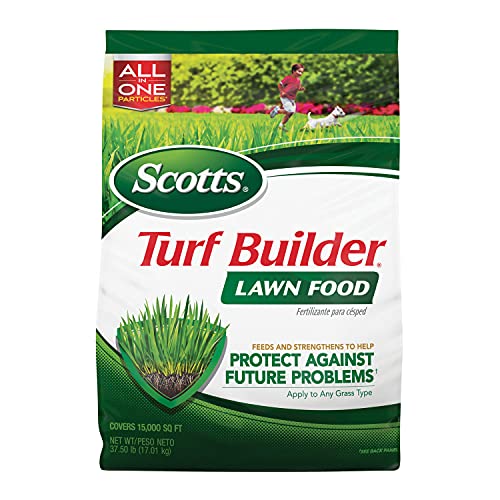
Scotts Turf Builder Lawn Food, 37.5 lb
$47.96A pesticide-free all-grass feeding that goes on wet or dry lawns in spring, summer or fall, with one bag covering 15,000 sq ft.
Best for: a straightforward granular program
Check price on Amazon
Milorganite Slow-Release Nitrogen 6-4-0 Fertilizer, 5 lb Bag (4-Pack)
$40.99A low-salt slow-release nitrogen with non-staining iron that the maker says feeds for 8 to 10 weeks without watering in.
Best for: feeding in hot, dry weather
Check price on Amazon Simple Lawn Solutions Advanced 16-4-8 Liquid Lawn Fertilizer, 1 gal
$59.77A balanced 16-4-8 with fish and seaweed, one gallon covering 12,800 sq ft, positioned as a monthly supplement to a regular program.
Best for: sprayer owners spoon-feeding
Check price on Amazon
Scotts Turf Builder Liquid Lawn Food, 32 fl oz
$17.96A 29-0-3 liquid in a reusable hose-end applicator with a see-through bottle; the label allows kids and pets back once the spray dries.
Best for: small yards without a spreader
Check price on AmazonHow we chose
We did not test these products in person. Picks are researched from manufacturer specifications and owner manuals, engine and safety certifications where they apply, warranty terms, public recall records, and the recurring themes in verified owner reviews. We favor established brands with large review counts and parts support, match each pick to a real yard size or task, and place it in the tier where its price and capability actually belong.
Frequently asked questions
Is liquid or granular fertilizer better for lawns?
Granular is the better base for most lawns because slow-release granules feed for weeks, spread quickly and usually cost less over a season. Liquid acts faster and is useful for quick green-up, small lawns and supplemental feeding, but it fades sooner and needs more applications. Both deliver the same nutrients; many owners run a granular program and add liquid between feedings.
How long does liquid fertilizer last?
Liquid fertilizer typically shows results within days and lasts a few weeks, depending on the nitrogen source and weather. That is why makers such as Simple Lawn Solutions position their liquids as monthly applications. Slow-release granular products last longer; Milorganite, for example, says its 6-4-0 feeds for 8 to 10 weeks. Follow the label interval rather than reapplying on a fixed schedule.
Does granular fertilizer need to be watered in?
Many do; check the label. Watering in moves granules off grass blades and into the soil, reducing burn and nitrogen loss. Some products are designed not to need it: Milorganite says its low-salt formula does not require watering in, and Scotts Turf Builder Lawn Food can be applied to wet or dry lawns. Avoid applying right before a heavy downpour, which washes granules away.
Can liquid fertilizer burn grass?
Yes. Liquid fertilizer mixed stronger than the label allows, sprayed in high heat or applied to drought-stressed grass can scorch leaf tips. Mix carefully, spray in cooler parts of the day and follow any watering instructions. Granular fertilizer burns too, usually where granules pile up at turns or overlaps. Slow-release and low-salt products carry the lowest burn risk.
How do I calculate how much fertilizer my lawn needs?
Measure your lawn, then divide 100 by the nitrogen percentage on the bag to find pounds of product per 1,000 sq ft for 1 lb of nitrogen. A 29-0-3 needs about 3.4 lb per 1,000 sq ft. Multiply by your lawn size in thousands. Always use the label rate if it differs. The fertilizer calculator does the math and counts bags.
Researched, not professional advice. This page is compiled from published specifications, manuals, labels and owner-review consensus, not hands-on testing. Follow the manufacturer's instructions and product label, and consult a qualified professional where safety, chemicals, fuel or structures are involved. As an Amazon Associate we earn from qualifying purchases.